

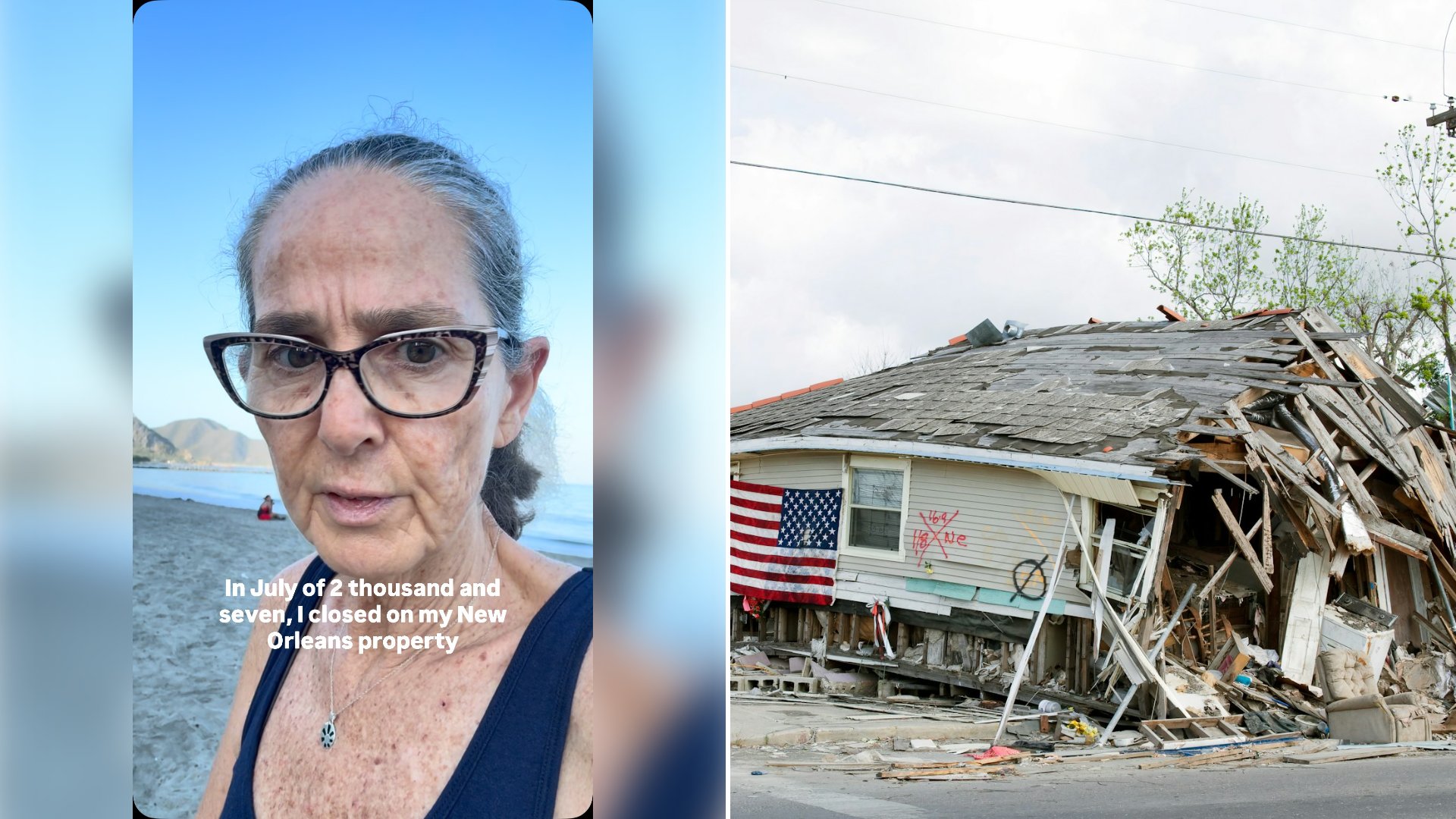
“I sold 99% of everything I owned in 2007. And I never went back.” That is how the caption on a nearly three minute reel from iamjodibrown opens. In the video, a woman with gray hair and dark framed glasses stands on a beach with high rise buildings behind her and tells the story to the camera, with white captions running along the bottom of the frame.
According to her, the turning point was Hurricane Katrina. She writes that for two years afterward she drove around New Orleans looking at people’s possessions piled on curbs and scattered across yards, and that it changed what she thought mattered. Her list is short and in capitals: “PEOPLE. PLACES. EXPERIENCES.”
The on screen captions fill in the timeline. “In July of 2007, I closed on my New Orleans property,” they read at the start. What she kept fit into “a small five by five foot storage unit,” and she says she left the country “with a backpack and a promise to myself” that she was going to try and find somewhere else to live. Later captions say she was furious about what she had witnessed happen to US citizens in New Orleans after the storm, and that she wanted to take the money she had and try to get settled in another country. Then comes a line the written caption leaves out: it “didn’t work out the way I hoped,” followed by “a lot of things don’t work out the way I hope but here’s what I took away.” This is her own account of why she left, and the video does not go further into those events than that.
The part about the streets is blunt. A caption has her saying that after Katrina, all she saw on the side of the street was discarded belongings. Another says her stuff does not mean much when it is all over and done, however much you care about it. From there she turns to the practical result: “I’ve lived in studio apartments since 2007, almost 20 years.”
Her caption explains why she thinks it paid off. Living small, she writes, has given her “the ability to MOVE.” She can change direction and adjust when circumstances change, and make decisions without first having to figure out what to do with a house full of stuff. In the video she says it keeps her limber and able to adjust.
Her advice is aimed at people looking at the next chapter of their lives. She asks them to look around the house, but not at what they like or what they paid for. The question she poses is “WHAT DO I ACTUALLY NEED?” She says some of what surrounds us may be “limiting your options” and ends with two short instructions: “Get lean,” and, if you could use extra money, consider that some of that stuff “can help fund whatever comes next.” In the video she adds that as we get older and things start to change, we are surrounded by things that are “weighing you down” and keeping you from being able to make more fluid choices. Her practical step is to make a list of the things you need and let go of the rest, and, if you need a little money, to start selling some stuff on Facebook Marketplace, Etsy or other platforms. She is not telling people to liquidate everything; the captions have her saying she is not trying to liquidate. The video ends on the caption “Peace out.”
The scale of the storm she describes is documented. According to the National Hurricane Center, Katrina made its first landfall near Buras, Louisiana, on August 29, 2005, and the storm was responsible for approximately 1,200 deaths. The U.S. Census Bureau reported from the 2009 American Housing Survey that 74 percent of current homeowners in the New Orleans area said their homes were damaged by Katrina, and that more than 65,000 housing units were still uninhabitable as of 2009. Those figures say nothing about her particular belongings or sale.
If you are weighing a downsizing move, her steps are simple: walk through each room, write the list, and decide item by item what stays. Anything you let go can be sold, and her written caption says that money can help fund whatever comes next.

Leave a Reply