

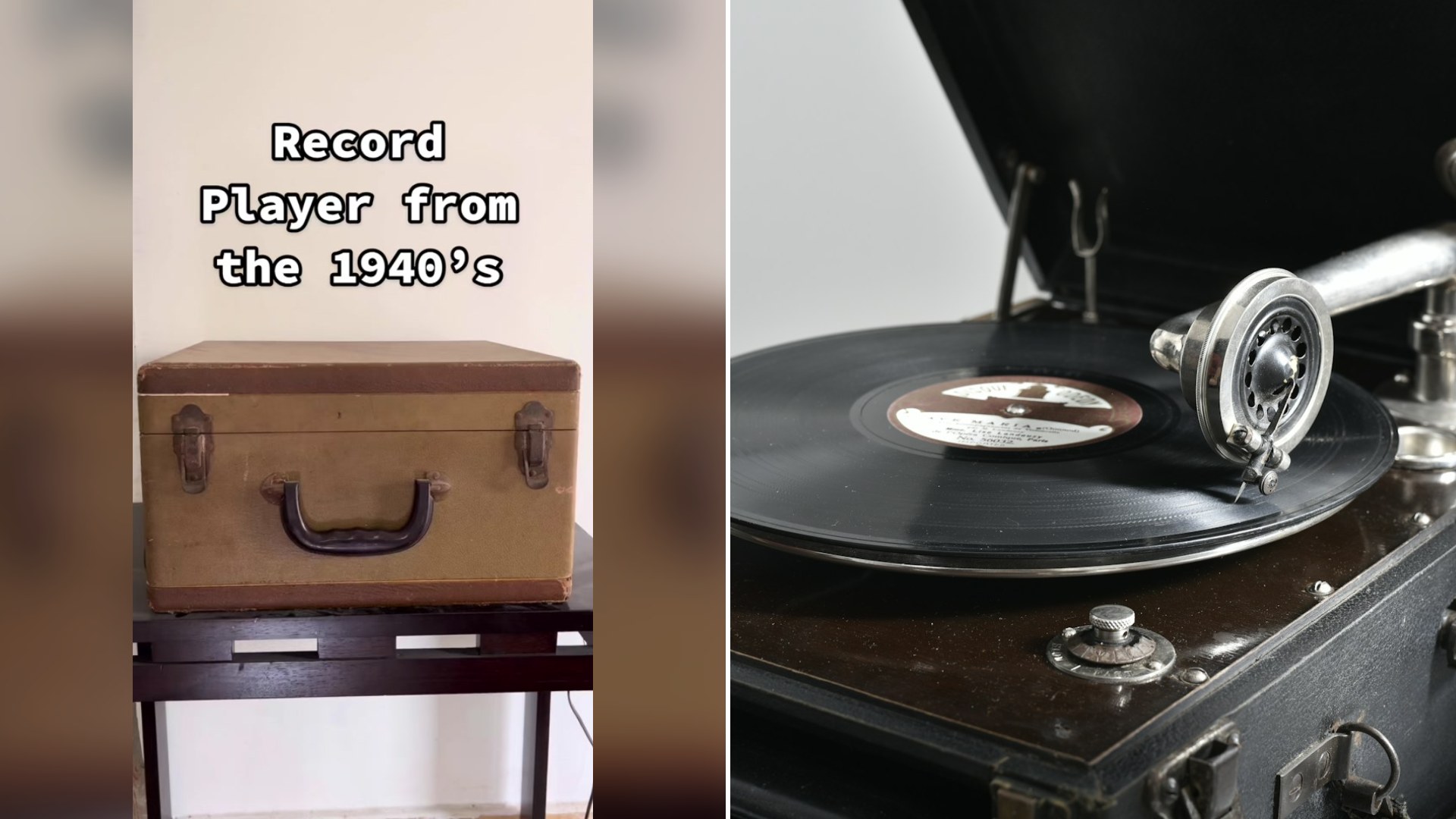
Some family heirlooms are jewelry or furniture. Others spin. The creator behind @jeffsvinylrecords, who goes by Jeff, opens a short post by asking whether you have ever seen a record player from the 1940s. Then he shows the one in his family, a suitcase style record player that belonged to his great grandfather.
What He Shows
Jeff says the player is a little under 100 years old. By the 1940s date he gives, it is roughly eight decades old, which is still a remarkable age for something that survived intact. He points out that it has some pretty cool features. It has its own built in speakers, so no extra equipment is needed, and it even has a radio.
The format of the records was different too, he explains. Records back then were mostly 10 inches across, kept in paper sleeves, and played at a speed of 78 rpm, compared with the 33 rpm used today. He says even his forefathers knew that you must clean a record before you play it. He then holds up the record cleaner his great grandfather used to remove dust and debris before listening to his favorite music.
There is one disappointment. The stylus, the tiny needle that rides in the groove, is pretty worn out. And in case anyone was wondering, he says, the player runs on electricity. He finishes by showing a photo of the man himself, whom he calls the legend.
A Few Notes On What You Are Seeing
The creator’s description is warm and informal, and a couple of details are worth a closer look for anyone curious about this kind of machine.
Suitcase record players were designed to be carried. The case closes up with a handle, so the player can go to a friend’s house or a party. They were popular because they combined the turntable, amplifier and speaker in one portable unit.
The records of that period, played at 78 rpm, were commonly made of shellac, a brittle material, and not of the vinyl we know today. Some people who responded online pointed this out, and the creator did use the word vinyl in a loose way. This is general background, not a criticism. Many people call all old records vinyl, but if you collect them, it helps to know the difference. Shellac discs are heavier and more fragile than later vinyl records, and they can crack if dropped.
A worn stylus matters a great deal. On 78s, a stylus that is too worn can damage the grooves, and a stylus meant for later records is the wrong size. If you ever want to play an heirloom player, a specialist who works on vintage audio can tell you whether a replacement is available.
Where 78s Fit In History
The speed Jeff mentions explains a lot about the era. Records spun at 78 rpm were the standard for decades, with each side holding only a few minutes of music. The long playing record at 33 rpm and the 45 rpm single arrived at the end of the 1940s and gradually took over, which is why a player from that decade sits right at the turning point. A machine like his great grandfather’s belongs to the age just before the format most collectors know best.
Why Cleaning Mattered
Jeff’s point about the cleaner is a nice reminder that careful listening has a long history. Dust and grit in a groove can cause crackle and wear. Every generation of record lovers has had its own tools, from soft brushes and cloths to the cleaners we use now. His great grandfather’s cleaner is a small artifact that suggests how much care the man took with his music.
Caring For An Heirloom Player
If a family machine like this is sitting in your home, a few precautions apply.
Check the power first. Old cords can become brittle, and wiring in vintage electronics can degrade. Do not plug in a player that has not been inspected by someone who knows how. This is especially important with machines from the 1940s.
Do not force anything. Lids, latches and tone arms can stick. Gentle movements protect fragile parts.
Protect the records. Keep them upright, away from heat and sunlight, and in their sleeves. Shellac records should be handled by the edges and stored carefully.
Clean the exterior gently. A soft dry cloth removes dust. Avoid harsh cleaners on old finishes.
Keep the story. Write down who owned it and when, and keep a photo of the owner nearby, the way Jeff keeps one of his great grandfather. The history of an object is part of its value.
Think before restoring. Replacing parts can improve performance, but sometimes the original condition has more meaning to a family than a perfectly working machine.
Asking Family For The Story
If relatives know the history of a machine like this, ask them about it while the details are fresh. Where did it sit in the house? Which songs were played most? Did the radio matter as much as the records? Those answers turn a worn object into a living piece of family history, and they are easy to lose if nobody writes them down.
More Than A Machine
It is easy to see why the post struck a chord. A record player is a way of hearing the past, and having one that was used by an ancestor adds a personal layer. Whether or not it plays today, it holds the habits of a household, the evening routines, the songs and the care taken before a record touched the needle.
Jeff does not claim the machine is valuable in dollars. He simply shows it, explains what makes it interesting, and ends with a picture of the person who used it. That is a good way to share any heirloom. Show what it does, explain how it worked, and remember the person who loved it.

Leave a Reply