

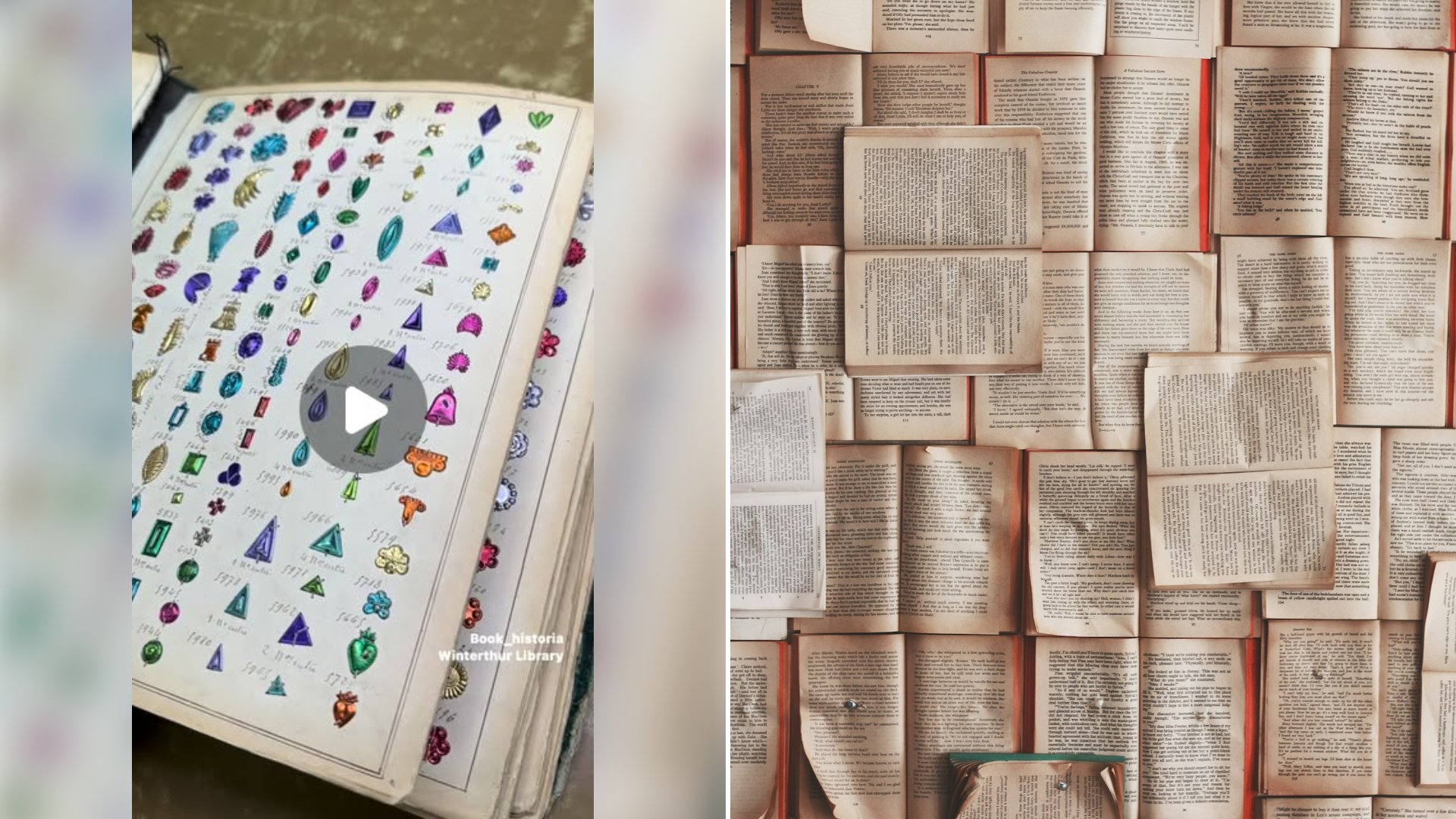
Long before anyone could flip through a glossy catalog or scroll a product page, sales depended entirely on what a traveling salesman could physically carry with him. In a reel from @book_historia, a collector slowly pages through a genuine nineteenth century French sales sample book, its pages lined with row after row of delicate decorative metal foil ornaments, each one mounted and preserved exactly as it would have been shown to a prospective buyer well over a century ago.
The foil pieces themselves are strikingly ornate for something meant purely as a sales tool: intricate cutouts and embossed designs in thin decorative metal, the kind that would have once been used to dress up gifts, decorations, or small household goods. Seeing dozens of them preserved together in a single book turns a simple product catalog into something closer to a time capsule.
Sales sample books like this one served a very specific function in nineteenth century retail. Before photography was widely usable for commercial catalogs, and well before mass printing could reliably reproduce fine product detail in color, traveling salesmen needed to bring the actual merchandise, or a close physical representation of it, directly to shopkeepers and buyers. A sample book let a single salesman represent an entire manufacturer’s product line without hauling cases of full inventory from town to town. Instead, he carried a compact, durable book containing actual physical samples, swatches, or miniature versions of the goods being sold, bound together so a buyer could flip through and place an order based on what they could see and touch in person.
This system was especially common in industries built around texture, pattern, and fine detail, things that simply didn’t translate well into early printed advertising. Textile mills used sample books filled with actual fabric swatches. Wallpaper manufacturers bound in paper samples showing pattern and color. And smaller decorative goods manufacturers, including makers of foil ornaments, ribbon trim, and other delicate novelty items, used the same approach: mounting real, physical examples of their product directly into a book a salesman could carry on the road.
The pre-photography retail era relied heavily on this kind of face-to-face, hands-on selling precisely because there was no reliable substitute for it. Early catalog illustrations were hand-drawn or engraved, which meant fine texture, metallic shine, or delicate cutwork simply couldn’t be conveyed accurately on a printed page. A buyer ordering decorative foil ornaments for the holiday season, for instance, needed to see the actual shimmer and precision of the metalwork to judge quality, something no illustration of the period could fake convincingly. Sample books solved that problem by removing the need for illustration altogether.
These books also served as a practical safeguard for manufacturers. By controlling exactly which samples got shown and how they were presented, a company could standardize what its traveling sales force represented in the field, cutting down on miscommunication between a factory and a buyer hundreds of miles away. The books themselves were often built to survive heavy travel: reinforced bindings, protective covers, and sturdy pages meant to hold up to being opened and closed dozens of times a day across weeks or months on the road.
Surviving examples like the one shown in this reel are genuinely rare today. Sample books were working tools, not objects meant to be preserved, and most were discarded, damaged through heavy use, or simply lost once a product line was discontinued or a salesman retired. The ones that do survive, particularly from the nineteenth century, offer historians and collectors a uniquely tactile window into retail history that printed catalogs and advertisements from the same period simply can’t match, since what’s preserved inside isn’t a picture of the product. It’s the actual thing.
For collectors of antique ephemera, a well-preserved sample book sits in a category of its own: part historical document, part physical artifact, and part design archive, all bound into a single object that was never meant to last this long in the first place.
More from Vinyl and Velvet
- An Antique Warehouse Tour Reveals a Working Miniature Salesman’s Sample Barber Chair and a Mystery Object Several Commenters Swear Looks Like a Bazooka
- Poster Conservator Reveals the Donor Poster Technique Used to Rebuild a Missing Torn Corner of a Vintage French Travel Poster Without Ever Touching It With Acrylic Paint
- Spy Museum Exhibitions Coordinator Plays a Modern Recreation of a Soviet Bone Record, Led Zeppelin on Somebody’s Rib X Ray With the Center Hole Burned Through by a Lit Cigarette

Leave a Reply