

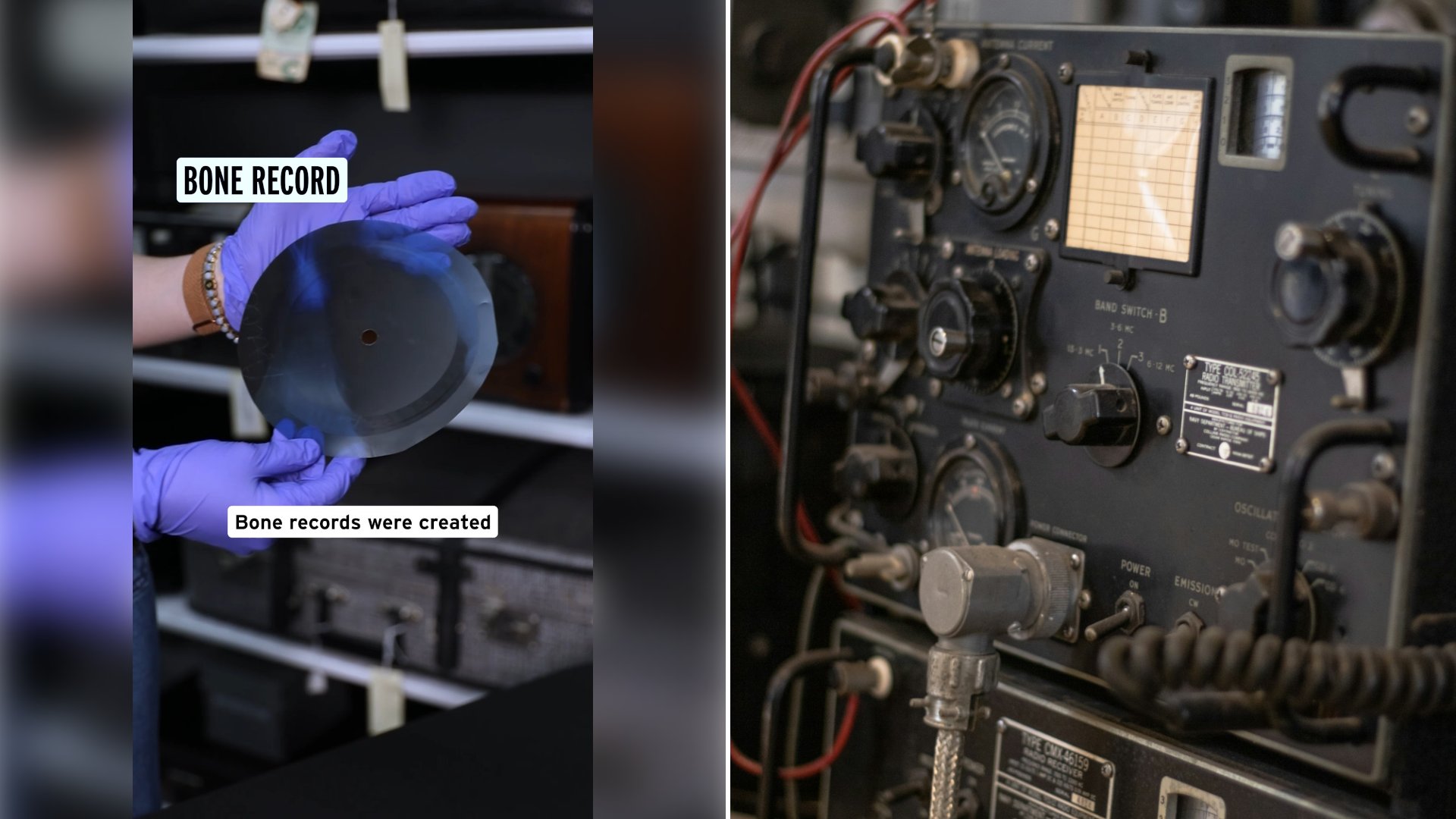
An exhibitions coordinator at the Spy Museum holds up a dark disc to a bright light and the image shows through it: a pale set of ribs. “So, this is somebody’s X-ray,” she says in the captions of a reel posted by @spymuseum on September 25, 2026. “It kind of looks like ribs to me. But now it’s a Led Zeppelin record.”
The post’s caption sets up the history: “To smuggle banned Western music into the Soviet Union in the 1950s and 1960s, bootleggers created bone records by etching audio grooves into discarded X-ray film. Our modern bone record recreation plays Led Zeppelin’s ‘Going to California.’” So the disc in the video is the museum’s recreation, not an original from the period.
In the 64 second video she stands in front of shelves of audio gear, wearing purple gloves, and explains it in plain steps, with captions on screen. At 0:07 the caption reads “This is a bone record,” a “BONE RECORD” text banner appears at 0:09, and at 0:12 a title card gives her job as exhibitions coordinator. “Bone records were created in the Soviet Union in the 1950s and 1960s,” she says. “They were created, notably, out of X-ray film.” The process, as she lays it out, starts in the trash: “Bootleggers would go to hospitals and dumpster dive for discarded X-ray film in the trash.”
From there it is hands on. “They would take the discarded X-ray film, cut out about a circle like a plate size, and then burn a hole in the middle with a lit cigarette.” The video cuts to a close up of exactly that: a gloved hand holds a disc of film while a lit cigarette touches the center and burns the spindle hole, with a thin trail of smoke rising from the film.
The next step is where the music comes in. “Then, they would copy a record obtained legally onto one of these X-ray films, using an old modified gramophone and a recording lathe.” In other words, the bootleggers started from a legitimate record and cut a new copy into the film. She finishes the explanation with “This is Led Zeppelin, ‘Going to California.’ Let’s listen to some bootlegged music.”
The last stretch of the reel is the playback. At about 0:49 she leans down to a Victrola portable turntable beside her and places the film disc on the platter. The camera then moves to a close up of the turntable with its lid open and the tone arm over the disc, and it stays there to the end of the reel. A caption reads “That sounds great” at 0:56.
The museum’s account is consistent with what a university exhibition says about the real thing. Syracuse University Libraries, in a display on Soviet bone records, says the bootleggers worked from discarded technology and exposed X-ray film, which is where the names “bone” and “rib” records come from. It says the music was copied from existing vinyl discs, either pre revolution records or newly imported ones, and that the images left on the discs included body parts such as ankles, ribs and skulls.
The same exhibition notes that bootleggers emerged in postwar Leningrad, that a general amnesty after Stalin’s death in 1953 freed more than a million prisoners and some bootleggers went back to recording, and that by the mid 1960s the last bone records had been etched. It lists what was on them: early bootlegs carried pre war jazz, tango and Russian émigré music, and as Western music filtered in the discs carried Duke Ellington, Bill Haley, and later Elvis Presley and The Beatles. Rock and roll, it says, was all but untouchable under state radio’s controls. Dealers and makers were imprisoned for years at a time, according to the exhibition, and the quality a buyer got was unpredictable.
If you come across an old X-ray disc for sale, ask where it came from and look at what is pictured, since the Syracuse exhibition says the images on genuine discs included ribs, ankles and skulls. The museum labels the disc in this reel a modern recreation, and a listing should say just as plainly whether a disc is a period piece or a copy.
More from Vinyl and Velvet
- British Intelligence Secretly Hid Real Maps, Compasses and Cash Inside Monopoly Sets During World War II to Help POWs Actually Escape German Camps
- Tetris Sparked an Actual Cold War Legal Battle Between the Soviet Government and American Game Companies, and the Rights Fight Lasted for Years
- A Collector Walks Through the Quiet, Coffee-Paired Ritual of Choosing and Spinning a Record

Leave a Reply