

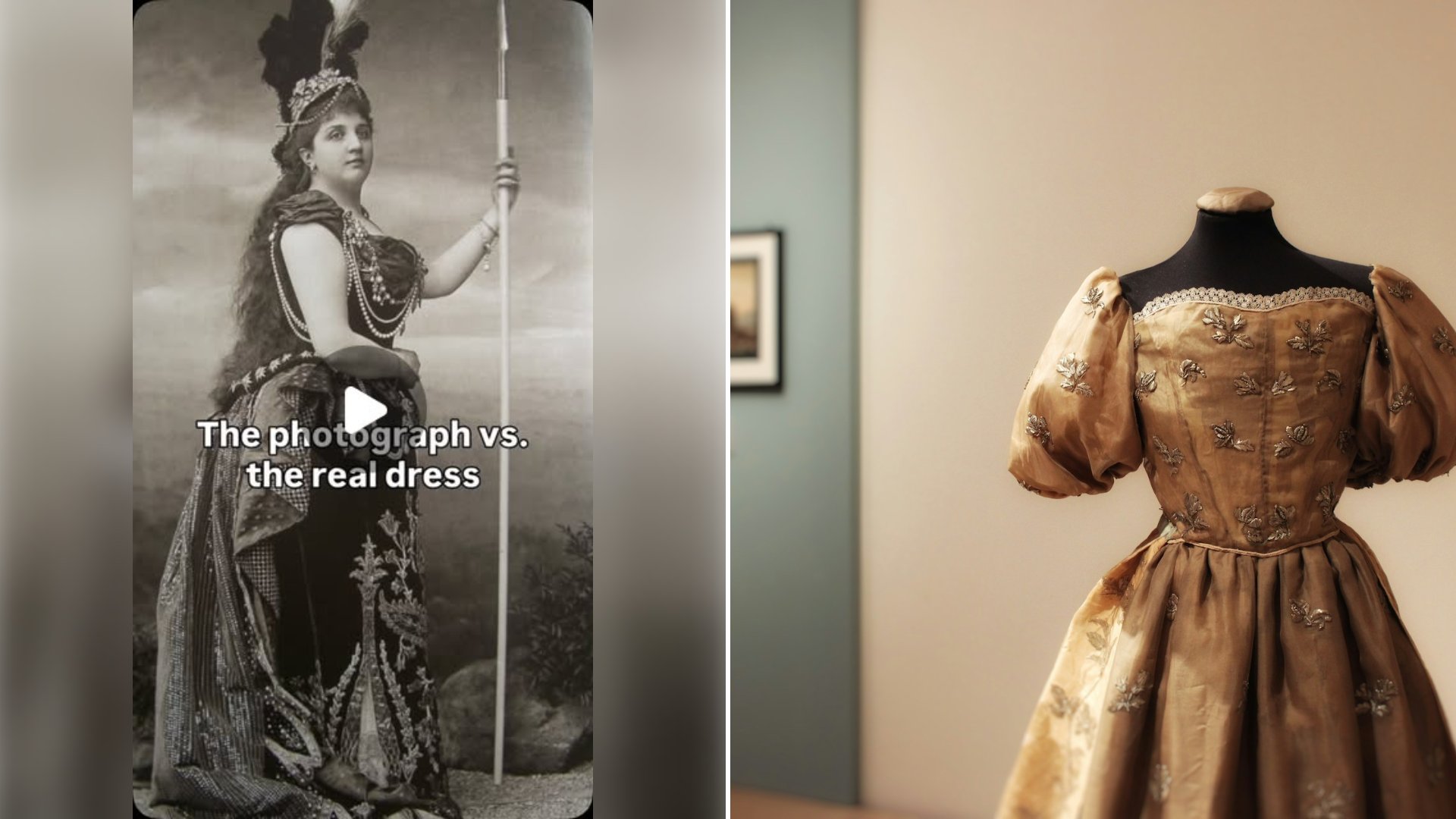
Fashion historian @the_art_of_dress built this piece around a side-by-side that does not need much explaining once you see it. On one side is a faded black and white photograph of a Parisian society hostess, dressed for an evening of entertaining, captured in the kind of formal studio portrait that was common for women of her social standing in the early twentieth century. On the other side is the dress itself, the very gown from that photograph, preserved and now displayed behind museum glass. A hundred years sit between the two images, and the comparison makes that gap feel almost instantaneous.
This kind of then-and-now pairing has become one of the most effective formats in fashion history content precisely because it closes the distance between a garment and the person who actually wore it. A dress on a mannequin in a glass case can feel abstract, something to admire for its craftsmanship but hard to connect to a real evening, a real party, a real woman standing in a real room. Put the original photograph beside it, and the dress stops being an artifact and becomes something someone chose, fitted, and wore to make an impression.
Society hostesses occupied a genuinely powerful role in early twentieth century Parisian social life. Entertaining well was not a hobby for women in this position, it was a form of social currency, and the clothes worn for an evening of hosting were chosen with the same deliberateness a politician might apply to a public appearance. Paris was the center of the fashion world at the time, home to the great couture houses that dressed European aristocracy and the American elite who crossed the Atlantic specifically to be fitted there. A gown worn by a prominent hostess was not just an outfit, it was a statement about taste, connections, and status that every guest in the room would clock on arrival.
Garments from this era survive in museum collections today largely because of just how much labor and material went into them. Beading, embroidery, boning, and hand-finished seams were standard on formal eveningwear, and a single gown could represent hundreds of hours of work from a house’s ateliers. That level of craftsmanship is part of why institutions prioritize preserving period eveningwear specifically, since it documents not just fashion trends but the skilled handwork of an era before ready-to-wear manufacturing took over. Textile conservators who handle pieces like this typically store them flat or on padded, acid-free supports away from light, since both silk and the metallic threads common in beaded eveningwear degrade quickly under UV exposure and humidity.
Photographs like the one paired with this gown also serve as valuable primary sources for fashion historians trying to date and authenticate garments. A studio portrait with a visible date or a identifiable sitter gives researchers a fixed point to work from, something far more useful than guessing a gown’s era purely from its construction. When a photograph and the surviving garment can be matched to each other, as they are here, it turns the object into something closer to a historical document than a decorative one, and that is exactly why pairings like this get so much attention from people who follow fashion history content. The gown is not just old and beautiful. It is provably tied to a specific moment, a specific woman, and a specific evening, which is a rarer thing in museum collections than most people realize.
What makes this particular video land is the plainness of the comparison. There is no need for narration explaining why it matters once the two images sit next to each other. The photograph shows a woman in her moment, confident and dressed to entertain, and the museum case shows what was left behind once that moment passed. It is a reminder that every preserved gown in a glass case once moved through a room on a real person, and that the fashion history collectors obsess over today was, at the time, simply what someone wore to host a party.
More from Vinyl and Velvet
- Sewing Creator Makes the Grace Kelly Rear Window Dress From an Edith Head Design, Adding Black Beaded Leaf Appliques to a White Skirt for Her September Dress Project
- Creator Posts a Crowded Archive Shop Shoe Tour Where On Screen Labels Name Comme des Garcons, Balenciaga, McQueen, Tom Ford, YSL and Margiela Seasons as Each Pair Is Held Up
- Dry Cleaner Posts Her Phone Calls Over a Damaged $15,000 Vintage Dior Dress and Says Getting Answers About Who Is Insured Turned Into an Entirely Different Situation

Leave a Reply