

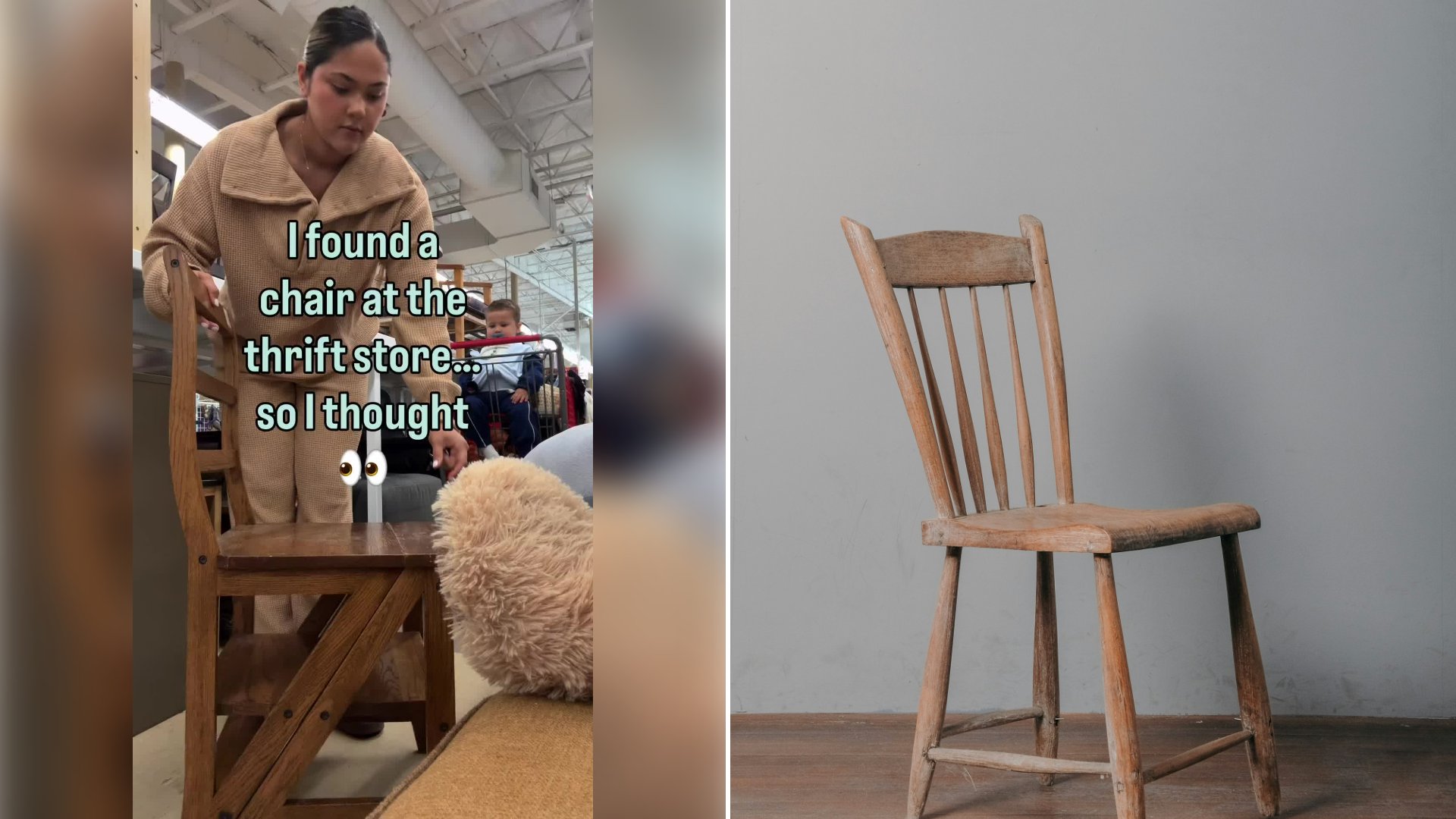
The chair looks ordinary enough on a thrift store shelf: dark wood, a slatted back, four legs. Then the shopper behind @the.thrifted.estate unlatches the seat back and folds it forward, and the whole thing opens into a four-step wooden ladder. “It’s a freakin’ ladder!” she says, genuinely startled, before climbing the lower rungs to test whether it holds her weight.
“I found a chair at the thrift store… so I thought,” the on-screen caption reads, trailing off right before the reveal, with a pair of cartoon eyes punctuating the pause. A toddler watches from a nearby shopping cart as she works the mechanism, and the clip ends on a top-down shot of the fully unfolded ladder sitting on the store floor, four even steps stacked where a chair back used to be.
@the.thrifted.estate
Furniture that folds, flips, or otherwise disguises a second function has its own name among collectors and furniture historians: metamorphic furniture. The best-known version is the metamorphic library chair, a design that became fashionable in Georgian-era England, when English furniture makers like Morgan and Sanders patented library chairs built specifically to double as a set of steps, letting a reader pull a book from a high shelf without hauling a separate ladder across the room. The design caught on because it solved a real space problem in homes with tall bookcases, and surviving period examples, with their brass hinges and reinforced joints, are still actively collected today.
What this thrifted piece shows is a later, simpler descendant of that same idea: a functional library-step chair built for a home rather than a formal study, with none of the ornamentation of a Georgian antique but the same folding logic underneath. That makes it harder to spot on a shelf than an obviously labeled step stool, which is exactly why her reaction reads as genuine rather than staged; from the front, nothing about the chair announces what it can do.
For anyone shopping furniture secondhand, a convertible piece like this is worth a quick hands-on check before it goes back on the shelf unexamined: look for a seat back that unlatches rather than one that is simply hinged for decoration, check whether the legs are notched to lock into a stepped position, and test the weight-bearing joints the way she does in the clip before trusting it with real use. A piece engineered to fold and bear weight needs its hardware intact, since a worn hinge or a cracked leg joint is a lot more consequential on a ladder than on a chair that only ever holds someone sitting still.
More from Vinyl and Velvet
- Thrifter Spots a Dried Out Carved Folding Book Stand Someone Donated, Brushes Conditioner Into Every Cutout, and Commenters Say It Is a Rehal, a Stand Used for Reading the Quran
- Thrifter Lifts a Blackened Horned Toad Off a Glass Shelf for $3.99, Says It Is a James Avery Bronze Paperweight That Sells for $190 New, Then Polishes It Gold With a Nail Buffer
- Thrift Restorer Brings a Tarnished Four-Dollar Goblet Back to Its Former Shine as a Few Dollars and Some Elbow Grease Restored Its Former Sparkling Glory

Leave a Reply