

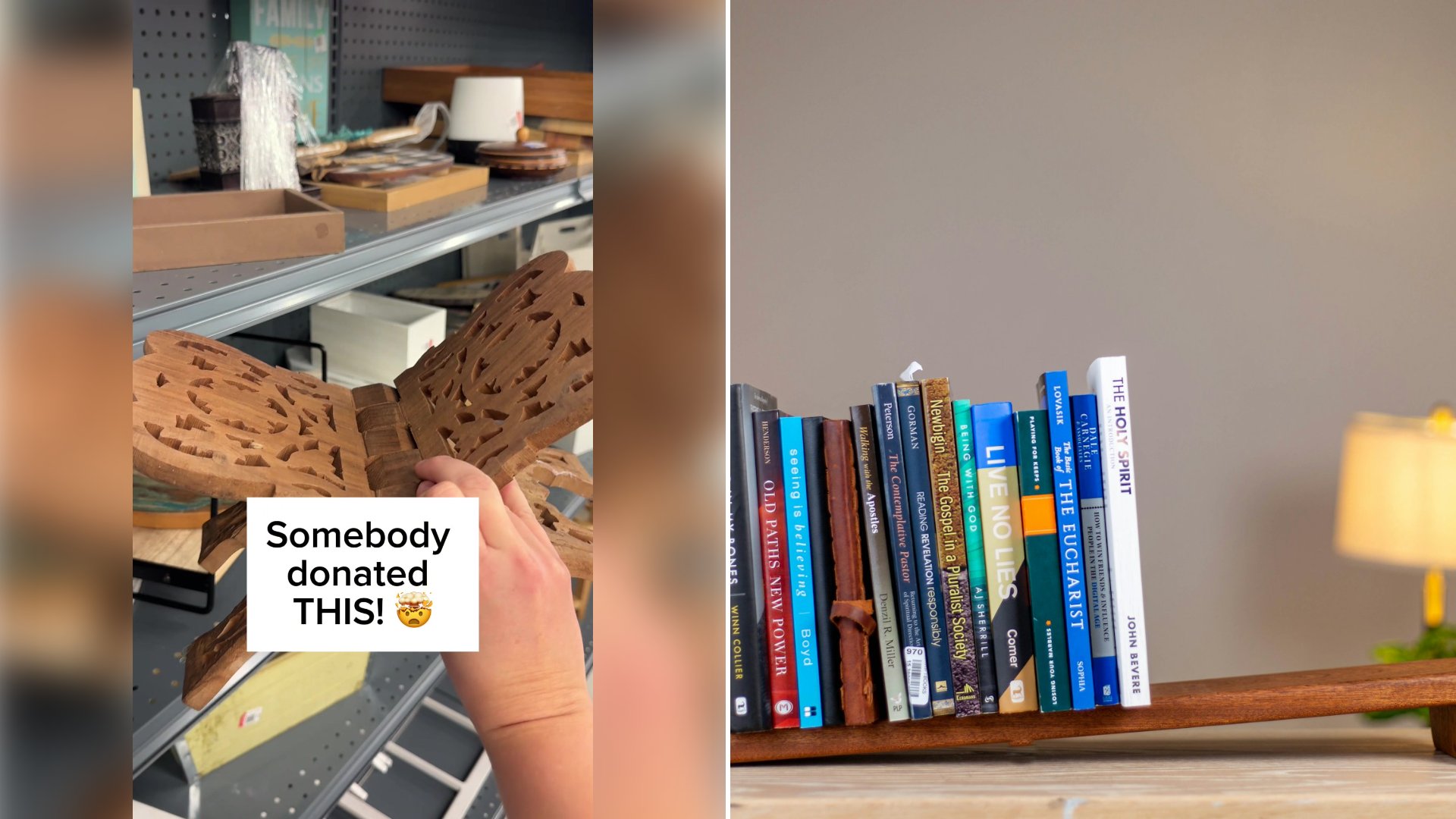
Jenna Townsend, who posts as @touch.of.townsend, opens her clip standing in a thrift store aisle with a hand over her mouth and a text box that reads “Somebody donated THIS!” The camera then finds what she means on a low metal shelf beside a pile of housewares: a pale, folding wooden stand carved all over with pierced leaves and scrolls, the two halves crossed like an open X.
Her caption, posted to TikTok on September 4, 2026, calls it “A DREAM THRIFT FIND” and a “hand carved wooden book holder,” and explains the problem: “The wood was dried out, but with a little love it now looks brand new again!” Her hashtags tag it as a Goodwill find.
Back home, with the text “Let’s clean it up!” on screen, she lays the stand on a white cloth and squeezes a thick amber conditioner from a bottle straight into a round brush with a wooden handle. The label is not readable in the clip. She works the brush into the carving in small circles, pushing it into each cutout, and the difference shows within seconds: the treated half turns a deep reddish brown while the untouched wood next to it stays pale and dusty looking. She does the faces and the inner edges where the two halves lock together.
The finished stand goes onto a wooden dresser in front of a dried flower arrangement and an amber glass vase, propped open with a book resting in the V. “How gorgeous is this book holder,” her last text box reads. The final shots circle the empty stand.
What Commenters Recognized
The comments named the object. Several viewers wrote that it is a rehal, a stand used for reading the Quran. One who said she is Muslim explained that it is most commonly used to hold the Quran, but “it’s just a holder,” and called it a beautiful addition to the home. Another wrote that in Pakistan these stands are used when reading the Quran, and a third said it is a stand for any book that families happen to use for the Quran, while another commenter insisted it is meant for the Quran alone.
Museum collections back up the identification of the form, though not the age or origin of her piece, which the video does not show. The Pitt Rivers Museum at the University of Oxford describes a Qur’an stand from Iran in its collection as a “rahla,” a folding lectern, designed to hold a large copy of the Qur’an, and notes that early examples were often made of luxury woods such as walnut or teak. The Weltmuseum Wien holds a 19th century folding Quran stand from Turkey, catalogued under the Turkish name geçme rahle, made of wood with bone and mother of pearl.
Reviving Dry Carved Wood Without Damaging It
What she shows works as a cosmetic refresh: a conditioner brushed in until the color comes back. If you find a stand like this, and especially if it might be old, conservation guidance suggests a gentler order of steps.
Clean before you add anything. The Canadian Conservation Institute says most wooden objects with firm, stable surfaces can be cleaned of loose dirt “using a soft paintbrush and vacuum cleaner,” and that wet cleaning is unsuitable for bare wood because “bare wood readily absorbs water.” Carved cutouts trap dust, so brush them out first, or the conditioner will seal the grime in.
Know what conditioners actually do. The institute’s note on furniture finishes states that wood does not need to be “fed” to replenish natural oils or moisture, contrary to many product claims, and that commercial restoration mixtures and polishes, which usually contain waxes, oils or silicones, are not recommended for museum objects because they can leave a sticky build up. It also warns that oil applied to pieces that were not originally oiled often leaves them darkened. The color change in her video is exactly that kind of darkening, which is fine for a decorative find you want deeper in tone, and worth thinking about first if you suspect a piece has age or value.
If you want a protective coat, the same note recommends a paste wax free of colorants and perfumes, applied thinly and evenly, rubbed in well and not repeated often.
Check how it folds before you treat it. Her stand opens on interlocking edges at the center, which she conditions along with the faces. Open and close a stand like this a few times before you buy it to make sure the joint moves freely and none of the carving is split.
More from Vinyl and Velvet
- Thrifter Lifts a Blackened Horned Toad Off a Glass Shelf for $3.99, Says It Is a James Avery Bronze Paperweight That Sells for $190 New, Then Polishes It Gold With a Nail Buffer
- A Goodwill Price Tag Gets Peeled Off a Mysterious Vintage Computer Speaker That Still Plays, Clicks, and Sounds Just Right
- A Creator Gives a Nostalgic Tour of Her Own Retro 1970s-Style Basement and Explains Why She Loves It

Leave a Reply