

Anyone who has spent time in a thrift store knows the urge to invent a story for an object. A chipped teapot becomes a grandmother’s wedding gift. A worn leather chair becomes a favorite reading spot. The creator behind @hillarymarieugc says she is not the only one who does it, and in a short post she shares the story she made up after one particular visit.
A Name That Kept Appearing
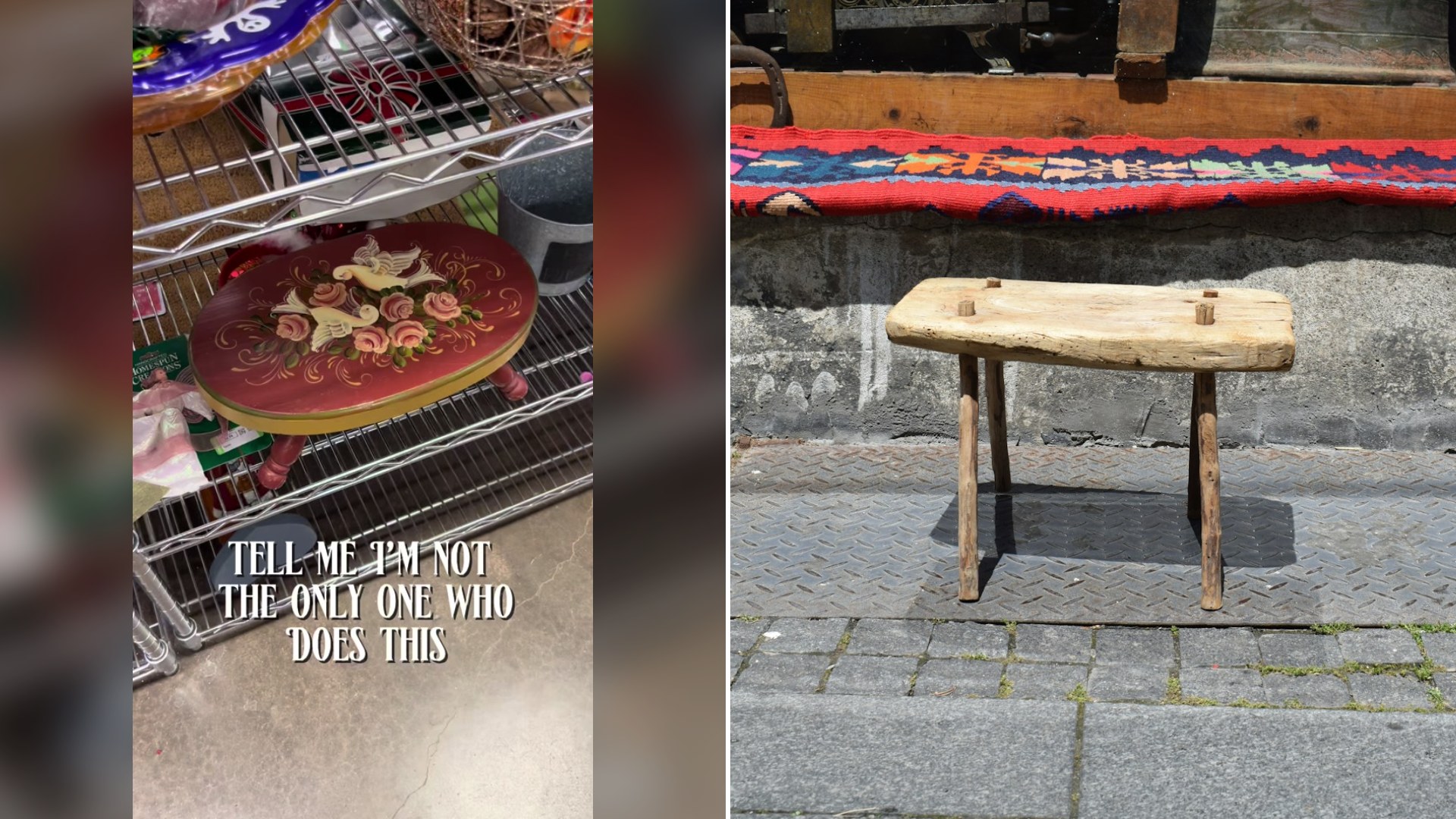
She says she was walking through the thrift store when she began to notice the same name over and over, Dolores. It was on little hand painted pieces, including a stool and some artwork. She describes tiny details that were clearly made with care. In another aisle, she found handmade wooden shelves, trays and toys. They were unfinished, she says, but beautifully built.
That is the entire factual core of her story. A name, a pattern of handmade work, and a store that happened to hold it all. She does not name the store or the city, and she does not give Dolores a last name.
The Story She Imagined
What follows is entirely her imagination, and she says so. “Maybe I’m making this up entirely,” she says. In her head, though, the wooden pieces and the painted pieces belong together. She pictured an older couple, with him in the garage building things with his hands and her adding the paint, the flowers and the details that made the pieces hers. She imagined years of creating side by side, and now their work waiting at a thrift store for someone to bring it home.
She is careful to add that none of it may be true. She also offers a gentle ending. Even so, she says, Dolores’s work is still making someone stop and smile. In her caption she calls this the magic of thrifting, the way you sometimes bring home a little mystery.
It is worth underlining that the couple, their roles and their history are speculation. Nothing in her post confirms who made the pieces, whether they were made by two people, or why they ended up in a store. What she has is a name, some paint and some wood, and a warm instinct to imagine the hands behind them.
Why Handmade Pieces Pull At Us
There is a reason these objects stop people in their tracks. A machine made item is the same as a thousand others, but a handmade one carries traces of a person. A slightly uneven brushstroke, a hand drawn flower or a joint cut by eye can be more moving than perfection. For many shoppers, those little signs of human effort are the reason to bring a piece home.
Handmade crafts also hold memories for people who grew up around them. Many families had someone who painted, whittled, sewed or built things for the house, and the results often ended up at craft fairs, church bazaars and on relatives’ shelves. When those pieces appear in a thrift store, they can feel like a message from another time.
How To Spot And Appreciate Handmade Finds
If you want to look closer the next time you see a piece like the ones she describes, here are a few places to start.
Look for a signature or name. A painter might sign on the bottom, the back or the edge of the piece. A name repeated across different items, as she noticed, is a clue that they were made by the same hand.
Check the underside. Look at the bottom of a stool or tray for pencil marks, dates, stickers or stamps. Some crafters used labels or small tags to mark their work.
Study the construction. Handmade wooden items often show tool marks, hand cut joints, nails or screws that are not perfectly uniform, and sanded edges. Factory pieces tend to be uniform.
Look at the painting style. Decorative painting on wood and tin has a long tradition, often featuring flowers, fruit and scrolls. Hand painted details usually vary slightly from piece to piece.
Feel the finish. Old paint can show crackling or wear along the edges where hands have held it. That wear is part of its charm and not necessarily a flaw.
Judge the condition. Look for cracks, wobbles, water damage, and signs of pests in wood. A sturdy handmade item is worth far more than a fragile one, to you if not to the market.
What Is It Worth?
Unsigned handmade items rarely fetch high prices, and a thrift price is usually modest. Their value is often personal. For a collector of folk art, a known maker may add value, but most shoppers are buying for the story and the look. If you are curious, search for the maker’s name together with the type of item, and look at how similar pieces have sold. Be cautious about assuming a piece is rare simply because it feels special.
Giving Handmade Things A New Life
One of the nicest parts of thrifting is what comes next. A hand painted stool can sit beside a bed or hold a plant. A wooden tray can serve breakfast or corral remotes on a coffee table. Unfinished shelves can be sanded and painted, or left alone to show their natural character. If you do change a piece, think about whether the original paint is part of its appeal before you cover it.
You can also pass a piece along. If your own home is full, donating things you no longer need keeps the cycle going and gives the next person a chance to feel the same small thrill she describes.
Telling Your Own Stories
She ends her post by asking if others make up stories about thrift finds too. It is a lovely question, and for many shoppers the answer is yes. Imagining the people behind an object is not a lapse of judgment. It is a way of paying attention. Just be sure to keep the line clear between what you know and what you imagine, as she does. The facts are a name and a pile of handmade work. The rest is a sweet story, and sometimes that is exactly what makes a thrift store trip worth taking.

Leave a Reply