

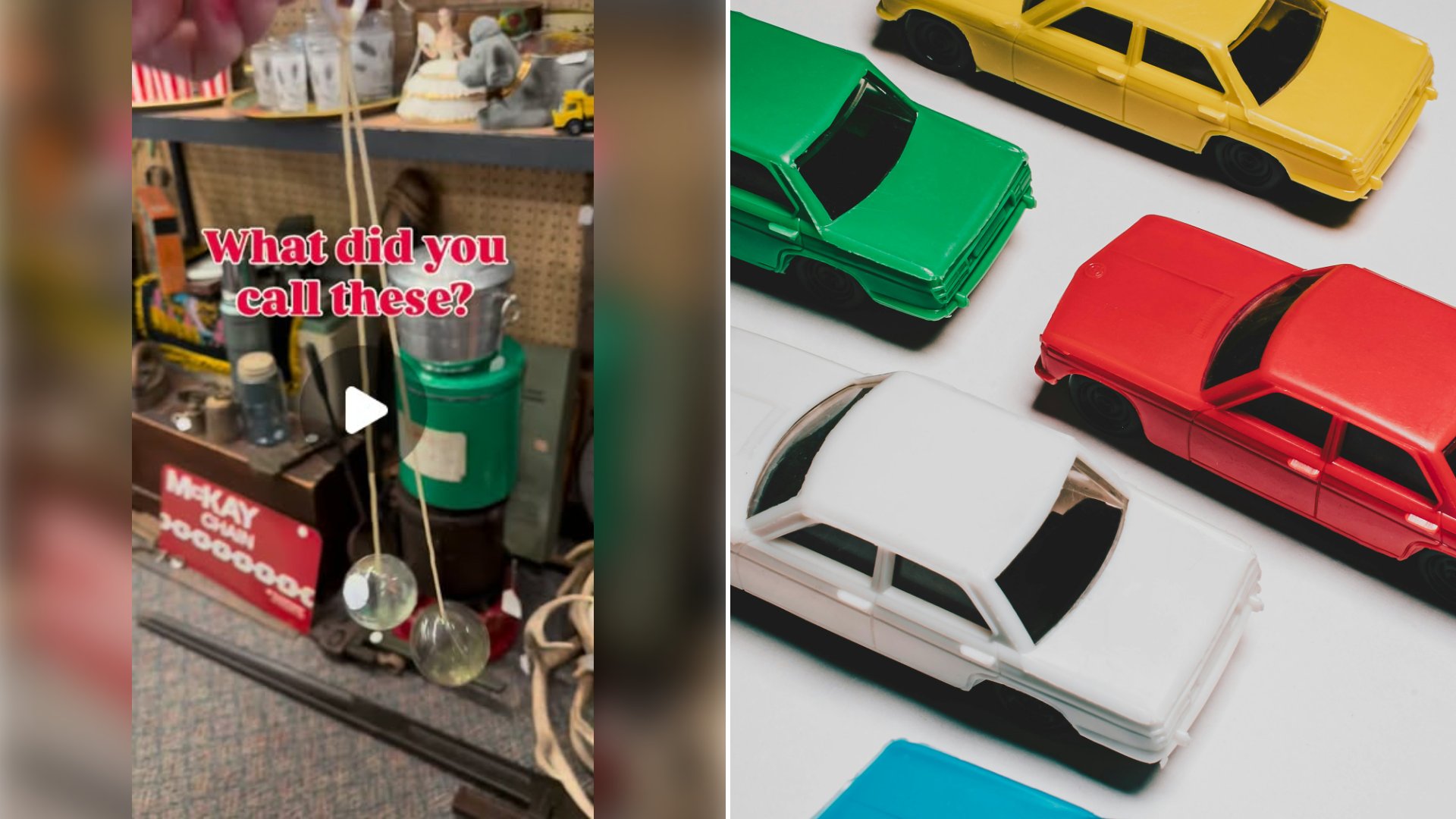
Two hard plastic balls on strings swing up and down in the video, smacking together above and below a central handle at a speed that makes the whole thing sound like a tiny machine gun. The creator, @part.time.pickers, holds up the toy, gets it clacking at full speed, and then turns to the camera with one simple question: what did you call this thing as a kid? The comments section does the rest, filling up almost instantly with a dozen different answers, half of them insisting their name was the only correct one.
It’s a format that works because almost everyone over a certain age has a visceral memory of this exact sound, the rapid clack-clack-clack building into a blur, and the real risk of catching a knuckle or an eyebrow if the rhythm slipped even slightly. Nobody in the comments seems to agree on a single official name, which is really the whole point. Regional slang and generational memory collide every time a video like this gets posted, and the toy itself ends up being almost secondary to the argument it kicks off.
The toy’s actual name is the Clackers, sold under that trademark in the United States starting in 1971. It consisted of two solid acrylic balls, each attached to either end of a length of string with a ring or small tab in the middle, and the physics were simple: a practiced up-and-down motion kept the balls swinging fast enough to collide above and below the user’s hand in a steady rhythm. It was marketed heavily as a skill toy, something kids could get progressively better and faster at, which is exactly the appeal still visible in viral clips of the toy today.
The problem was the material. The original acrylic balls were hard and could shatter under stress, sending sharp plastic shards flying, and the toy also had a well-documented habit of smashing straight into fingers, wrists, and knuckles when a user lost the rhythm even briefly. The United States Consumer Product Safety Commission, created in 1972, looked closely at Clackers as one of its earliest high-profile safety cases, and the acrylic version was effectively pulled from the market by the mid-1970s over the shattering risk and the injury reports piling up from schools and households. Manufacturers later tried safer versions using wood or softer plastics, but the sharp, loud, slightly dangerous original is the version most people over 50 actually remember.
Despite the recall history, Clackers never fully disappeared from cultural memory, and that’s largely because the toy was genuinely almost impossible to replicate with anything else. There’s no modern equivalent that produces the same sound or demands the same specific wrist motion, which means a video showing one in action instantly transports anyone who grew up with it straight back to a school playground, decades before safety standards caught up to what kids were actually being handed to play with. It’s a small, loud piece of toy history that got banned for good reason and remembered fondly anyway, which is exactly the contradiction playing out in a comment section still arguing about what to even call it.
More from Vinyl and Velvet
- Gen X Creator Lists Childhood Things That Felt Normal, From Waiting in a Running Car to Buying Cigarettes for His Parents and Spending Hours Out of Reach of Any Phone
- Two Retro Podcasters Hold on a Toy Revolver Photo Labeled I Can Smell This Photo for 55 Seconds While Their Caption Asks if Anyone Remembers the Roll
- Game Boy Owner Says Mom Kept the Toys R Us Receipt From July 18, 1994, Showing a $49.99 Game Boy and a $19.99 Yoshi Game, and the Old Handheld Still Turns On Today

Leave a Reply