

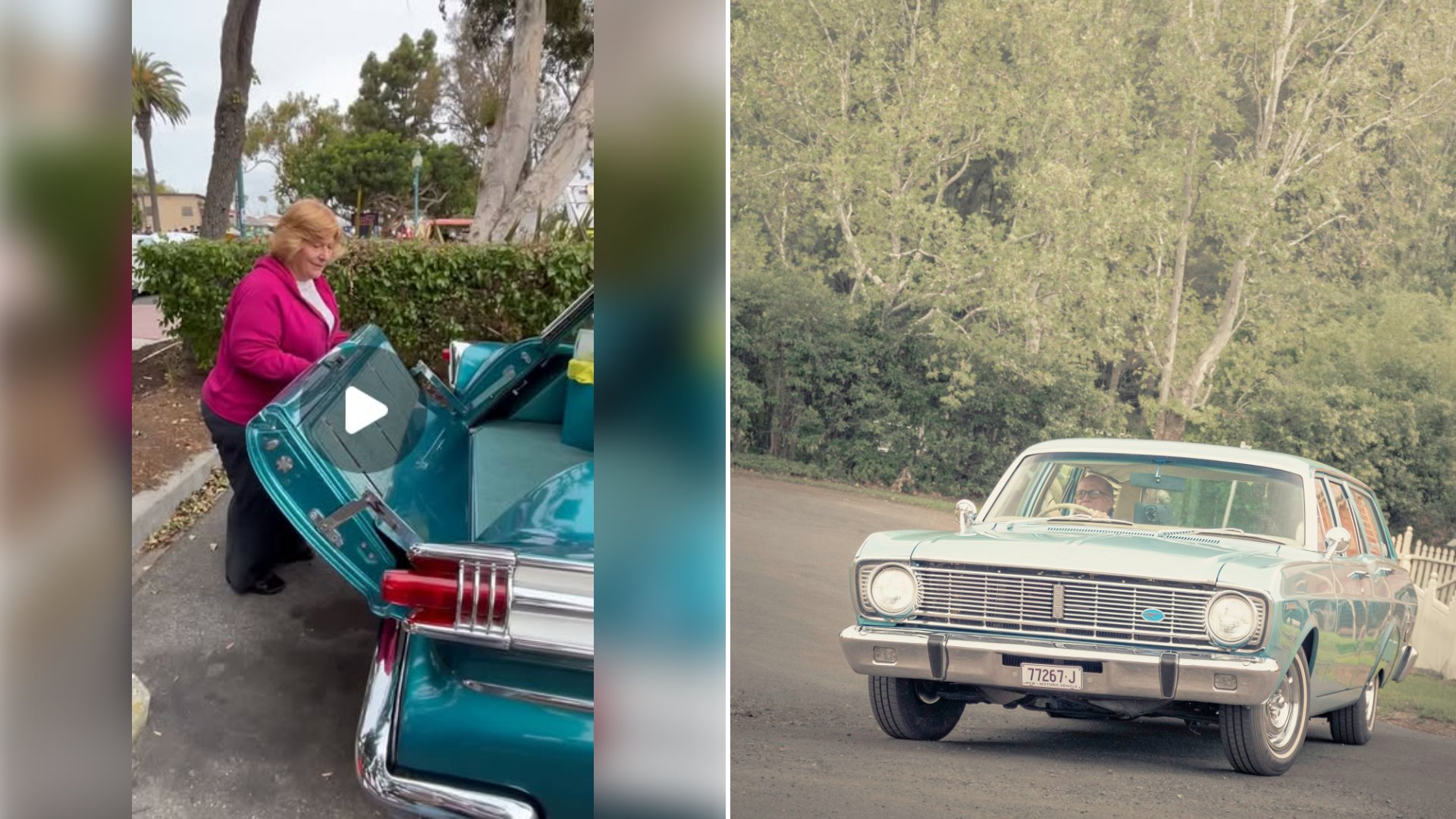
The video opens on a long, gleaming 1958 Mercury Commuter station wagon parked and ready for its close-up. The owner, @bettyzwithchevyz, walks around to the back of the car holding nothing more than a small key, slides it into a nearly invisible lock near the tailgate, and turns it. What happens next is the entire point of the video: the rear window retracts on its own, followed by the tailgate dropping open, all triggered by one small twist of a key that looks like it should open a mailbox, not move glass and steel.
The reaction in the comments is immediate disbelief, mostly from people who had no idea a car built decades before power liftgates became standard could already do something this mechanically elegant. There’s no fumbling with a manual latch or wrestling a heavy door, just a key turn and the car does the rest, which is exactly the kind of forgotten engineering detail that makes a seven-decade-old station wagon feel more clever than plenty of modern SUVs parked in the same driveway.
The 1958 Mercury Commuter was part of Mercury’s full-size wagon lineup for that model year, sitting on the same general platform as the rest of Mercury’s 1958 range and sold as a practical, family-oriented alternative to the brand’s flashier hardtops and convertibles. Mercury, along with several other American automakers in the late 1950s, was actively experimenting with power-assisted features on its station wagons, since the segment’s whole appeal was hauling cargo and people, and anything that made loading and unloading easier gave a wagon a real selling point over its sedan counterparts.
The key-operated rear glass and tailgate setup worked through an electric motor wired into the car’s body, triggered by a lock cylinder mounted near the tailgate rather than requiring the driver to reach inside the cabin for a separate switch. Turning the key closed a circuit that ran the motor, retracting the glass into the roof or door frame before the tailgate itself could swing down, all without the driver needing to touch the glass or the latch by hand. It was a genuinely advanced convenience feature for 1958, arriving years before power liftgates and power windows became common, everyday expectations on mass-market vehicles.
Full-size wagons from this era, Mercury’s Commuter included, have become a specific niche within classic car collecting precisely because fewer of them survived compared to sedans and coupes from the same years. Wagons were treated as work vehicles for much of their lives, hauling kids, groceries, and cargo through daily use that sedans built for show driving never had to endure, and that heavier use took its toll over the following decades. A well-preserved, fully functional example with its original power features still working, like the one in this video, represents a much smaller surviving pool than the broader 1958 Mercury lineup, which is part of why seeing one not just intact but still mechanically operating exactly as designed draws this much attention.
What the video ultimately captures is a reminder that automotive engineering wasn’t starting from scratch when modern convenience features rolled out. Detroit’s designers in the late 1950s were already solving the exact same problems, how to make loading cargo faster and easier, with mechanical ingenuity that simply didn’t carry forward into mainstream production the way it probably should have. Watching that solution still work, key turn and all, nearly seventy years later is the kind of small moment that explains why people keep these cars running instead of letting them rust away in a field.
More from Vinyl and Velvet
- A Rare 1948 Tucker 48 Surfaces Online With a Helicopter-Derived Engine, Three Headlights, and Six Exhaust Tips, and the Creator Says It Was Preston Tucker’s Own Personal Car
- A Restorer in Belgium Pulls Open a Vine-Covered Barn Door and Reveals a 1971 Citroën DS21 Pallas That Had Been Hidden Since 2005, and Commenters Call the ‘Goddess’ the Most Beautiful Car Ever Built
- Detailer Stops an 82 Year Old Widow From Selling Her Late Husband’s Untouched 1968 Pontiac GTO for Just $1,000 and Uncovers a 19,000 Mile Survivor Hiding Under Decades of Garage Dust

Leave a Reply