

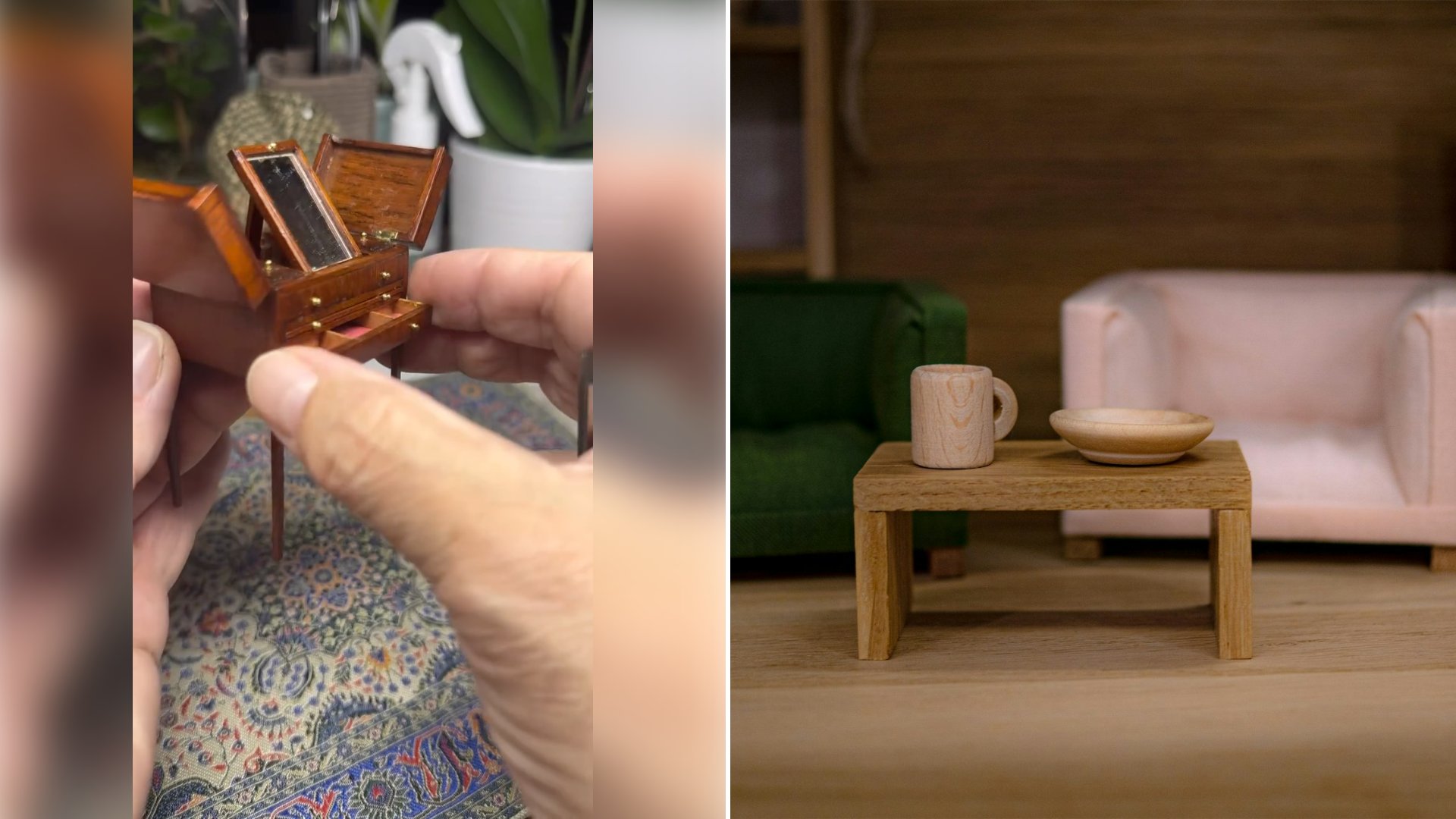
Dollhouse-scale furniture has its own dedicated collecting world, built around artisans who spend hours shrinking full-size furniture design down to a scale that fits in the palm of a hand without losing a single working feature. A miniatures collector who regularly posts pieces picked up from estate sales recently showed off one of the more impressive examples to come through her collection: a tiny hardwood vanity cabinet with more moving parts than most full-sized furniture ever has.
The piece came from a recent estate sale, the kind of source serious miniatures collectors watch closely, since dollhouse furniture from skilled individual makers rarely shows up in ordinary thrift stores and tends to surface instead when a longtime collector’s own estate is finally being sorted through. What she pulled out of that sale was immediately recognizable as a cut above a mass-produced dollhouse accessory, built with the same joinery logic and functional detail a full-scale furniture maker would use, just scaled down to roughly a twelfth of ordinary size.
The vanity’s standout feature is a pair of swing-out tabletop sides that fold open from the main cabinet, each one extending the usable surface the way a real vanity or secretary desk would. At the center of the piece sits a pop-up mirror, hinged to a small wooden stand at the back that holds it upright once raised, a detail that requires the same basic engineering as a full-sized folding vanity mirror shrunk down to a fraction of the scale. Getting a hinge and a kickstand mechanism to function smoothly at that size, without the mirror flopping over or the stand failing to hold its angle, is exactly the kind of technical challenge that separates a serious miniatures artisan from a hobbyist gluing pieces together.
Opening the cabinet further reveals a row of tiny compartments, each with its own small removable lid, designed to hold miniature objects the way a real vanity’s drawers and trinket trays would hold jewelry or cosmetics. Below that sits a butler’s tray that slides out from the body of the piece on its own small track, adding a second usable surface for displaying more miniature objects, and beneath that, a final drawer lined to match the fabric or finish used inside the upper compartments. That bottom drawer, it turns out, is a faux: it does not actually open, a small bit of trompe l’oeil the collector admitted fooled her at first until she tried to pull it out herself.
Everything about the piece is designed to fold back together and lock into a single compact, traveling-friendly form once the demonstration is over, with each hinge and panel clicking back into its resting position. That kind of fold-flat engineering, built at dollhouse scale and still functioning smoothly decades after it was made, is precisely what collectors in this niche are chasing when they hunt through estate sales rather than big-box miniature kits.
The final detail is the one that matters most to anyone trying to value or authenticate a piece like this: a signature on the underside reading the maker’s name alongside the year 1997, confirming both who built it and roughly how long ago. A dated, signed piece gives a collector something a mass-produced miniature never offers, a direct line back to an individual craftsperson working at a specific point in time, which is exactly the kind of provenance that turns a dollhouse accessory into a genuine collectible rather than simply a toy.
Pieces like this rarely attract the same attention as full-sized antique furniture, but within the dedicated world of dollhouse and miniature collecting, a hand-built, fully functional, and clearly signed vanity like this one is treated with the same seriousness a full-scale furniture historian would give an original writing desk. It is a reminder that scale has very little to do with how much craftsmanship, or how much collector demand, an object can carry.

Leave a Reply