

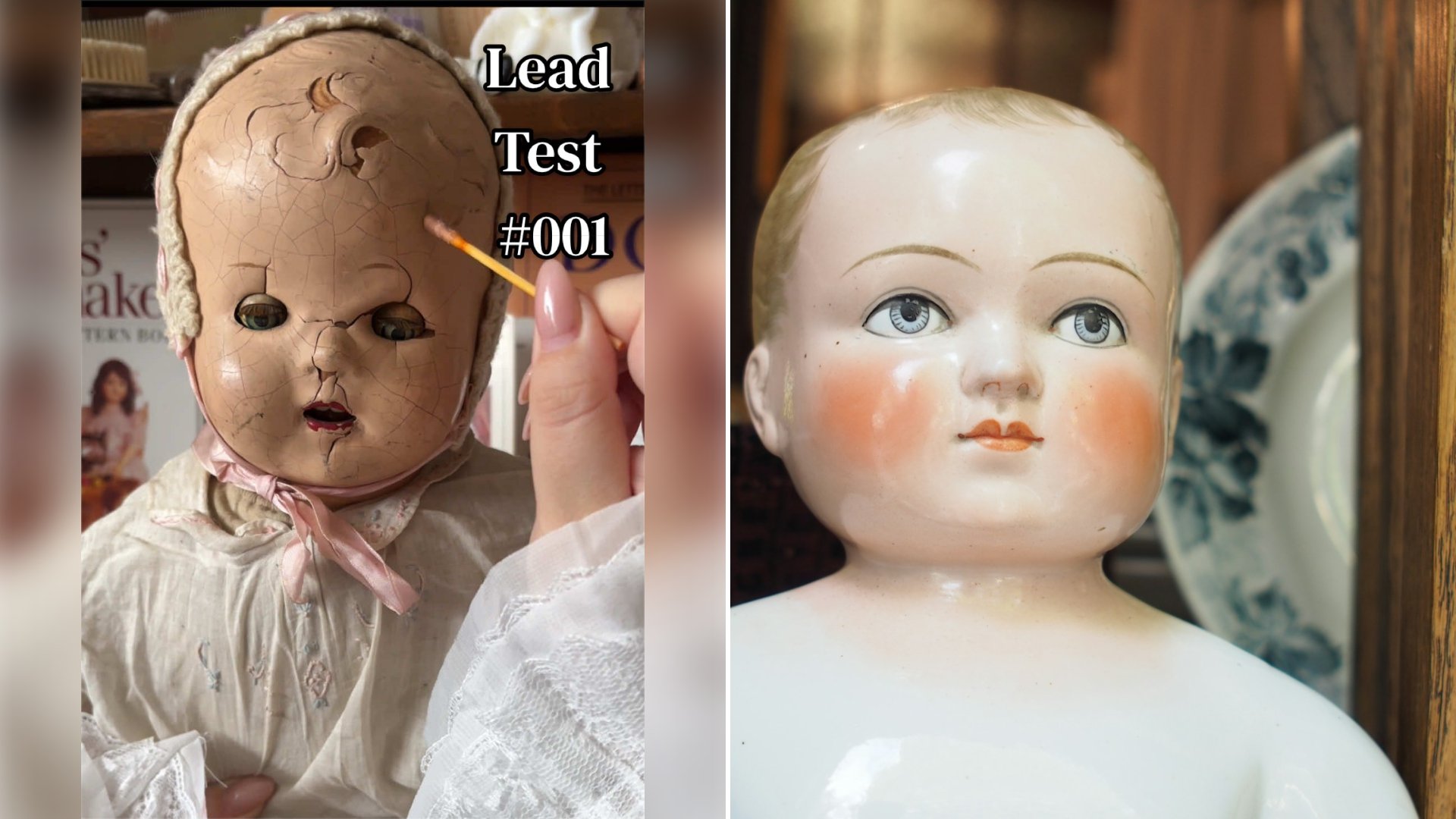
“My hair fell out and I don’t know why.” That is the first line of the video, spoken by the antique doll collector behind @soulmori as she holds a cracked, bonneted baby doll up to her cheek. Her next line explains the experiment: “So I am testing my antique dolls for lead paint.” The on screen label calls it “Lead Test #001,” and the caption files the doll as “subject 001 in the Doll Lab,” a doll she calls Dolly.
She lays out her reasoning in a few sentences. According to her video, her doctor said the hair loss might be stress, “but I don’t feel very stressed.” Her conclusion is “Something else must be going on,” and her suspicion lands on the collection around her: “these dolls are very old.” That link between the dolls and her hair is her own guess. Nothing in the video is a medical finding, and she does not say she has had any test of her own.
The setting tells you how deep the hobby goes. Shelves of antique dolls fill the wall behind her, and the doll books propped up on the table during the test include one with “How to Repair & Restore Dolls” printed across the top. Dolly herself has a painted face with heavy cracking and flaking, a lace bonnet tied with a pink ribbon, and a white gown.
How she ran the swab test
The kit is a tube marked “Test Swabs.” She explains the color code as she goes: the swab “is already an orange color and this means there is no lead present. But if it turns dark purple, it means there is lead detected.” Following the instructions, she dips each swab into a small dish of water and runs the wet tip along the part of the doll she wants to check. Her cat wanders into one shot, and she explains, “My cat thought I was shaking a box of treats here.”
The first swab goes along the doll’s body. She chose Dolly first, she says, “because she is one of my favorites and I hold her a lot.” The result, in her words: “my hopes were quickly crushed as I saw this dark purple part on the swab.”
She kept going “just to see how bad the lead is on this doll.” Next came the leg and the foot, which she picked because they are “the most untouched areas of the doll,” and she reports that the swab again went “that dark purple color we were hoping not to find.” The last test was the head, chosen “because I hold her head to mine a lot.” Her verdict: “it is all purple.”
She ends with a question and a joke. “Does this mean I have to get rid of the dolls? I think I would rather just be bald.” Then she asks which doll in her collection she should test next. The video does not show any lab result, medical result or decision about the collection.
What a home swab can and cannot tell you
A color change on a retail swab is a screening result, not a measurement. The U.S. Environmental Protection Agency says consumers should exercise caution when using lead test kits to evaluate consumer products, and points to laboratories recognized under its National Lead Laboratory Accreditation Program for paint chip samples. The EPA’s list of recognized kits covers only three products, and only for surfaces such as wood, drywall, plaster and ferrous metal, for use by certified renovators. A painted doll is not on that list.
For comparison, the U.S. Consumer Product Safety Commission’s rule at 16 C.F.R. part 1303 treats paint and similar surface coatings as banned hazardous products when they contain 0.009 percent lead or more by weight, and that ban extends to children’s products that use such coatings. That rule governs products sold today. It does not tell a collector what went into the paint on a doll as old as hers, which is exactly the question she is asking.
On the health side, the Centers for Disease Control and Prevention says a blood lead test is the best way to assess a person’s exposure to lead, and that healthcare providers and most local health departments can run one. A swab on a doll cannot answer whether the person holding it has been exposed.
If you want to check a painted doll in your own collection
Start with a sample, not a swab, if the answer matters. A few loose flakes from an already damaged area, collected into a sealed bag and sent to an NLLAP recognized lab, gives a number rather than a color.
If you do use a swab kit, do what she did and test separate zones: the body, the limbs and the face. Write down which swab touched which spot and photograph each tip next to the area it came from, so you have a record if you later send a sample to a lab.
While you wait for answers, stop the habits she describes. She says she holds Dolly a lot and presses the doll’s head to her own. Display flaking pieces behind glass or in a case instead, wash your hands after handling them, and keep them out of reach of children and pets.
Do not sand, scrape or repaint a cracked painted face to “fix” it before you know what is in the paint. The EPA’s guidance on reducing lead exposure at home says lead dust can form when paint containing lead “is scraped, sanded or heated,” and it recommends cleaning “using a wet mop, cloth or sponge to reduce the likelihood of chips and dust forming.” Wipe the shelves where flakes collect with a damp cloth rather than a dry duster.
More from Vinyl and Velvet
- Sky Dancers Was One of the Hottest Flying-Doll Toys of 1994, Until It Started Injuring Kids’ Faces Badly Enough to Get Pulled From Store Shelves
- 10 Things From Childhood That Were Much More Dangerous Than We Remember
- Woman Pulls Out a Pair of Banned 1970s Clackers Toys and Proves She Can Still Swing Them Like a Pro as the Once Dangerous Nostalgic Toy Comes Roaring Back to Life

Leave a Reply