

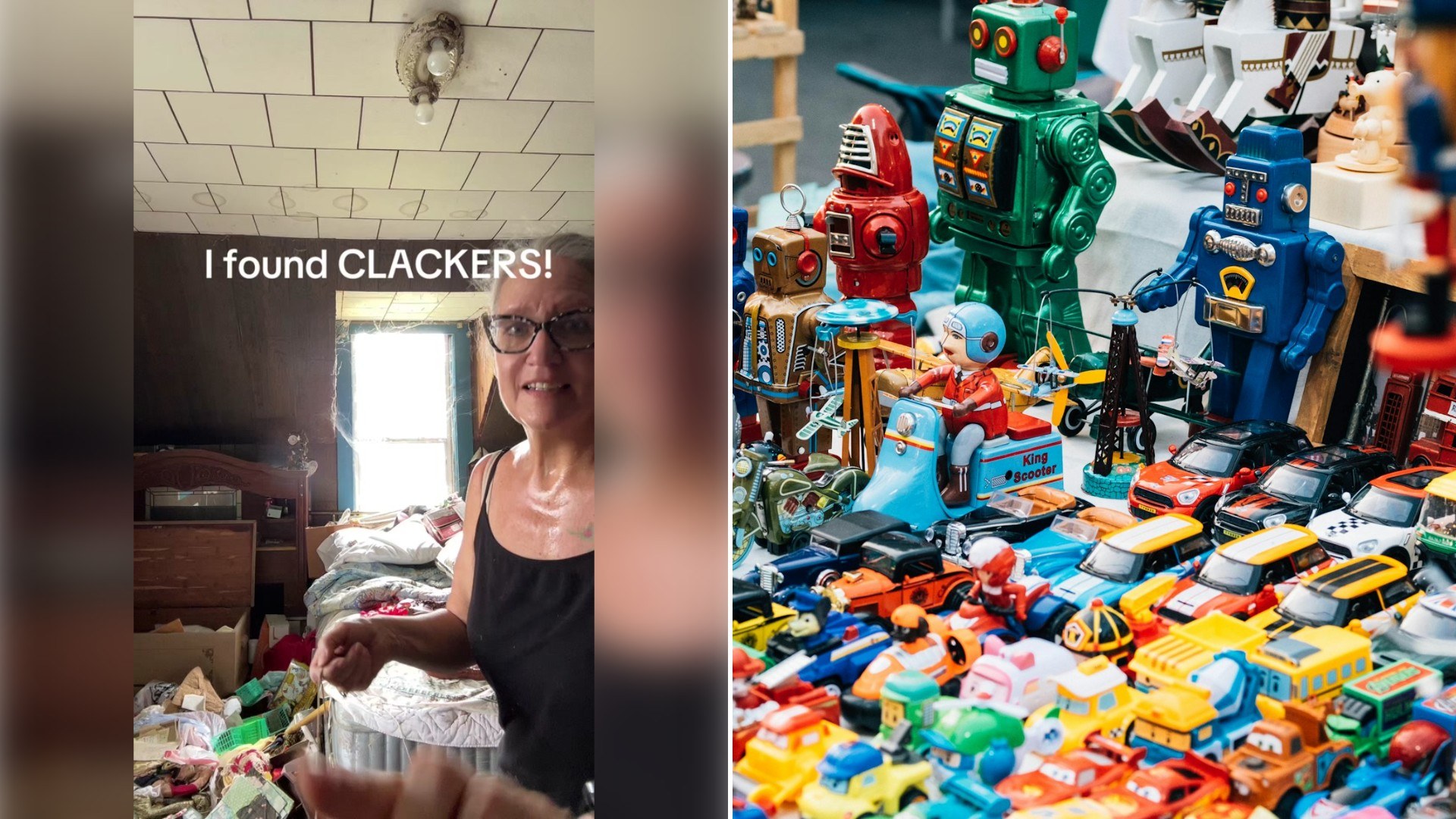
Some toys are remembered as much for their danger as for the fun of playing with them, and few fit that description better than clackers, the once-popular children’s toy made of two hard acrylic balls swung together on a string, which @momma.santi proudly holds up in a video declaring simply, I found CLACKERS. What follows is a genuine demonstration that she can still expertly swing and clack them together, a skill that clearly has not faded despite the toy’s decades out of the mainstream.
Filmed casually, the video leans entirely on the novelty of the rediscovery itself rather than any elaborate production, letting the toy’s own rattling, clacking sound and the creator’s evident skill carry the moment. There is a specific, almost incredulous energy to watching someone confidently demonstrate a toy most viewers will only vaguely remember being warned about.
Clackers enjoyed a brief but intense popularity in the 1970s before safety concerns, largely centered on the acrylic balls shattering or causing injury during vigorous use, led to the toy being pulled from many markets and eventually banned or reformulated in several places. That history is exactly what gives the toy its specific nostalgic charge, remembered not just fondly but almost mythically as the fun toy that was, quite literally, too dangerous to keep selling as originally designed.
Rediscovering a genuinely banned or restricted toy carries a different kind of nostalgic thrill than an ordinary vintage find, tapping into a slightly rebellious, forbidden-fruit quality that safer toys from the same era simply do not carry.
Part of what makes clackers such a distinctive entry in toy history is how directly physical the danger actually was, rather than some abstract regulatory concern applied after the fact. The toy required real force and rhythm to operate properly, swinging the two balls together and apart in a steady arcing motion, and that same physical intensity is exactly what occasionally caused the acrylic to shatter under repeated impact, sending sharp fragments flying toward the user’s hands, face, or eyes. Knowing that history adds real tension to watching someone swing an original set confidently on camera decades later, since the risk being casually demonstrated was never hypothetical.
The specific skill on display here also deserves real credit, since clacking two hard balls together in a smooth, controlled rhythm is a genuinely difficult physical motion to master, one that takes real practice and muscle memory to get right without simply mashing the balls together arrhythmically. Watching someone execute that motion confidently and immediately, with apparently no rustiness despite presumably not having practiced in years, suggests either a childhood spent genuinely mastering the toy or a surprisingly durable kind of physical memory that persists long after conscious practice has stopped.
Banned or discontinued toys occupy a particular, well-documented niche within collecting culture more broadly, prized specifically because their removal from the market makes original, undamaged examples genuinely harder to come by than toys that stayed in continuous production. A collector who tracks down a working, intact set of original clackers is not just finding an old toy; they are finding a specific artifact of a moment when consumer safety regulation and childhood recreation collided in a fairly dramatic, well-remembered way.
There is also something worth saying about how this kind of rediscovery content plays differently depending on the viewer’s own generational relationship to the toy in question. For viewers old enough to have actually owned or been warned about clackers firsthand, a video like this one triggers a very specific, personal memory. For younger viewers with no direct experience of the toy at all, the appeal shifts toward pure novelty and mild disbelief that a children’s toy this straightforwardly risky was ever mainstream in the first place, which is its own kind of entertainment entirely.
It is also worth noting how toy safety standards have evolved dramatically since the clackers era, making a rediscovery like this one function almost as an informal history lesson in how differently childhood recreation used to be regulated. Modern toys marketed to children undergo far more rigorous safety testing than anything from the clackers era ever faced, and encountering a toy this directly, unapologetically risky by today’s standards offers a genuinely useful, tangible sense of just how much that regulatory landscape has shifted over the intervening decades.
The casual, low-production style of the video also fits the subject matter in a way a more polished presentation likely would not. Clackers were never a sleek, premium toy to begin with; they were a loud, simple, slightly chaotic novelty item, and filming the rediscovery with the same unpolished, spontaneous energy honors that original spirit far better than a heavily edited reveal video would. The rattling, imperfect sound of the balls clacking together on camera is, in a real sense, the entire point.
There is also a small but meaningful lesson here about the unpredictable second lives that discontinued or banned products sometimes get decades later, resurfacing not through any official rerelease but through exactly this kind of individual rediscovery, tucked away in a drawer or a childhood storage box and rediscovered essentially by accident. That kind of resurfacing carries a different emotional weight than a modern retro-reissue toy manufactured deliberately to cash in on nostalgia, since it represents a genuinely surviving original rather than a reproduction built for a new generation of buyers.
For fellow collectors of vintage and novelty toys, a find like this one is a reminder that some of the most memorable pieces of childhood nostalgia are the ones that came with an actual warning label, and demonstrating real, retained skill with one only adds to the appeal.

Leave a Reply