

Before there were batteries, infrared beams or a remote buried in the couch cushions, there was a little metal gadget that worked by making a sound nobody in the room could hear. A clip from @ghostincome.hq opens up a television remote from 1956 to show how.
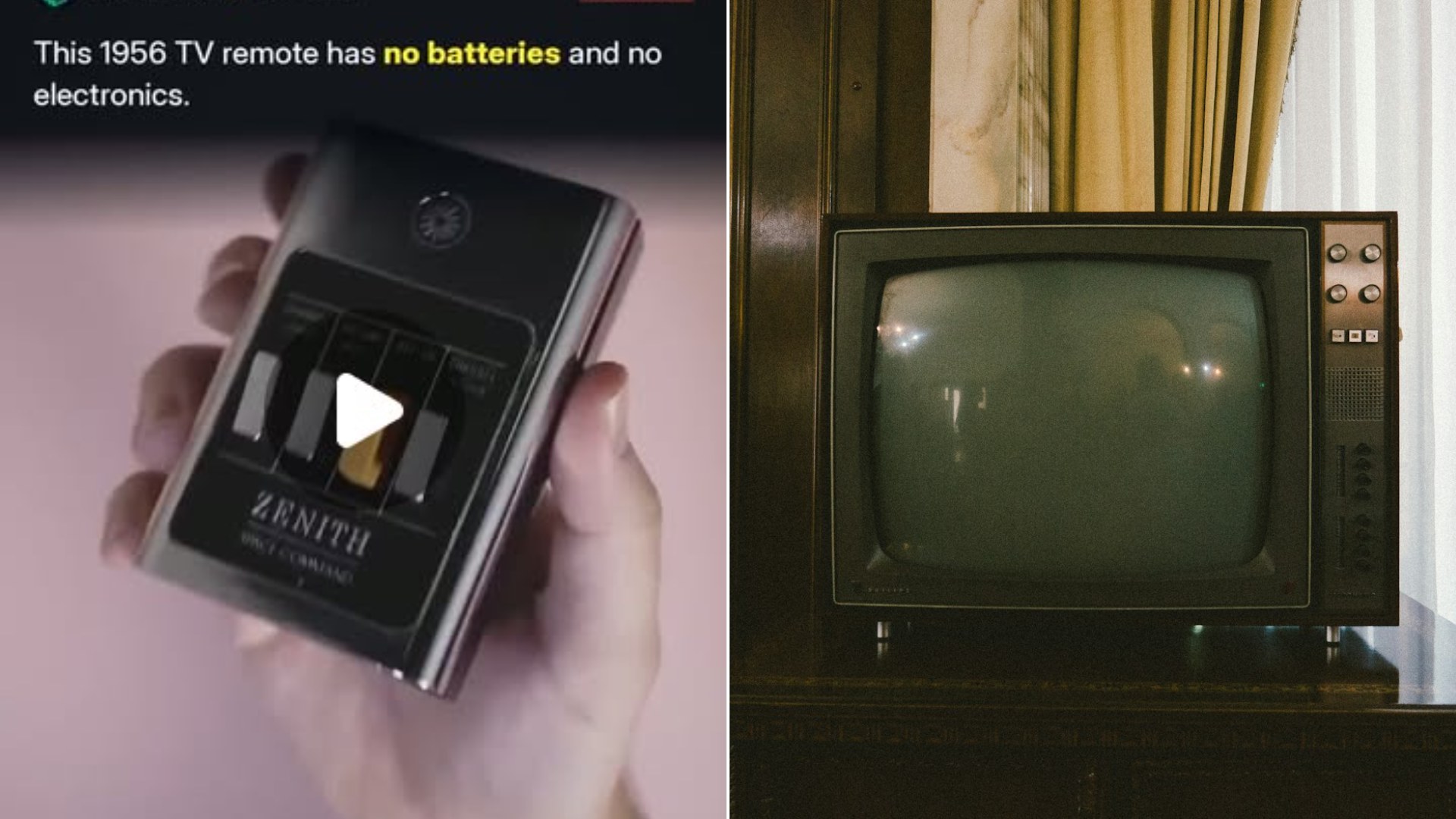
According to the creator, the remote has no batteries, no circuit board and no light of any kind. Open it up and you find four aluminum rods and four tiny hammers. Press a button, and a hammer strikes a rod, and the rod rings. The pitch is too high for people to hear, the creator says around 40,000 cycles a second, but the television was listening for it. The creator adds that 9 million ultrasonic remotes followed before infrared took over.
The Remote That Came Before It
According to Zenith’s own company history of its remotes, the company’s first remote, called Lazy Bones in 1950, was wired to the TV set, and people tripped over the cable. In 1955 came the Flash-Matic, Zenith’s first wireless remote. It used a directional flashlight aimed at photo cells at the corners of the screen, and because it had no protection circuits, sunlight could make the tuner turn on its own.
Enter the Space Command
The remote shown in the video matches the style of the Zenith Space Command, which the same company history says was developed under Dr. Robert Adler, who proposed using ultrasonics. Production began in the fall of 1956. The transmitter held four aluminum rods, each about two and a half inches long and cut to ring at four slightly different frequencies. A spring driven hammer struck each rod, and the rods handled channel up, channel down, sound on and off, and power on and off.
The magic was in the set, not the remote. The television needed six additional vacuum tubes to listen for those sounds, which raised the price of the set by about 30 percent, according to the same history. The company also says more than 9 million ultrasonic remote control TVs were sold during roughly 25 years of the ultrasonic era, which lines up with the figure the creator gives.
The video does not name the brand, so we cannot say for certain which model is in the clip. The creator’s description simply matches this famous design.
If You Come Across One
- Check the markings. Brand names and model numbers are often stamped on the body or underside.
- Look for the rods. Missing or bent rods can make a mechanical remote hard to restore.
- Do not force the buttons. Old springs and hammers can be fragile.
- Keep it dry and away from heat, and handle it gently, since aluminum parts can bend.
- Value depends on the model, condition and whether the matching TV still exists, so compare similar sold listings before paying a premium.
It is a neat reminder that the humble remote started as a bit of clever mechanics. The next time you lose yours, be glad it is not still ringing at 40,000 cycles a second.
More from Vinyl and Velvet
- Her Favorite Thrift Store Went 50 Percent Off, So She Waited On Fenton Cranberry Glass She Passed Days Earlier, And It Paid Off
- She Kept Seeing The Name Dolores On Handmade Pieces All Over A Thrift Store And Pictured The Older Couple Behind Them
- His Great Grandfather’s 1940s Suitcase Record Player Has Built In Speakers, A Radio, And The Cleaner He Used Before Playing His Records

Leave a Reply