

A $14.99 platter that buyers will pay $125 for. A $10 pair of bracelets worth $150 each. A $299 painting that is really worth $1,500. Antiques expert @DrLoriV walked into a thrift store in Montgomeryville, Pennsylvania, and says the most valuable items are the ones other shoppers walk right past.
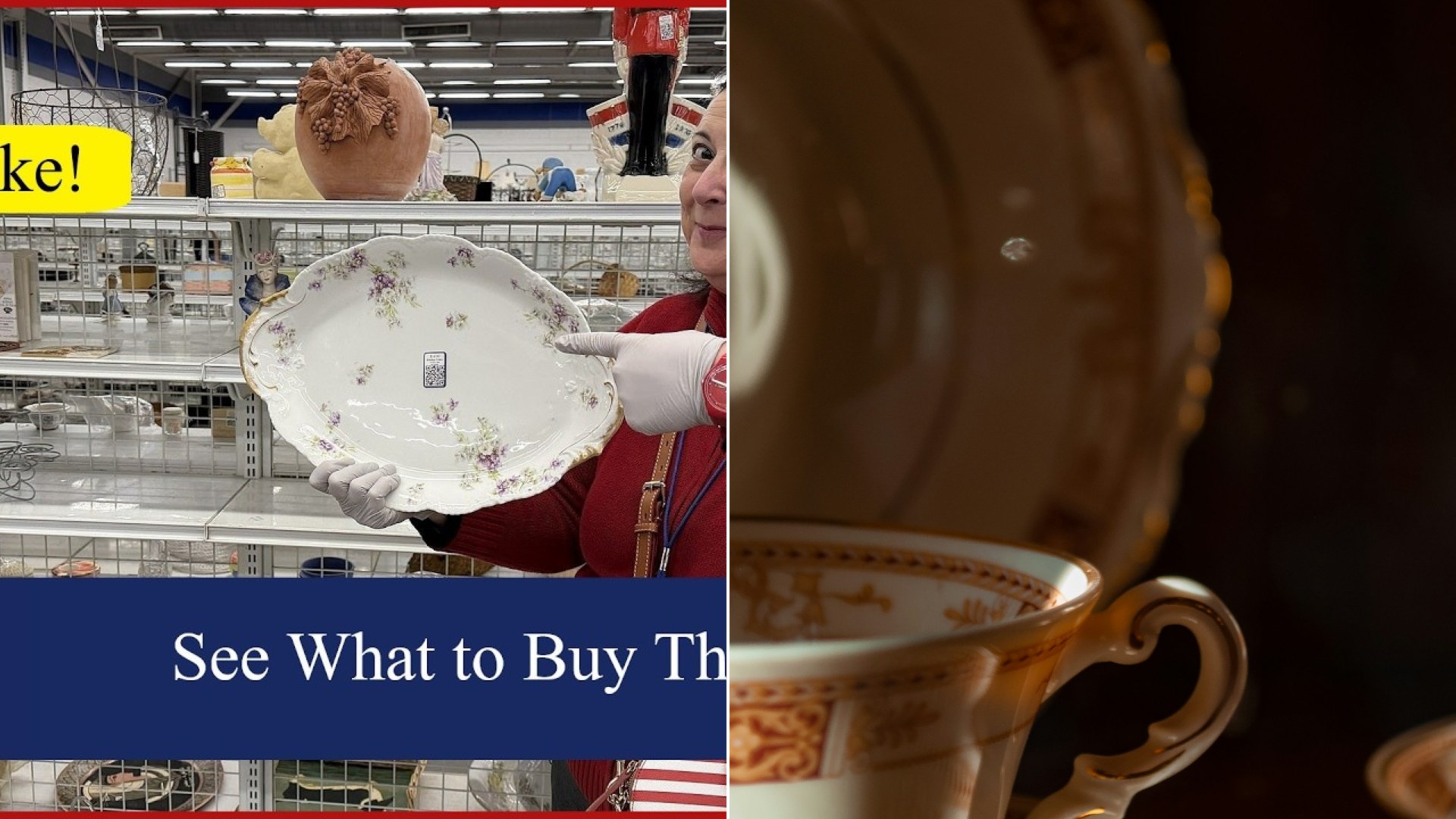
The store was Liberty Ministries, and her plan was the same as always: show what to buy and what to walk by. As she tells it, the secret is knowing what willing buyers pay on the resale market and comparing that with the sticker price. Here are the finds that stood out.
First up was a platter marked Theodore Haviland for Limoges, France. Dr. Lori pointed to a small curve in the gilding that tells you the piece was made in the late 1800s or early 1900s, plus a mark saying “patent applied for,” which also suggests an early piece. The store wanted $14.99. She says buyers pay $125.
Where Shoppers Make Mistakes
Her best lesson came from a painting. Many people assume thrift stores know the value of everything because everybody looks things up. Not so, she says. This piece was signed, and under a loupe you could see actual brush strokes, not the dots you would find in a print. The store had priced it as a print at $299. As an original work of art, she says it brings $1,500. That is why it pays to carry a small magnifier.
The same thing happens in reverse with famous names. A hanging light fixture made of slag glass had the look of a Tiffany lamp, but she explained that Tiffany’s leading is not thick, and this one had thick leading and textured glass. It dated from the 1970s and was priced at $44.99 against a value of about $50, so she walked by.
Another example was a piece of blown glass that most people would mistake for Murano. It was actually made in California, with a different decoration inside and out. The price was $5.99, and she called it a $25 base.
Small Prices, Bigger Payoffs
Several other pieces on her list show how little you sometimes need to spend:
- Two crystal bracelets, $10 for both. She pointed to faceted cut crystals and separator beads she linked to a designer who worked for Coco Chanel in France from roughly the 1930s to 1945. She says each bracelet is worth $150.
- An Austrian porcelain teapot, $9.99. Tiny hand-painted flowers and an “Austria” mark gave it away, along with a painter’s number. Value, $40. Notice the lid was held on with plastic wrap, not tape.
- A quality doll, $9.99. Ceramic hands and belly and glass eyes are what to look for. Value, $40.
- A pair of 1950s lamps with applied roses, $6.99 each. The shades need replacing, but the original finials are why they are valuable. Value, $55 each.
- An Elgin wall regulator clock case in oak, $14.99. Just the case, she said, is worth $75.
- A Tony Stewart NASCAR collectible from 2007 in the original box, $1.99. Worth $15.
- A bistro-style party plate, $1.49. It has a spot for a wine glass stem. A lot of people do not recognize it, and she says it is worth $6.
What She Left on the Shelf
Dr. Lori is just as clear on what to skip. A damaged bone china piece by Adderley was $19.99, and she said it is worth $40 in good condition but would not pay $20 with rose petals missing. A squat American-made jug at $16.99 was worth around $10. A stool with replacement legs at $15 was worth $20, but she noted that without the replacement legs it would be worth $50, so condition and originality matter.
The 50 Year Cycle
One idea from this trip is worth writing down. Dr. Lori talked about a “50-year cycle,” meaning that collectors tend to start hunting for things that are about 50 years old. Right now that points to the 1970s. She picked up unmarked, American-made plates in a colonial American style for 99 cents each, because buyers pay about $4 apiece.
She was honest that $4 does not sound like much after you list, pack and ship it. Her advice is to bundle the item with something else, and to make sure you sell it in the right market, because a piece may bring more on one platform than another.
A Shopping Plan You Can Use Tomorrow
- Bring a loupe and your phone. A loupe shows brush strokes and printing dots. Your phone shows what similar items sold for.
- Check every bottom and back. Marks like “Austria,” “France,” or “patent applied for” help date and place a piece.
- Look at weight and materials. Heavy milk glass with embossed grapes, ceramic parts on a doll, and solid wood all point to quality.
- Do not trust a famous name on a hunch. Learn what the real thing looks like. A thick leading or a missing mark may be the difference.
- Always check condition. Chips, missing petals and replaced parts cut value quickly.
- Remember the full cost. Leave room for cleaning, shipping and your time before you call it a bargain.
Dr. Lori closes by saying she left the treasures there for you. Whether or not they are still on the shelf, next time you stop at a thrift store, look a little closer at the platter in the back and the painting that seems a little too nice. She says someone before you missed it.
More Stories You May Like
- Chunky Plastic Bracelets In A Thrift Store Bin Could Be Bakelite Worth Thousands And A Warm Water Smell Test Can Help You Tell
- Thrifter Who Almost Skipped A Small Town Thrift Store While Driving Through Finds The Vintage Coach Purse She Had Been Waiting For
- Yard Sale Seller Priced Everything At 50 Cents Including A 1990s Little Caesars Jacket From His Days Working There, And One Shopper Says Finds Like It Are Out There

Leave a Reply