

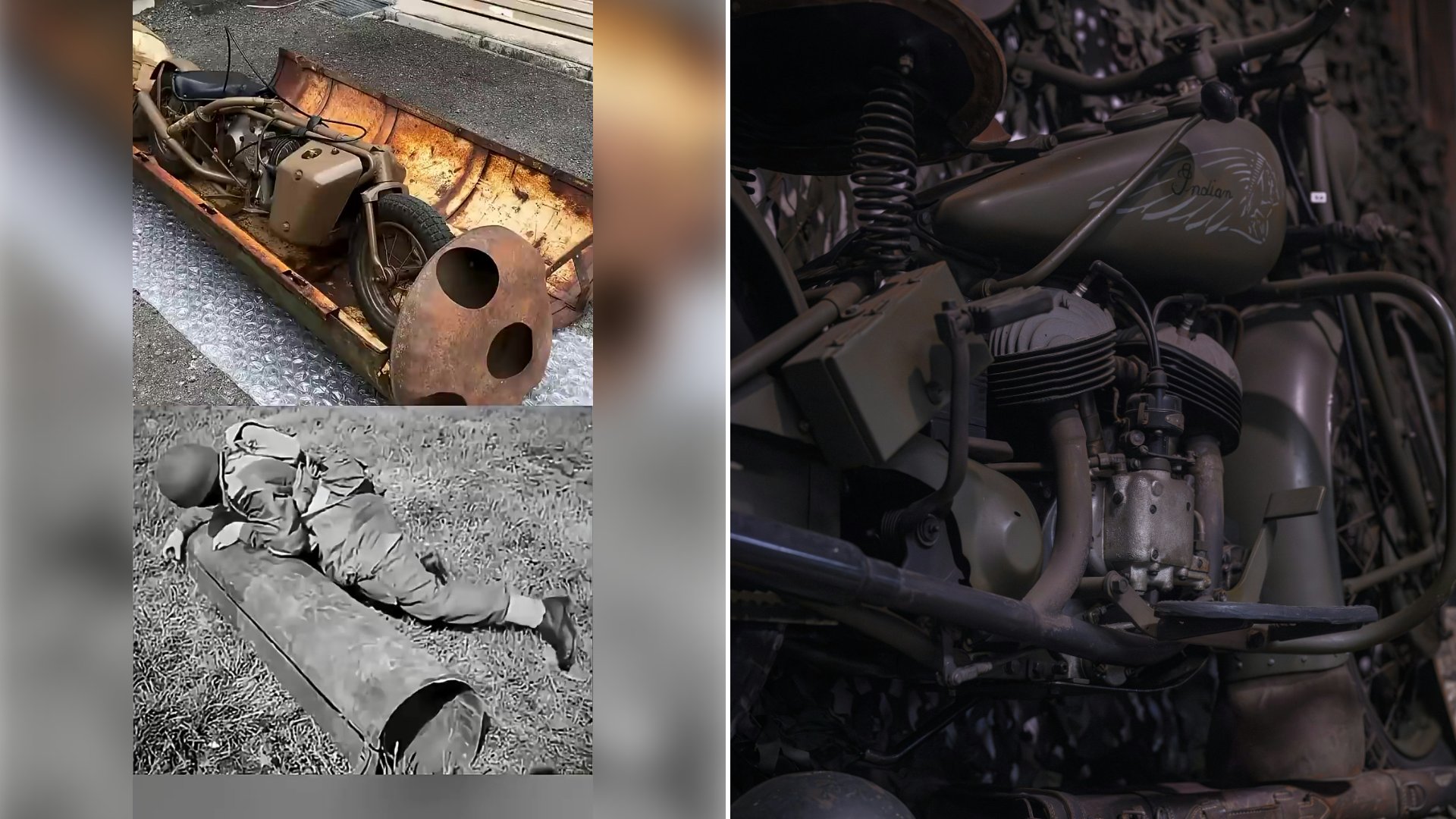
A split-screen video from the account 55(WAHIN) pairs grainy black-and-white WWII footage of a British paratrooper crawling out of a parachute-dropped canister next to a small folding motorcycle with modern footage of a rusted, decades-old example of that same machine sitting on a driveway. The caption identifies it simply as “Welbike (1942–1945 moped,” and the clip has pulled in 52,200 likes, 184 comments, and more than 5,200 saves from viewers who had clearly never heard of the thing before.
@boss55.1 Welbike (1942–1945 moped #keşfet
The Welbike was exactly as strange as the footage suggests. Developed by the British Special Operations Executive and manufactured by Excelsior Motor Company starting in 1942, it was built around one single, specific problem: paratroopers who landed behind enemy lines had no transportation once they hit the ground, and running on foot across unfamiliar territory was slow and dangerous. The solution was a motorcycle small and light enough to be packed inside a metal airdrop container roughly the size of a large drum, parachuted down alongside the soldiers, and assembled in under a minute once it landed.
To fit inside that canister, the Welbike had to be stripped down to almost nothing. It weighed about 70 pounds, had no suspension, a tiny 98cc two-stroke engine, and a seat and handlebars that folded flat for storage, which is exactly the compact, collapsed shape visible in the rusted frame shown in the video. Top speed was roughly 30 miles per hour, and the fuel tank held barely enough for 90 miles of riding, which was the whole point: this was never meant to be a soldier’s long-term ride, just a way to cover a few crucial miles immediately after landing.
In practice, the Welbike turned out to be better in theory than on the battlefield. Its complete lack of suspension and painfully low ground clearance made it nearly useless on the rough, uneven terrain paratroopers typically landed on, and relatively few of the roughly 3,800 units built ever saw the dramatic combat drops they were designed for. Most of its documented use ended up being far less glamorous — ferrying messages and personnel around military bases and depots in Britain rather than being parachuted behind enemy lines. Even so, it remains one of the more inventive oddities to come out of wartime engineering: a motorcycle designed from the ground up to be thrown out of an airplane.
Commenters leaned hard into the contrast between the gritty rusted original and how recognizable the basic idea still is. One person joked that it looked like a “WW2 Kukirin G4,” referencing the folding electric mopeds sold online today, and the comparison landed because it’s not wrong — the Welbike’s folding-frame, minimal-everything approach to a two-wheeled runabout is essentially the same engineering problem that budget folding e-bikes are still solving eight decades later. Others asked whether the rusted example in the clip was an original wartime survivor or a later reproduction, a detail the video itself does not specify.
Either way, the pairing of real archival footage with a weathered, surviving example of the machine is a rare combination. Most WWII oddities online are either pure historical footage or a modern restoration with no context attached — seeing both side by side, with the actual folding mechanism and engine visible in daylight, makes it much easier to understand exactly how a device this small was ever expected to carry a soldier anywhere.

Leave a Reply