

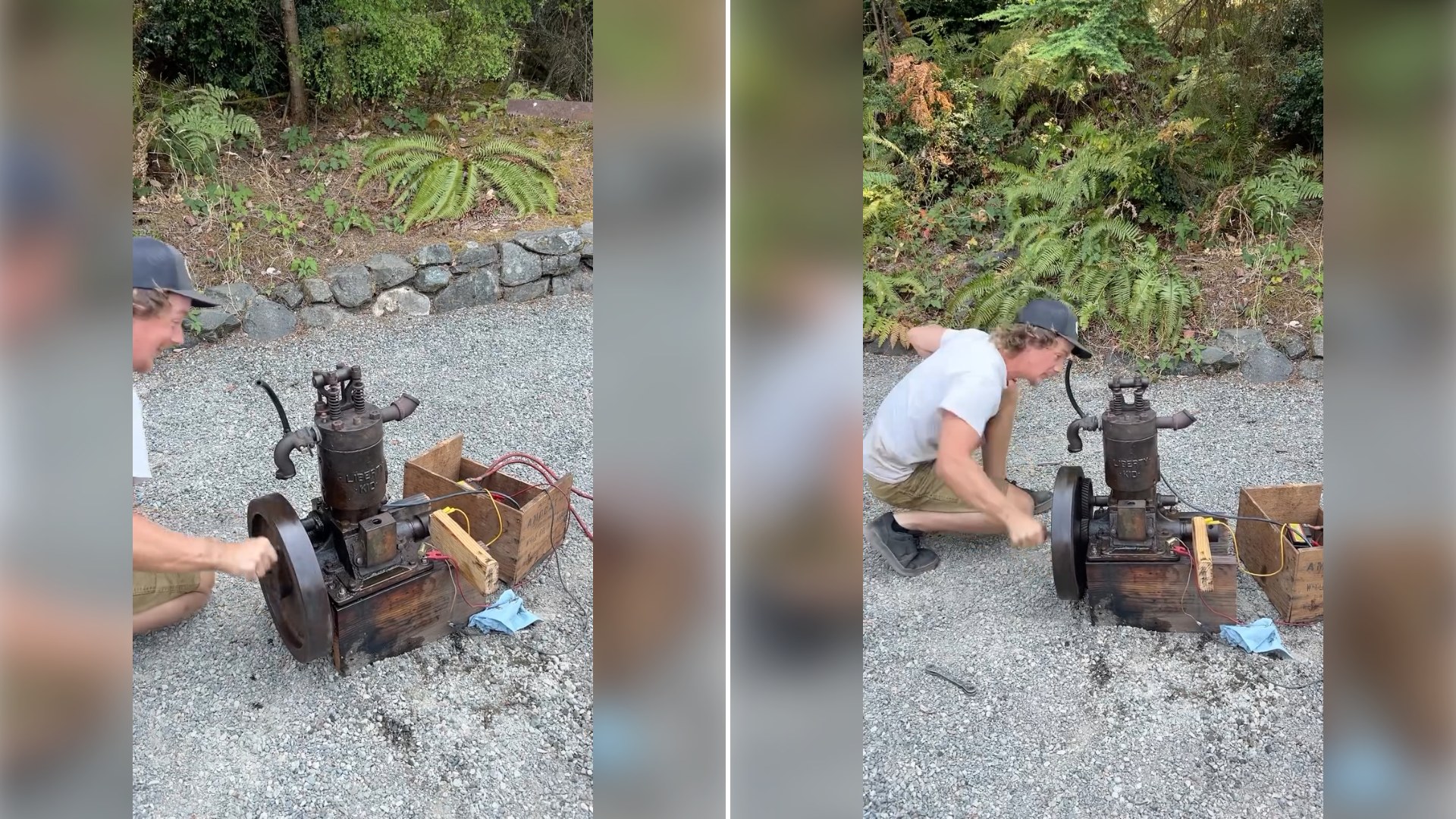
Few restoration projects test patience quite like freeing a decades-seized engine, and creator @the_barn_brothers documents exactly that grueling, satisfying process in a recent Instagram reel, slowly coaxing a 1920s stationary engine back to life through repeated hand-cranking, careful troubleshooting, and the kind of mechanical persistence that separates serious restorers from casual tinkerers.
Stationary engines represent a genuinely fascinating and often overlooked chapter of early twentieth-century mechanical history, having powered everything from farm equipment to water pumps to small-scale industrial machinery before electrification became widespread across rural America. These engines, typically fueled by gasoline, kerosene, or even natural gas, were built to run continuously at a single location performing a specific repetitive task, a design philosophy entirely distinct from the mobile, variable-load engines found in automobiles of the same era.
Freeing a seized engine that’s sat dormant for a century presents a genuinely daunting mechanical challenge, since decades of rust, hardened old oil, and corrosion can essentially weld internal components together, requiring patient, methodical intervention rather than brute force, which risks permanently damaging irreplaceable original parts. Restorers typically rely on penetrating oil applied repeatedly over extended periods, combined with careful, incremental hand-cranking to gradually work components loose without forcing anything that might crack or shatter under too much sudden pressure.
What makes this kind of restoration content so compelling to watch is the genuine uncertainty embedded in the entire process. Unlike restoring a more common vehicle or appliance with readily available parts and established repair procedures, bringing a century-old stationary engine back to functional life often requires real mechanical improvisation, since replacement parts for machines this old and this specific are frequently unavailable, forcing restorers to repair, fabricate, or creatively adapt components rather than simply ordering a replacement.
The antique and vintage engine restoration community has grown into a genuinely devoted hobbyist movement over recent decades, with dedicated collectors, swap meets, and even organized engine shows specifically celebrating these once-ubiquitous but now largely forgotten machines. For enthusiasts within this community, successfully reviving a seized engine represents not just a mechanical achievement but a genuine act of historical preservation, keeping functioning examples of early industrial technology alive for future generations to study and appreciate firsthand.
There’s also something deeply satisfying about the sheer physicality and visible effort documented in content like this one. Unlike modern engine troubleshooting, which often involves diagnostic computers and sealed, inaccessible components, a vintage stationary engine’s mechanical workings are fully visible and comprehensible to a patient observer, making the restoration process genuinely educational for viewers curious about basic mechanical principles that modern, more complex machinery tends to obscure behind layers of electronic control and sealed housing.
This kind of restoration content has found a substantial and devoted online audience, part of a broader fascination with watching patient, skilled work gradually solve a genuinely difficult problem. The appeal lies not in instant gratification but in the slow accumulation of small progress, each crank of the handle and each successful loosening of a stuck component building toward an eventual, hard-earned payoff when the engine finally runs again.
It’s also worth noting how projects like this one serve an important documentary function, preserving not just the physical machines themselves but the specific restoration knowledge and troubleshooting techniques required to bring them back to life. As fewer people retain hands-on experience with this kind of early mechanical technology, video documentation of successful restorations becomes an increasingly valuable resource for future restorers facing similar challenges.
Ultimately, @the_barn_brothers’s patient restoration work succeeds because it respects the genuine difficulty and uncertainty of the process rather than editing it down to a quick, effortless transformation. Watching a century-old engine slowly, stubbornly come back to life through careful persistence offers a genuinely satisfying reminder that some of the most rewarding mechanical achievements require real patience rather than quick fixes.

Leave a Reply