

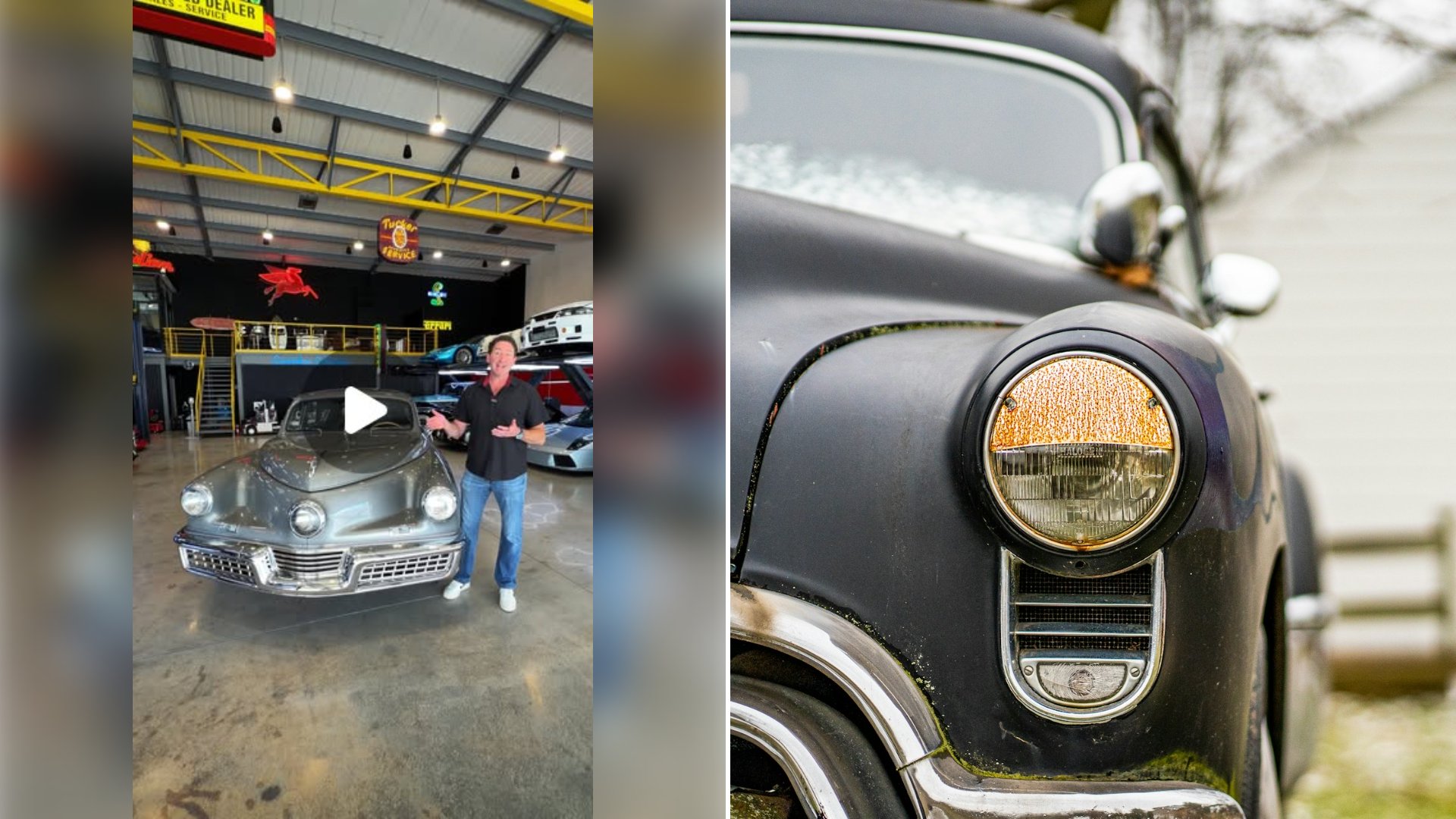
Most car tours point out leather seats and sound systems. This one points out a rear mounted engine that traces its design back to a helicopter, a third headlight mounted dead center that swivels with the steering wheel, and a gear shift lever built into the steering column specifically so the driver never has to let go of the wheel to change gears. The car is a 1948 Tucker, and the collector walking through it clearly understands he is standing next to one of the strangest and rarest automobiles ever sold to the American public.
The tour, shared by @avantsofficial, moves through the car’s unusual engineering piece by piece rather than treating it as a single novelty. Each feature gets its own explanation, building a picture of a car that was not just styled differently from its competitors but was genuinely engineered on a different set of assumptions about what a car should do.
The Tucker’s backstory is one of the most dramatic in American automotive history. Entrepreneur Preston Tucker founded the Tucker Corporation after World War II with the goal of building a genuinely revolutionary car, packed with safety and engineering features well ahead of what Detroit’s big three were offering at the time. The production car, officially the Tucker 48, used a rear mounted six cylinder engine that Tucker’s company adapted from a design originally developed for helicopter use, a highly unconventional choice that gave the car a distinctive low, flat profile. The third headlight, nicknamed the Cyclops eye, was mounted in the center of the front end and turned in sync with the steering wheel to illuminate the road around corners, decades before swiveling headlight technology became a feature automakers advertised again. The column mounted gear shift paired with a pre selector transmission system let drivers select a gear in advance and engage it with a simple lever movement, meaning a driver genuinely could shift without removing a hand from the wheel, exactly as the tour points out.
The company’s story ended almost as quickly as it began. Tucker’s ambitious plans attracted intense scrutiny, including a Securities and Exchange Commission investigation and stock fraud allegations that effectively destroyed the company’s ability to raise further capital, and production shut down in 1949 after only a small number of cars were completed. Most sources place the total number of Tucker 48 automobiles built at fifty one, and of those, the commonly cited surviving count today is around forty seven, making it one of the rarest production cars in American history relative to its original intended scale. Tucker himself was ultimately acquitted of the fraud charges, but by then the company itself was already finished, turning every surviving Tucker 48 into a physical artifact of one of the most notorious failed ventures in car manufacturing.
That rarity, combined with genuinely forward thinking engineering that predated features other automakers would not widely adopt for years, is exactly why a Tucker commands this level of reverence from collectors and casual viewers alike. It is not simply an old car. It is a nearly extinct physical record of what one company tried to build before regulators, investors, and bad timing combined to shut it down. Seeing one in person, let alone getting a detailed walkaround of its most unusual features, is the kind of moment that makes an in depth car tour worth watching start to finish.
More from Vinyl and Velvet
- A Rare 1948 Tucker 48 Surfaces Online With a Helicopter-Derived Engine, Three Headlights, and Six Exhaust Tips, and the Creator Says It Was Preston Tucker’s Own Personal Car
- A Restorer in Belgium Pulls Open a Vine-Covered Barn Door and Reveals a 1971 Citroën DS21 Pallas That Had Been Hidden Since 2005, and Commenters Call the ‘Goddess’ the Most Beautiful Car Ever Built
- Builder Installs a 30 Year Old Billet Steel Crankshaft His Grandfather Ground as Surplus From NASCAR Powerhouse Robert Yates Racing Into a 1965 Mustang Build Aiming for 650 Horsepower

Leave a Reply