

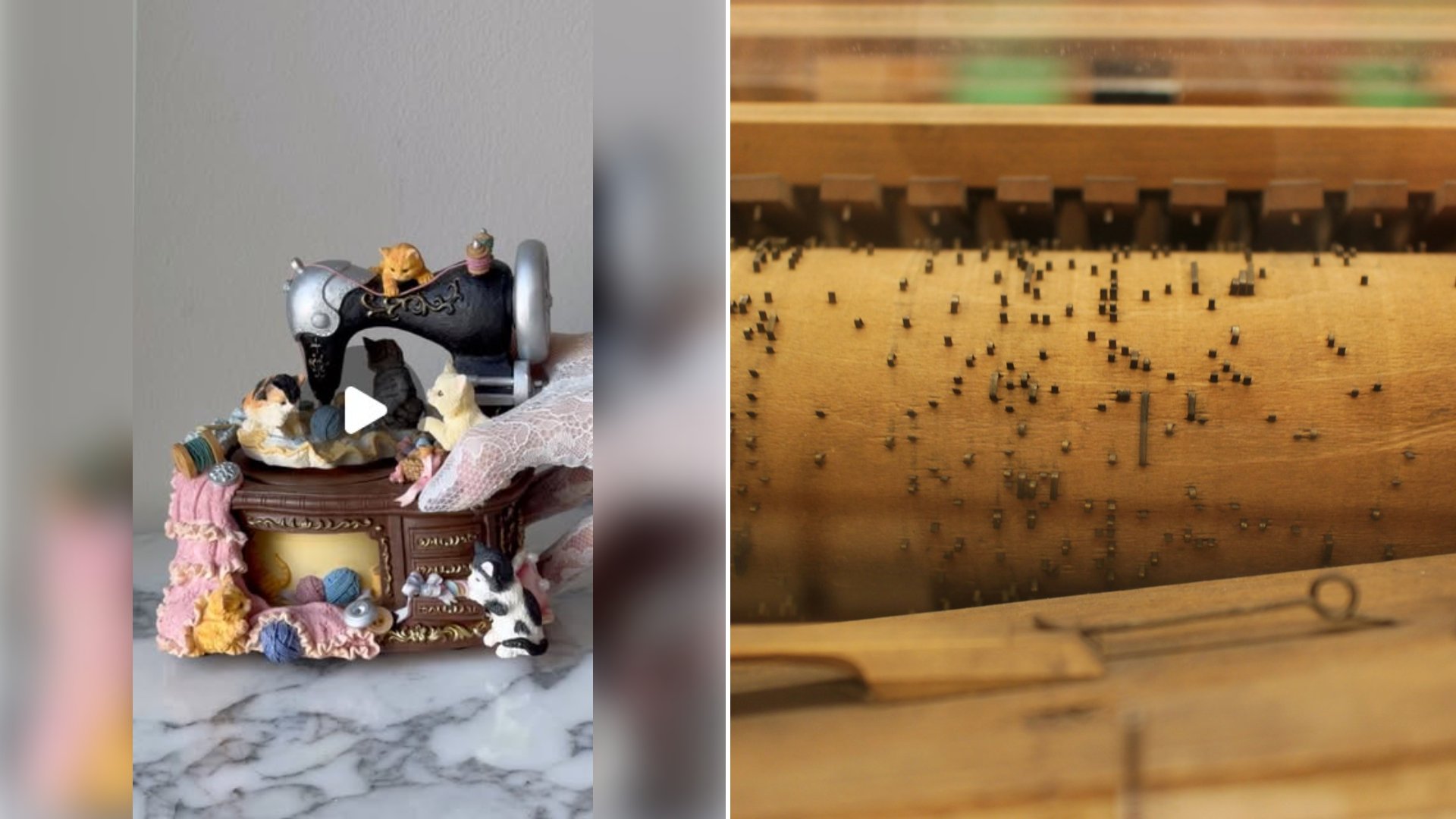
@estatesaleedit filmed a vintage animated music box shaped like a miniature sewing room, complete with a tiny table, sewing supplies, and a handful of cats posed around the scene. The moment the key turns and the mechanism engages, the whole thing comes alive at once, tiny figures rotating and bobbing in time with a plinking music box melody, each cat animated with its own small, repeating motion. It’s the kind of object that looks charming sitting still on a shelf and genuinely impressive once it’s actually running.
@estatesaleedit shows the piece up close, holding steady on the moving parts long enough to let viewers actually track how many separate motions are happening inside a scene that’s barely larger than a shoebox. There’s no single obvious gimmick driving it, instead it’s several small, coordinated movements running off of one wound mechanism, the kind of layered engineering that’s easy to underestimate until you watch all of it happening together in real time.
Animated music boxes like this one belong to a specific tradition of mechanical novelty items that became especially popular through the middle decades of the twentieth century, particularly pieces made in Japan and exported widely to American and European markets from the 1950s through the 1970s. These were more elaborate than a standard music box, which simply plays a tune when wound, because they paired a music movement with a secondary mechanism, usually a rotating cam or a series of small gears, that translated the motor’s turning into separate, timed movements for each figure in the scene. Building a music box like this one meant designing figures, a music mechanism, and a motion mechanism to all work in sync inside a housing small enough to sit on a shelf, which is a meaningfully more complicated manufacturing job than a plain music box ever required.
That complexity is exactly why surviving examples in full working order, like this one, are genuinely valued by collectors of mechanical antiques and music boxes specifically. The moving parts inside these pieces are delicate, often built from small metal gears, thin wire connectors, and fabric or composition figures that degrade over decades of handling, dust, and temperature changes. A piece that still winds smoothly and animates every figure correctly after fifty or more years means the original mechanism survived intact, without a key component seizing, snapping, or being lost, which is a meaningfully harder bar to clear than simply looking good sitting still on a shelf.
Part of what makes this particular video so watchable is scale. The entire sewing room scene fits comfortably in two hands, and yet it manages to pack in a level of detail and motion that would be impressive even on a larger, more modern animatronic display. There’s something inherently satisfying about watching precision engineering operate at a tiny scale, every gear and cam doing exactly what it was built to do, decades after whoever assembled it by hand finished the job. It’s a reminder that genuinely intricate craftsmanship doesn’t require size to be impressive, sometimes it’s more impressive because of how small it manages to stay.
More from Vinyl and Velvet
- Son Posts Daily Videos of His Father’s Hand Sculpted Winnie the Pooh Collectible Made for The Bradford Exchange in Hopes of Helping Him Finally Retire, and Pooh’s Own Voice Actor Shows Up to Comment
- Spy Museum Exhibitions Coordinator Plays a Modern Recreation of a Soviet Bone Record, Led Zeppelin on Somebody’s Rib X Ray With the Center Hole Burned Through by a Lit Cigarette
- Estate Sale Shopper Says She Leaves Every Estate Sale With a Little Trinket and This Time the Trinket Is a Red Stained Glass Koi Fish Lamp She Cradles in Her Arms

Leave a Reply