

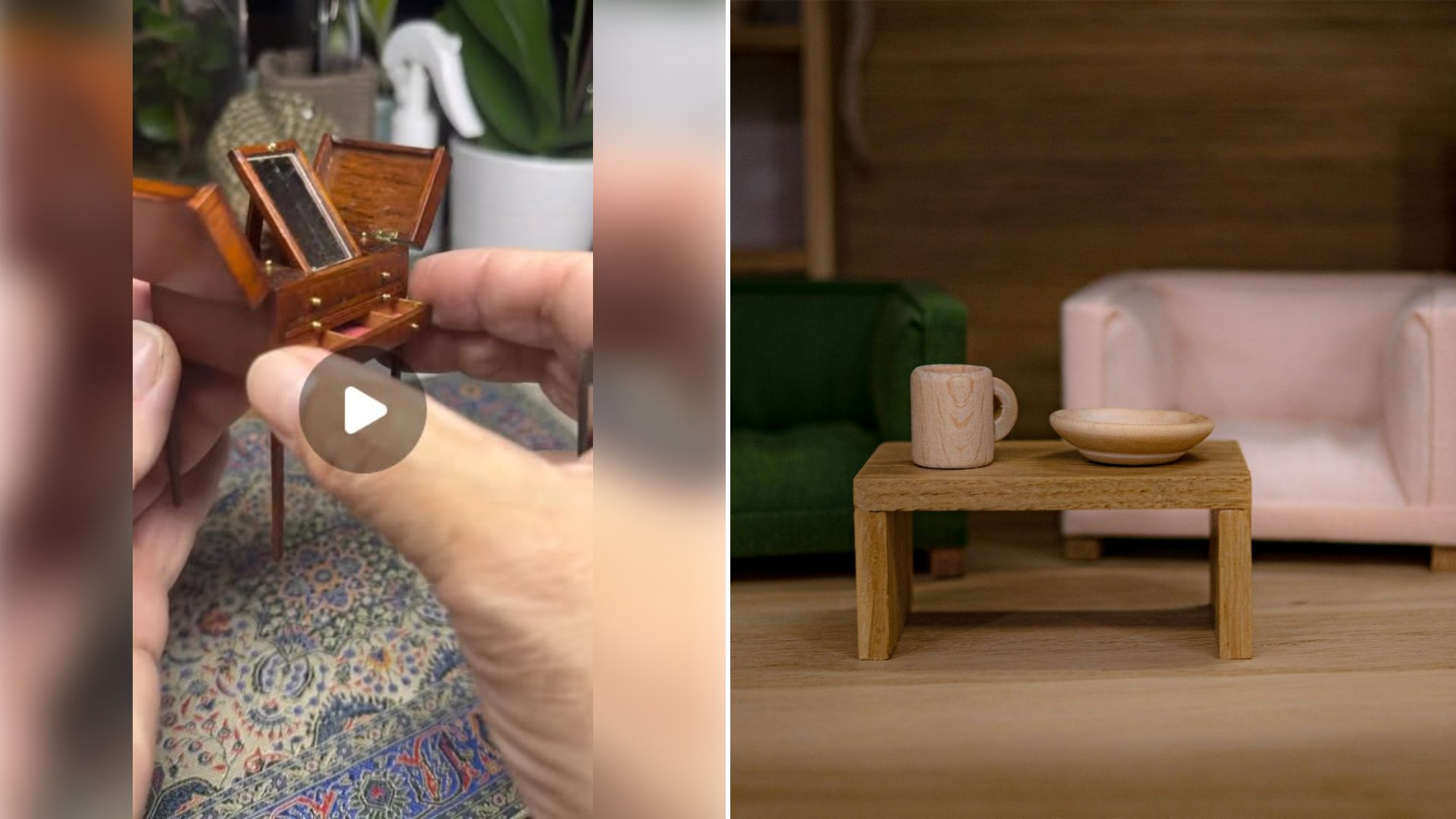
Most people picture dollhouse furniture as simple and static, little more than decorative shapes meant to be looked at rather than used. Miniaturist @dthomasminiatures shows exactly why that assumption falls apart once you see real miniature craftsmanship in motion. The piece at the center of this video is a tiny antique vanity cabinet, scaled down to dollhouse size but built with a working opening mechanism that would not be out of place on a full-sized piece of fine furniture.
Watching the cabinet open is the entire appeal of the clip. Small hinges, drawers, and compartments move in sequence, and the whole thing operates with a kind of mechanical confidence that is genuinely surprising at that scale. This is not a glued-together prop built for a single photograph. It is a functioning piece of furniture built small, which is a completely different and far more demanding discipline than it sounds like at first glance.
Dollhouse and miniature furniture making is a far older and more serious craft than most casual collectors realize. The tradition traces back centuries, to elaborate cabinet houses commissioned by European nobility that were built as status pieces rather than toys, filled with miniature furnishings made by the same guild craftsmen who built full-sized pieces for wealthy households. That lineage still shapes the top end of the hobby today. Serious miniature furniture makers work at roughly one-twelfth scale, the standard used across most of the dollhouse world, which means every joint, hinge, and drawer has to be engineered and cut at a fraction of its normal size while still functioning the way the full-sized version would.
That combination of scale and function is exactly what separates a true miniature from a simple model. A model can be carved, cast, or 3D printed to look right from a distance. A functioning miniature has to actually work, with hinges that swing freely, drawers that slide on tiny runners, and locking mechanisms that engage the way they would on a real piece of furniture. Craftsmen who specialize in this level of detail often spend dozens of hours on a single piece, and collectors who buy at the high end of the hobby are paying specifically for that functionality, not just the appearance of age or craftsmanship.
Estate auctions have become one of the more reliable places to find pieces like this changing hands, since serious miniature collections tend to get built up over decades and then liquidated all at once when a collector downsizes or passes a collection on. A piece built by a known maker and backed by any documented provenance carries real weight in that market, the same way a signed piece of full-sized antique furniture does. Collectors specifically seek out named makers because, as in most collecting categories, a recognizable name attached to a well-documented piece tends to hold and grow its value far more reliably than an unsigned, unattributed one.
What makes this particular video so watchable is how it upends the usual assumption about miniatures. Most people who have never been exposed to the high end of the hobby assume dollhouse furniture is static and decorative by definition. A piece like this proves that is only true of the mass-produced end of the market. At the level this craftsman is working at, miniature furniture making is closer to precision engineering than craft decoration, and an upcoming auction full of collectors circling a single cabinet is a pretty clear sign of just how seriously that end of the hobby takes itself.
More from Vinyl and Velvet
- An Antique Warehouse Tour Reveals a Working Miniature Salesman’s Sample Barber Chair and a Mystery Object Several Commenters Swear Looks Like a Bazooka
- Thrifter Lifts a Wooden Chair Off the Shelf, Flips the Seat Back Forward, and Realizes Mid-Reaction That the Whole Piece Unfolds Into a Four Step Library Ladder
- Antiques Dealer Opens a Wooden Chest Holding 764 Pieces of Gorham Sterling Made for a Table of 18, With Separate Forks for Oysters, Strawberries and Even Ice Cream

Leave a Reply