

Two jars of jewelry, sold sealed and unsorted at a thrift store, cost the reseller behind @h_media_ exactly $120. Nobody at the register knew what was inside, and neither did the buyer. That is the whole gamble of a mystery jar.
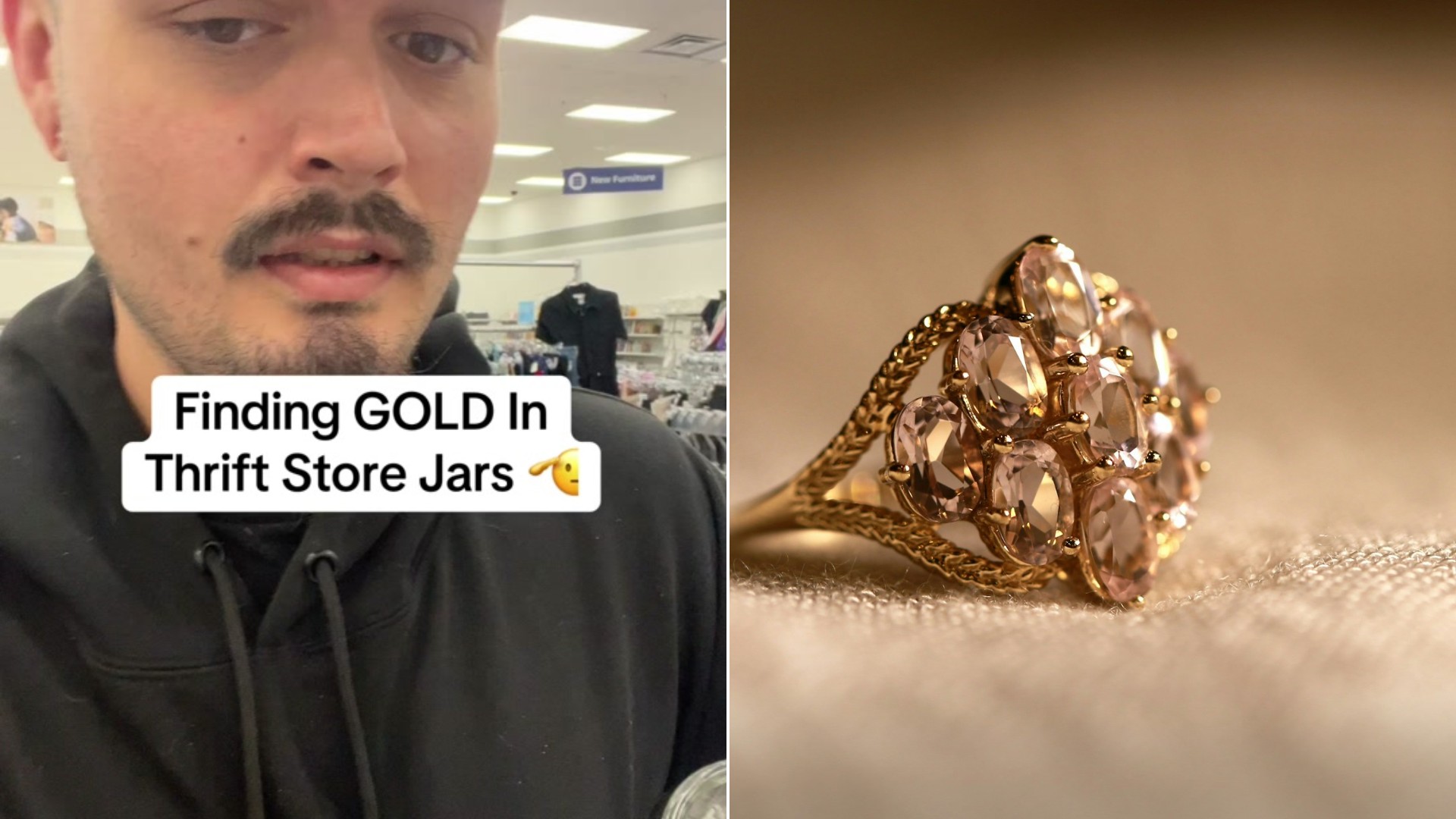
“We just grab these two jewelry jars for 120 bucks,” the reseller says, then promises to head home and dig through the contents. A few things visible through the glass had already caught an eye.
Through the side of the jar the reseller could make out a bracelet that “looks really cool,” a second bracelet hiding behind it that seemed to have jade on it, a decent strand of pearls and a pin sitting at the bottom. It was enough to justify the price, but a jar always hides more than it shows.
@h_media_
The Magnet Test That Sorts Treasure From Bulk
Before anything else, the reseller runs every piece past a magnet. Anything the magnet grabs goes straight into the bulk pile. Anything it ignores gets a closer look.
That one simple step is how a pile of costume jewelry gets cut down to the pieces worth real attention. Precious metals such as gold and sterling silver are not magnetic, so a piece that clings to the magnet is almost certainly base metal underneath.
Out of the first jar came a “really cool” Elgin pocket watch and a Fossil watch. There was also a lampwork glass bracelet and a pin that was not magnetic, which meant it needed testing before anyone could say what it was.
“We Have Our First Piece Of Gold” After The Acid Test
Next came a bracelet that looked interesting but proved to be 10 carat gold filled. Several other pieces were not magnetic and carried sterling silver marks, so those went into the keep pile for a closer look.
Then came the moment every jar buyer hopes for. The reseller applies acid to a ring, watches the result and announces, “All right, we have our first piece of gold.” The acid test confirmed a 14 carat ring, which the reseller calls beautiful.
The ring weighs about two grams, and the reseller adds that the pile of sterling silver comes to roughly 16 grams. Weight matters because silver and gold are often priced by the gram when they are sold for scrap, so a jar full of sterling pieces adds up faster than it looks.
Watches, Cameos, Chains And A Rack Full Of Earrings
The jars kept giving. There was a bunch of watches, among them a gold filled Elgin, and four small pieces with a little cameo detail that the reseller was not sure about. There was also an 18 carat gold filled chain, plus a pile of sterling silver.
The reseller also filled an earring rack with little stud earrings, a bunch of which went into the bulk pile to be sorted later. Not every piece in a jar is a star, but the small pieces still add up when they are sold in lots.
The reseller sums it up as “a really cool find” before moving on to the piece that closes the video.
The Stainless Steel Band That Sells For $250 To $300
At the bottom of the haul sat a band marked “Supreme Ion” on stainless steel. The reseller turns it over and says it just looks so cool.
The reseller explains that Supreme Ion is a negative ion energy band, and that these bands sell for $250 to $300. That single piece, according to the reseller, is worth more than twice what the two jars cost together.
Put the 14 carat ring, the gold filled watch and chain, the sterling silver and the band together, and the $120 gamble looks like a very good day at the thrift store.
How To Sort A Mystery Jar Like A Pro
Mystery jars and bags are sold at many thrift stores, and the odds are never guaranteed. Still, the method used in this video is worth borrowing if you ever take a chance on one.
Start with a magnet. It is cheap, it takes seconds and it clears out a lot of costume pieces in one pass. Anything that is not magnetic gets set aside, and that pile is where the interesting things hide.
Look for stamps and hallmarks on every piece. Marks such as “sterling,” “925,” “10K,” “14K” or “GF” for gold filled tell you a lot. Use a loupe or a magnifying glass, because the marks are often tiny and worn.
Do not trust a color. Plenty of brass and plated pieces look like gold, and plenty of real silver looks dull. Gold filled and gold plated are not the same as solid gold, and the prices are very different, so know which one you are holding.
Use an acid test kit for gold, as the reseller does, and follow the directions on the kit. Test on a spot that will not be seen, since acid can leave a mark.
Weigh what you find. A small kitchen scale that reads in grams helps you work out what a pile of sterling or gold is worth as scrap if the pieces turn out to have no collector value.
Finally, check watches and unusual branded pieces against recently sold listings, not asking prices. A sold price shows what a buyer really paid, while an asking price is only a hope.
Is A Mystery Jar Worth The Money?
It depends on the jar and on the day. Some jars are full of costume pieces that never earn back the price, and others hold the kind of surprise this reseller pulled out. The more you know about marks and metals, the better your odds.
The reseller calls the result a “NICE surprise,” and the numbers back that up. A $120 spend turned up a 14 carat ring, 10 carat and 18 carat gold filled pieces, about 16 grams of sterling silver, a pocket watch and a band that sells for $250 to $300.
If you try your own, set a budget you can afford to lose, bring a magnet and a loupe, and sort slowly. The best finds are often sitting at the very bottom of the jar.
More Stories You May Like
- Thrifters Spend $100 On Two Mystery Jewelry Jars At The Thrift Store And Pull Out 10 Karat Gold, 14 Karat Gold And Sterling Silver Worth About $445 Before The Stones Are Even Tested
- Collector Pays International Shipping And Duties For A Box Of Brand New 1990s Halloween Decor From A Canadian Store That Does Not Ship, Including A $1.49 Skeleton And $5 Shaking Ghosts
- Restored Honus Wagner T206 Card Sells For $1,982,500 While A WWE Title Belt Worn By Four Different Wrestlers Brings $716,750 At Heritage

Leave a Reply