

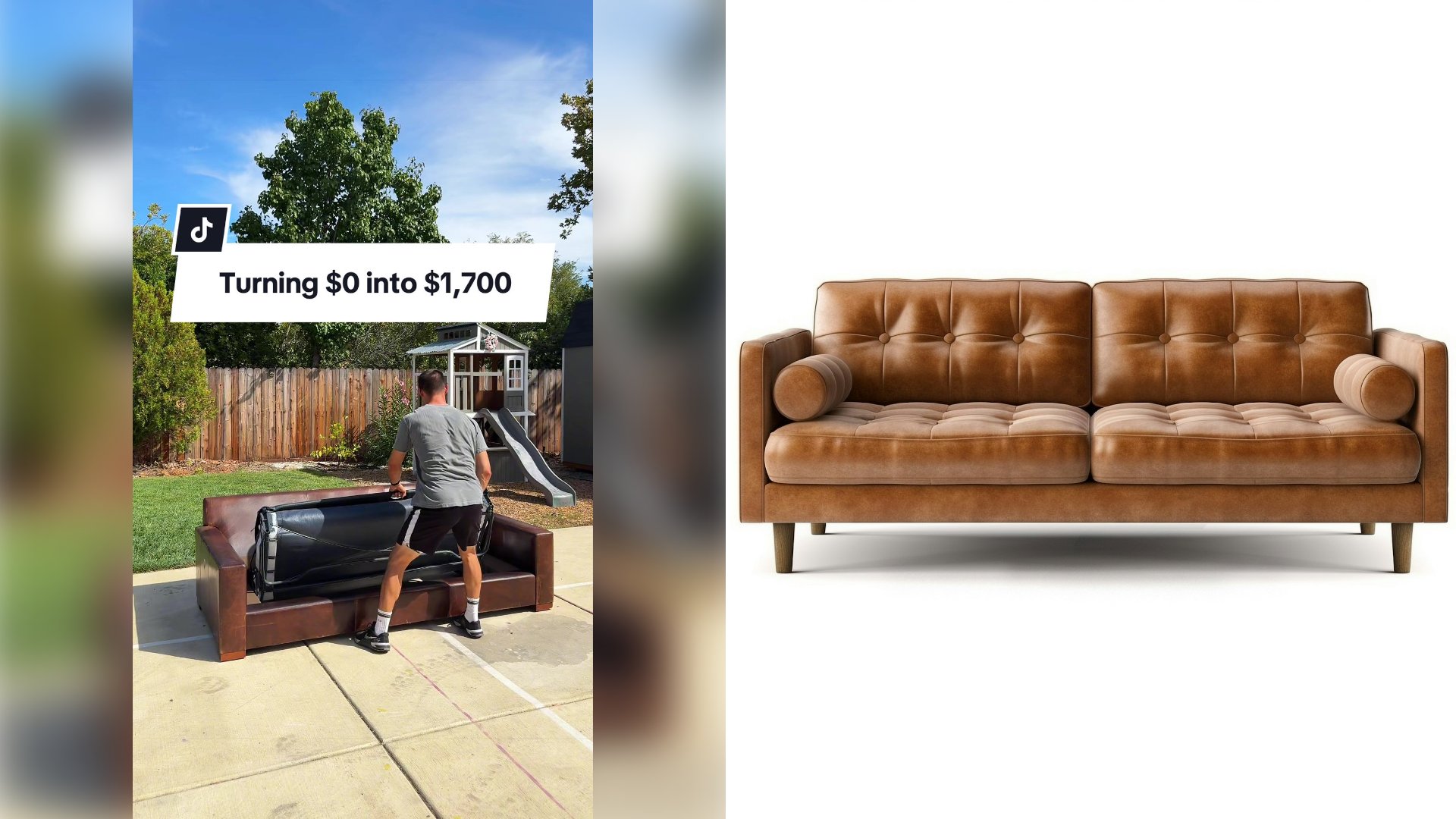
Starting a Facebook Marketplace flip with zero dollars in the bank is less about having capital and more about having the patience to scroll until something genuinely free turns up worth the trip. A reseller who documents exactly this kind of flip did just that, opening an empty wallet on camera before scrolling his way to a free listing that turned out to be a designer sleeper sofa most people would assume had to be a mistake.
The listing was for a Restoration Hardware Maxwell leather three-cushion sofa with a matching ottoman, posted as completely free. Restoration Hardware prices this exact model at just under $9,800 for members and just under $14,000 at regular retail, which is the kind of price gap that makes a free listing almost impossible to believe until it is sitting in your own driveway. He loaded it up and brought it home still not entirely convinced it would turn out to be worth the trip.
The first real test was mechanical rather than cosmetic. Sleeper sofas hide a pull-out metal bed frame inside the body of the couch, and the frame on this one had a bent hinge bracket that was keeping the mechanism from sliding properly. Comparing the working side of the frame against the damaged one let him isolate exactly which bracket had bent out of position, and a bit of careful work with a hammer and pliers was enough to straighten it back into alignment. Once the bracket was fixed, the pull-out bed slid smoothly, which meant the single most expensive thing that could have been wrong with the piece turned out to be fixable with basic hand tools rather than a trip to a repair shop.
With the mechanics sorted, the cosmetic work started. Deep scratches across the leather got treated with dark brown shoe wax polish worked in with a heat gun, a combination that softens the leather enough for the wax to blend into scuffed areas rather than just sitting on top of them. A more stubborn discolored spill mark on one of the cushions needed additional scraping and buffing before the wax could fully restore the color underneath, and a leather conditioning cream handled the rest of the surface, bringing a richer, more even tone back to the armrests and body of the sofa.
From there it moved to the smaller repairs that often make the real difference in how a secondhand piece eventually photographs and sells. One cushion had a zipper pull that had broken off entirely, fixed by cutting a small notch into each side of the zipper track and sliding a replacement pull into place, a repair that costs only the price of a hardware-store zipper pull but restores full function to a cushion that would otherwise be stuck half open. He also added fresh polyester fiberfill stuffing into the back of each cushion, a step that sounds cosmetic but does more than almost anything else to correct the sagging, lumpy look that gives away a tired, well-used piece of furniture.
The before-and-after comparison told the whole story at a glance: deep scratches smoothed into even, rich leather, a stained cushion restored to a clean matching tone, and a fully functional pull-out bed frame that worked exactly the way it was designed to. Staged on an outdoor rug with a few throw pillows for the final reveal, the sofa looked like a piece that belonged in a showroom rather than something picked up for free off a driveway listing.
He listed the finished piece for $2,000 and sold it to a buyer at $1,700, turning a $0 purchase into real profit through nothing more than careful mechanical repair, a bottle of leather conditioner, and a willingness to actually fix what was wrong instead of walking past a free listing because it sounded too good to be true. It is a solid example of why experienced flippers treat a damaged free item as a starting point rather than a dead end, since the gap between a broken designer sofa and a sellable one is often smaller, and cheaper to close, than it looks.
@flipthatcouch_

Leave a Reply