

Picture a stranger setting a little scale on your mother’s kitchen table, a folded card tucked under one corner to level it. He says the fairest-sounding sentence in the trade: bring me everything in the house that is silver, and I will weigh it all together. According to estate sale dealer Walter Ashford, that is how most American family silver leaves a house now. Not stolen. Weighed.
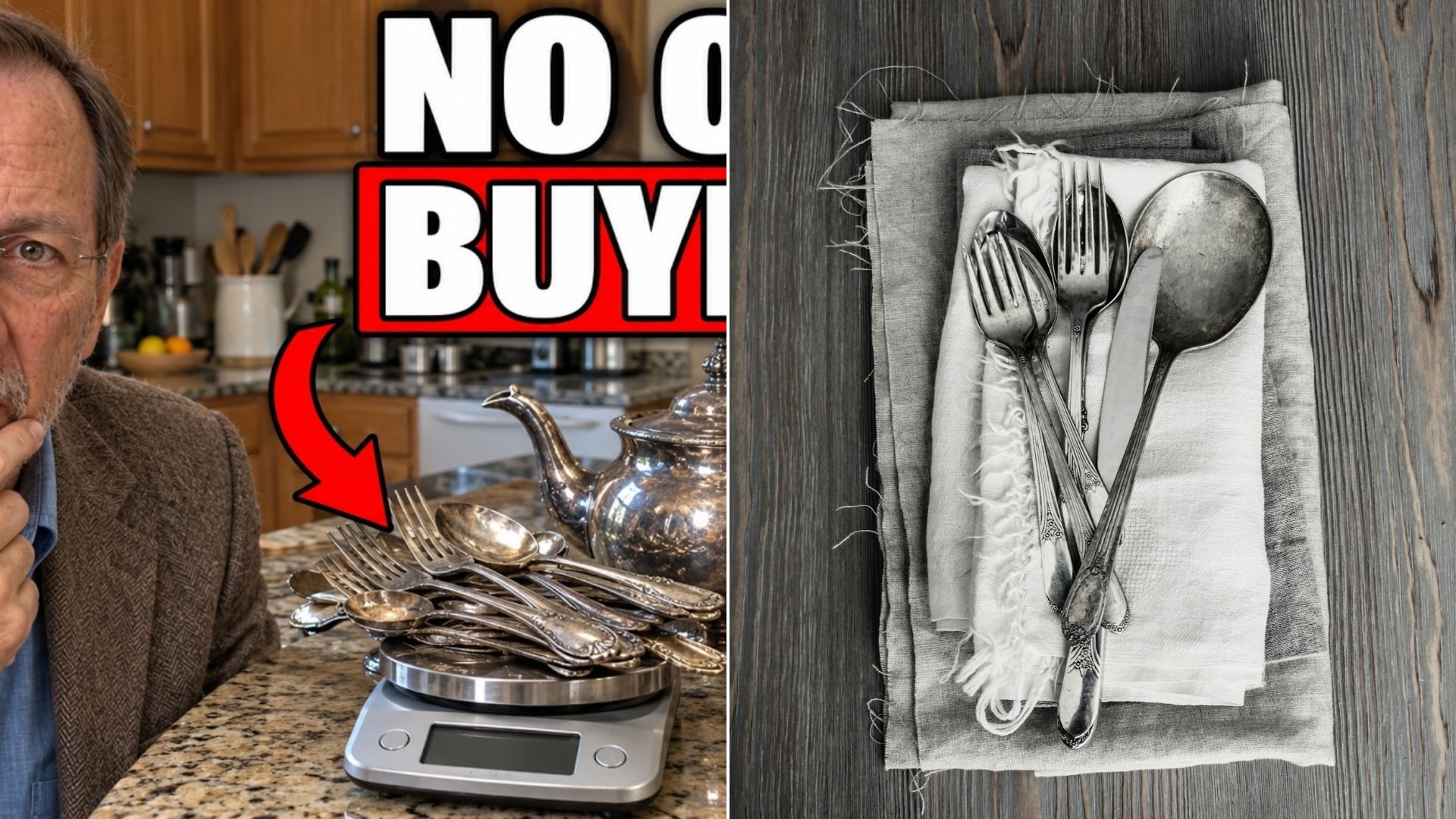
Ashford says he has spent 40 years buying and selling at estate sales, farm auctions and house clearances across the Midwest. He is a dealer, not a certified appraiser, and he is upfront that his advice is general information rather than a formal appraisal. His warning is simple: your silver has two prices at the same time, and they have almost nothing to do with each other.
Two Prices For One Spoon
One price is what the metal weighs. The other is what the object is, with its pattern, its maker and the fact that there are 12 matching pieces in a fitted chest. Ashford says the man with the scale is buying only the first price, and he is not hiding it. He is counting on the fact that you have never separated those two numbers in your own mind.
The timing matters, too. As Ashford recorded his video in October 2026, silver was sitting at around $60 a troy ounce, roughly half of where it went at the end of January. In the summer of 2018 it was under $16. He says the advice floating around the internet about family silver was written when a spoon was worth almost nothing as metal, and the scale in that canvas bag now offers nearly four times what it offered 8 years ago.
Read The Back Of Every Piece
Ashford says weight and tarnish tell you nothing. The word stamped on the back does. Look for sterling, 925, or ster. Treat marks such as EPNS, A1, triple plate, quadruple plate and 1847 Rogers Brothers as plated silver, which is a thin skin of silver over base metal. A magnet can rule things out, he says, but it cannot rule them in, because brass and nickel ignore magnets as well.
On English pieces, there may be no word at all, just a small lion walking sideways with one front paw raised, the sterling standard mark. On German, Austrian, Dutch and Italian pieces you may see 800 or 835, meaning 80% or 83 and a half percent silver. Write any number down exactly as it appears. As Ashford puts it, the number is the recipe, and the recipe is the price.
Weighted Pieces And Knives
The most expensive word on his list is weighted. A candlestick or compote that feels like money may be a thin sterling shell around plaster, pitch or cement. Ashford says refiners put the silver content of weighted candelabra at about 15 to 30% of the weight, and weighted salt and pepper shakers at 10 to 20%. He admits he once paid sterling money for a pair of weighted candlesticks in a barn lot, and found plaster and a threaded rod when he got home.
Knives are a quiet money drain too. A sterling dinner knife is a stainless steel blade set into a hollow sterling handle, and each handle carries roughly a quarter to a half ounce of silver. In one Connecticut sale he cites, a 74-piece service listed a total weight of 74.6 troy ounces plus 24 weighted handles. His advice is to move knives and butter spreaders aside before anything gets weighed.
What Buyers Actually Pay
Ashford says one American refinery pays 96% of the assay fine metal, then charges 50 cents a troy ounce with a $250 minimum, and settles in 10 to 12 weeks. That schedule is built for a jeweler’s scraps, not one family’s box, so most people sell to someone in the middle. He says published ranges run roughly 90 to 95% of melt from a bulk refiner, 80 to 90% from a coin shop and 50 to 75% from a pawn counter.
His free test is to look up the silver spot price, write it at the top of a sheet of paper and divide any offer by your own melt figure. If the answer is in the 80s, that is a trade. If it is in the 50s, that is also a trade, just not one you have to take.
When A Pattern Still Beats The Metal
Using real sold lots, Ashford shows that the pattern premium is real but modest. A Gorham Chantilly service sold in 2018 made $1,200 on about $820 of metal. A Kirk Repousse service sold in 2021 made $5,520 on about $3,800 of metal. A 74-piece Reed and Barton service sold in January of this year for $5,185, including the buyer’s premium, against nearly $4,900 of silver. Wanted patterns, serving pieces and complete services in their chests tend to sit above the metal.
He tells of a woman he calls Clarice, near Charles City, Iowa, who weighed her mother’s silver at home and wrote 212 ounces on an envelope. Her kitchen scale read household ounces, which run about 9% lighter than troy ounces, she counted the knives at full weight, and she included weighted candlesticks. When the first honest offer came in lower, she assumed it was a racket and sold everything in one afternoon.
Slow Down Before You Sell
Ashford says a 12-place service, once the knives are set aside, commonly carries somewhere in the region of $3 to $5,000 of metal at this year’s price. He does not think you are about to be robbed. His point is that melting is the only decision on the list that cannot be undone. Silver that goes into the crucible leaves the world.
His checklist is short. Read the back of every piece. Keep weighted items off the flatware scale. Photograph the back of one fork in daylight with its length written down so someone can identify the pattern. Never dip tarnished pieces before selling, because the quick dips strip the darkening that gives a pattern its depth. And anything that makes your heart jump should be looked at in person by somebody qualified. Whoever offers you a price, ask for the arithmetic piece by piece, and get more than one offer.
More Stories You May Like
- The Beanie Babies Retirement Myth Sent Prices Soaring But Most Sell For Little Today And Fakes Make It Worse
- Estate Sale Buyers Who Show Up Early And Sellers Who Accept Low Day One Prices Both Get Burned And Here Is How To Protect Yourself
- Vintage Dealer Says The Best Decorating Advice Is Buy Well And Buy Slowly Because Furniture You Keep Builds The Story Of Your Home

Leave a Reply