

Every collector knows the feeling of driving down an ordinary road and seeing a sign that says baseball cards. You slow down. You turn around if you have to. This time, the sign sat beside a rural New Hampshire road, and the shop behind it turned out to be even better than the sign promised.
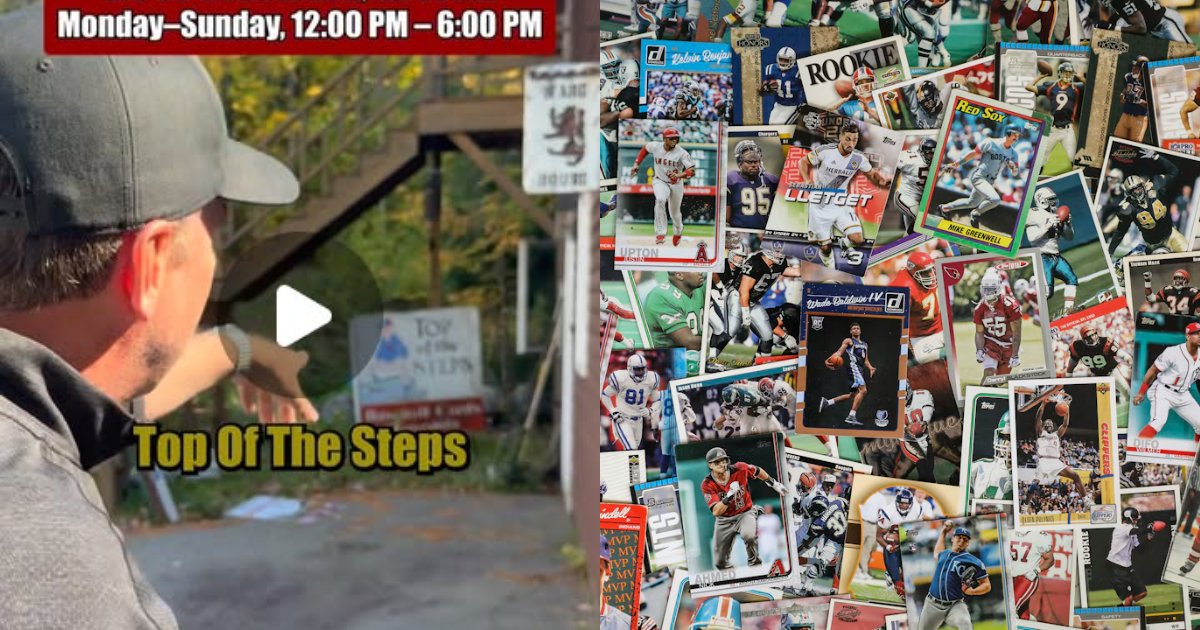
The visit was shared by @brianpirrip on Instagram, who stopped on a whim and ended up with a full tour of a small, friendly, family run shop.
A sign in the middle of nowhere
The story begins in a car on a rural road lined with trees. A wooden roadside sign for a baseball card shop appears, and the driver does not hesitate: they have to turn in. The caption calls it a card shop in the middle of nowhere. The driveway leads to a house and garage surrounded by woods, and a banner gives the details: Top of the Steps Baseball Cards and Memorabilia on US 302 in Bartlett, New Hampshire, open from noon to six every day.
Up the stairs and a friendly hello
He climbs the wooden exterior stairs to a red door on the second floor and peeks through the window. Cards everywhere. Then he notices someone sitting in an armchair on the other side of a sliding glass door on the side porch: the owner, Kenney, wearing a Red Sox cap. Kenney waves him in and says yes, they are open. He points out the ground floor shop and tells him where to find the light switch.
Thirty seven years of cards
The two chat easily. Kenney says visitors come from all over, especially in summer, and someone had just stopped by from Utah. The shop has been open for 37 years, since 1989, which he notes was Griffey’s rookie year. How did it start? He says there was a shop downtown that was doing very well, he traveled for work as an electrician, and his wife thought he might be home more. They both liked sports, so it made sense.
Asked about a favorite player, Kenney names Stan Musial and says he wishes he had one of the 1948 rookie cards. He explains that he has moved most of his stock downstairs. Before heading down, the visitor closes the sliding door so the cat does not get out.
The honor system card room downstairs
Outside, signs point to the downstairs shop, and a handwritten sign on the red door gives a Venmo account for payment. The visitor describes it as an honor system: you go in, pick out your cards and pay for them yourself. Inside is a spacious basement garage showroom. There are tables of mystery grab bags sorted by sport, vintage photos on the wall of the owner with visitors, and boxes of vintage packs, including 1988 Fleer, which he says he always liked. Someone has already ripped into one of the bags. He flips through sorted boxes of cards at the end, and a Part 2 is promised.
Tips for finding small card shops on the road
- Watch for hand painted signs along back roads. Some of the best shops are run out of homes and garages.
- Check the posted hours before you go. This shop lists noon to six every day.
- Say hello to the owner. A short chat can lead to great stories and tips on what to look for.
- Respect the honor system if a shop uses one, and bring a way to pay as the sign instructs.
- Look through the grab bags and the older packs. They can surprise you with the cards you grew up with.
How collectors judge a card’s condition
When people talk about a card’s condition, they usually look at four things: the corners, the edges, the surface and the centering of the image within the borders. Sharp corners, clean edges, a glossy unscratched surface and even borders all push a card toward the top of the scale. Professional grading companies will assess and seal cards in protective cases, though grading costs money and is mostly worth it for cards with real collector demand. A rookie card, meaning a player’s first officially issued card, often draws extra interest, but what any card is worth depends on condition, the player and current demand.
Storing cards so they last
- Slip valuable cards into soft sleeves, then into rigid holders, so edges and corners do not get dinged.
- Store them upright in sturdy boxes, snug but not packed so tightly that cards bend.
- Skip rubber bands, which dent edges and can stick to the surface.
- Keep cards in a cool, dry place away from sunlight, which can fade ink, and away from damp areas, which can warp cardboard.
Making the most of a grab bag
Mystery grab bags are a fun, low pressure way to browse, especially when sorted by sport. Treat them as a way to find cards you enjoy rather than a bet on landing something valuable. Ask yourself whether you would be happy with the cards even if they turn out to be common, and you will rarely be disappointed. If you are shopping on the honor system, count out payment carefully and leave the shop as tidy as you found it, which helps small owners keep the arrangement going.
Credit for the original post goes to @brianpirrip on Instagram.

Leave a Reply