

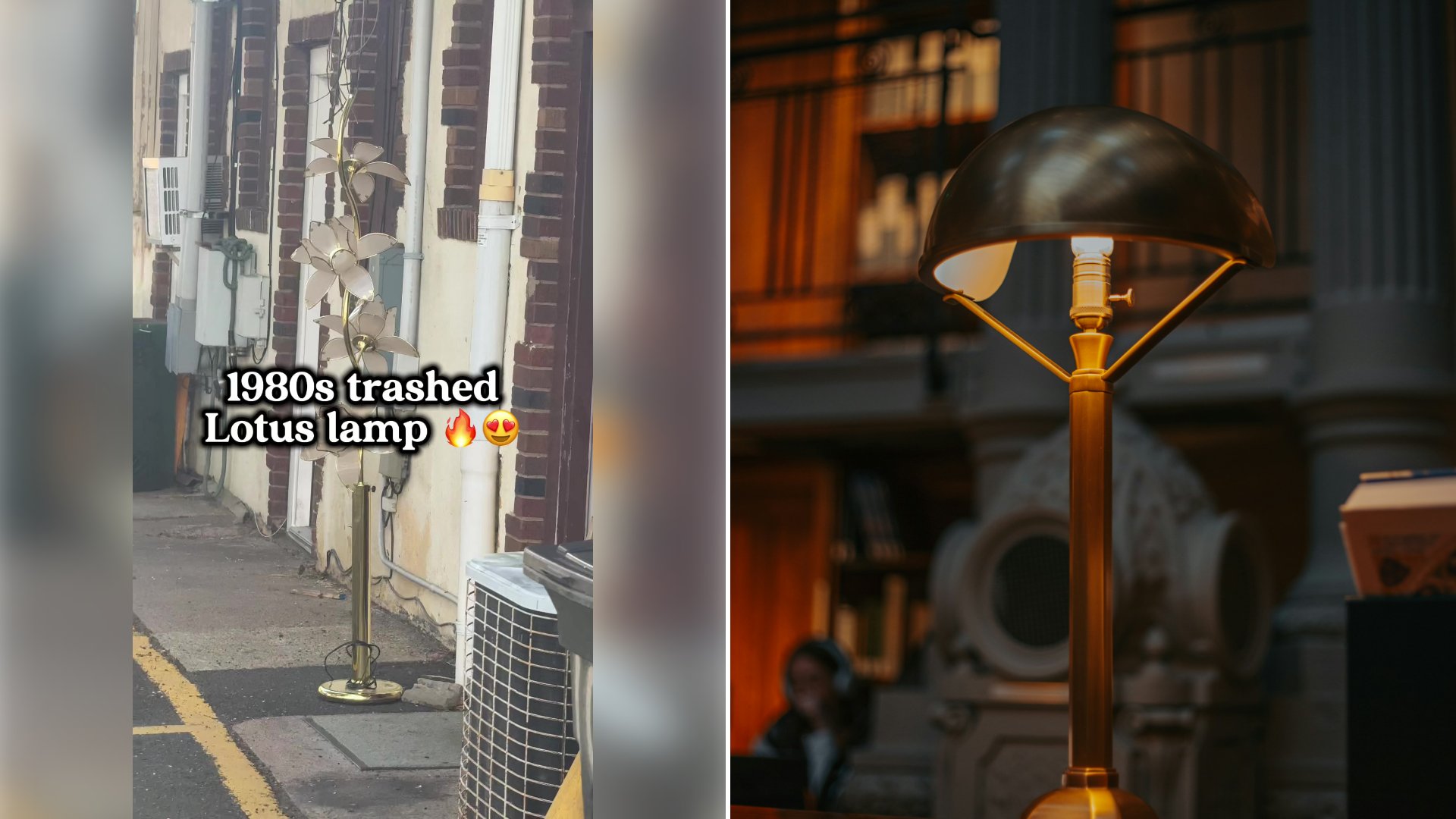
Finding a genuinely good piece of furniture sitting next to someone’s trash cans is the kind of moment that separates casual scrollers from people who have trained themselves to actually stop the car. A creator who regularly hunts for discarded vintage pieces did exactly that after spotting a tall brass floor lamp shaped like a cluster of blooming lotus flowers propped up against the back wall of a commercial building, clearly set out with the rest of the garbage.
Lotus-style lamps like this one were a defining fixture of late 1970s and 1980s home decor, built around sculptural brass stems that branch out into multiple frosted glass or acrylic petal-shaped shades. They were designed to throw soft, diffused light in several directions at once rather than a single downward beam, which made them a popular choice for living rooms and dens during an era that leaned heavily into sculptural, statement-making lighting. Decades later, well-kept examples regularly turn up in vintage lighting shops and online marketplaces, prized by collectors specifically chasing that sculptural brass-and-glass look.
Rather than simply grabbing it and walking away, the creator did what any cautious scavenger should do when an item is sitting on someone else’s property: he went inside the business to ask first. The exchange was brief and almost comically low-key. He asked what the deal was with the lamp out back and whether he could take it, and the employee he spoke with said she did not even know if it still worked, dismissing it outright as garbage. With permission granted, he thanked her repeatedly and headed back outside, clearly relieved he would not have to explain himself to anyone else on the way out.
It was only once he got back to the lamp that he noticed the catch. One of the lotus shade clusters was missing its flower entirely, leaving an awkward gap in what was otherwise a complete and strikingly sculptural fixture. A missing shade on a piece like this is not a minor cosmetic issue, since the petal-shaped shades are specific to each lamp design and are notoriously difficult to source individually once a set has been broken apart over the years. He had resigned himself to taking the lamp as-is, already working out in his head how he might disassemble and carry it, when the employee reappeared.
She had gone looking in the back of the store and come out holding the exact missing piece, the flower-shaped shade that had apparently been separated from the lamp at some point before it was ever set outside. Handing it over without being asked twice, she gave him back the one thing that would have otherwise left the lamp permanently incomplete. His reaction on camera was immediate and unguarded, a mix of disbelief and genuine excitement that the piece he thought he would never recover had simply been sitting a few feet away the entire time.
From there, the process turned practical. He worked through the lamp’s joints to figure out how it came apart, unscrewing the threaded retaining rings holding each glass panel in place, carefully separating the shade clusters from the brass stem, and disconnecting the internal wiring before loading the disassembled sections into his car. Breaking a lamp like this down into its component pieces is standard practice for anyone transporting a tall, delicate vintage fixture, since trying to move it fully assembled all but guarantees a cracked shade or a bent stem somewhere along the way.
What started as a routine pass by a dumpster ended with a complete, fully intact 1980s lotus lamp headed home for restoration, missing shade and all. It is a reminder of two things seasoned pickers know well: that businesses throw out genuinely good vintage pieces more often than most people assume, and that asking politely before taking anything, rather than just grabbing and leaving, occasionally gets rewarded with exactly the piece that makes the whole find complete.
@8tracktape

Leave a Reply