

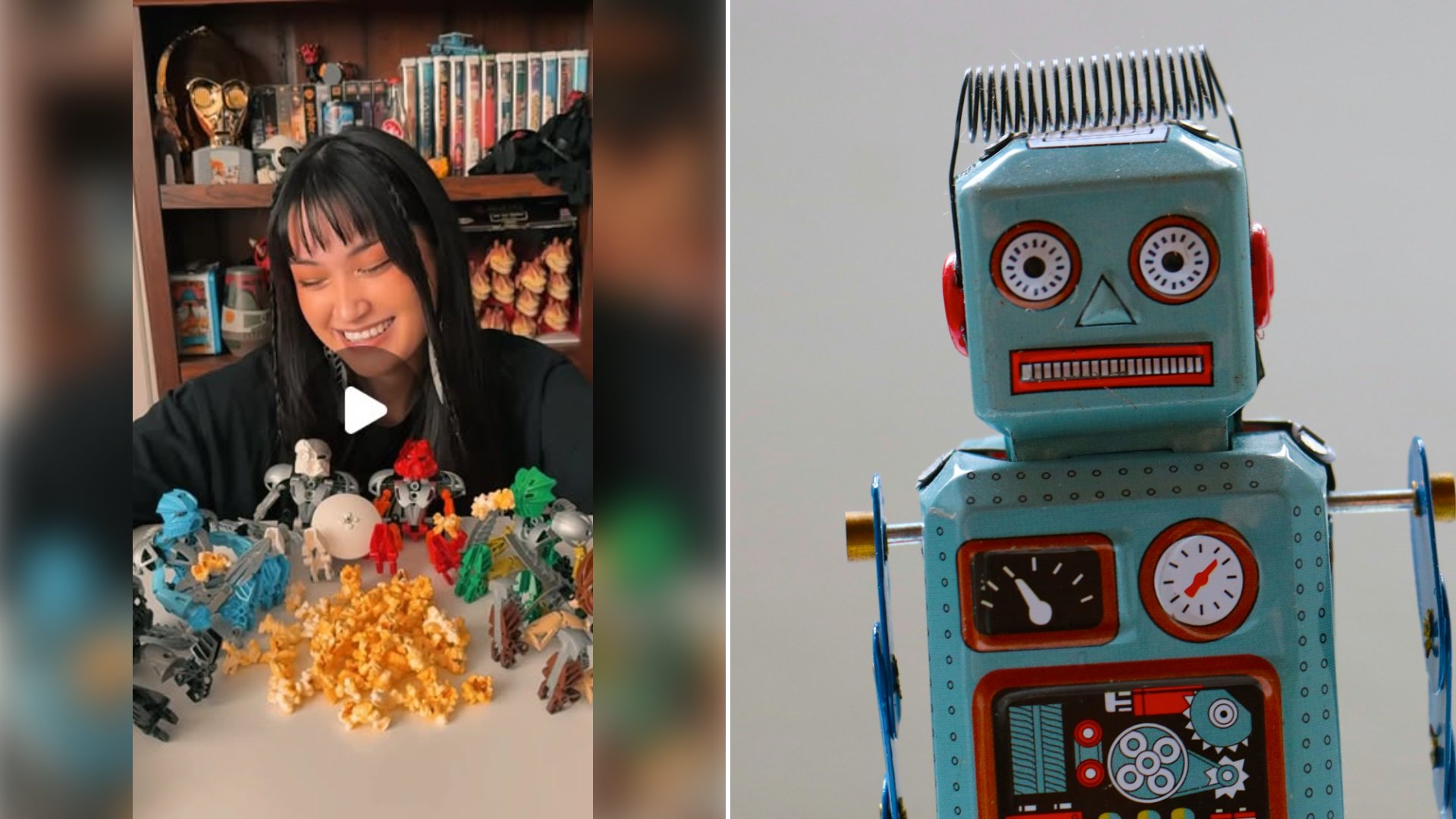
The video starts with a simple, almost ceremonial gesture: two hands twist open the lid of an old, slightly scuffed plastic canister shaped like a toy container that hasn’t been manufactured in over two decades. Inside, nested in the dark, are the unmistakable angular shapes of a childhood Bionicle figure. The creator, @pixelatederica, lifts each piece out slowly, letting the camera linger on the gear-like armor and colored masks that defined an entire toy line for kids growing up in the early 2000s.
One figure comes out, then another, then another, each one triggering a visible wave of recognition. There’s no dramatic reveal or big punchline here, just the quiet, specific joy of rediscovering toys that were once scattered across a childhood bedroom floor and then packed away and forgotten for twenty-some years. For anyone who grew up building and rebuilding these sets, watching the canister empty out one figure at a time hits differently than almost any other toy nostalgia video could.
Bionicle launched from LEGO in January 2001, built around a mythology-driven story of mask-wearing warrior beings called Toa defending the island of Mata Nui. It was a departure for LEGO at the time, mixing traditional brick-building with pre-molded, poseable action-figure parts, ball-and-socket joints, and interchangeable Kanohi masks that became the line’s signature collectible piece. The first wave introduced six Toa, Tahu, Onua, Gali, Lewa, Pohatu, and Kopaka, each tied to an element and a distinct color, and that original six-figure lineup remains the most recognized entry point into the toy line for anyone who was a kid during its early run.
The line expanded rapidly through the 2000s with new story arcs, new character tiers like the villainous Bohrok and the Rahkshi, and increasingly complex builds that pushed well beyond simple action figures into genuine construction sets. LEGO supported the story with animated films, a tie-in video game, and comics, turning Bionicle into one of the company’s biggest product lines of the decade before the original story concluded and the toy line was discontinued in 2010, only to be briefly revived in 2015 and 2016 with a rebooted, simplified version aimed at a new generation.
On the collector market today, original early-2000s Bionicle sets, especially ones still sealed in their original canister packaging, can command meaningfully more than their original retail price, with complete first-wave Toa figures and rarer limited-release characters drawing the strongest interest. Mask variants matter too. Certain Kanohi masks were produced in different colors across different releases, and tracking down a specific color variant to complete a set is its own mini obsession within the broader collecting community. Loose figures missing pieces or masks sell for far less than complete, boxed examples, which is exactly why finding an intact canister with every original piece still inside, the way this video shows, is a genuinely good pull.
What makes Bionicle nostalgia so specific compared to other early-2000s toy lines is the narrow window of kids it actually hit. Anyone born roughly between the early and mid 1990s would have been the right age to be building and trading these sets during their original 2001 to 2010 run, which makes the toy line feel almost generational in a way broader franchises don’t. It wasn’t just a toy, it came with an entire mythology that rewarded kids who paid attention across multiple releases, which is likely part of why unboxing a surviving canister decades later still produces the kind of genuine, unscripted reaction captured in this video. The appeal isn’t really about the plastic. It’s about remembering exactly how it felt the first time, piece by piece, all over again.
More from Vinyl and Velvet
- Gamer Realizes Halo 3 Launched 19 Years Ago Today, Watches His Hair Turn Gray on Camera and Says He Is Booting Up the Master Chief Collection That Night
- Man Powers Up the Original Xbox From When He Was 15 for the First Time Since About 2007 and Opens the Tray to Find a Halo 2 Disc Still Inside, With a Warped Tour Sticker on Top
- Game Boy Owner Says Mom Kept the Toys R Us Receipt From July 18, 1994, Showing a $49.99 Game Boy and a $19.99 Yoshi Game, and the Old Handheld Still Turns On Today

Leave a Reply