

Most people look out over the Manhattan skyline and reach for a phone. jamescookartwork took a typewriter instead. He hauled a red, hot-rod-painted 1960s Olympia SM3 up to the Edge at Hudson Yards and spent three weeks typing a picture of the city, one letter at a time.
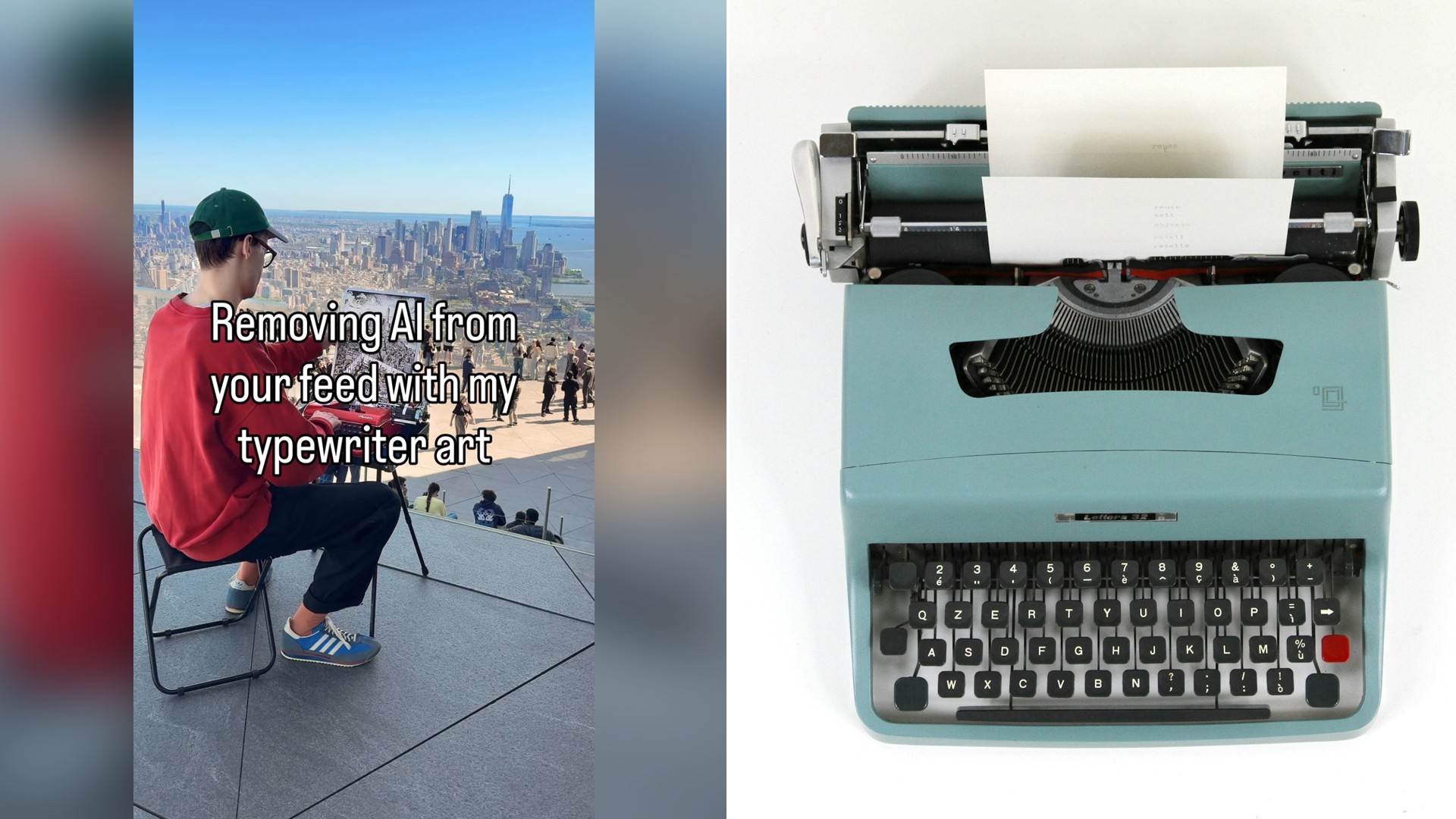
The deck sits 1,100 feet above Manhattan. According to his post, the machine is 70 years old, and everything in the finished piece was made with its keys.
View this post on Instagram
Three Weeks Of Typing A City Into Existence, With “No AI And No Undo Button”
The artist describes the work as “a drawing of New York City made entirely” on his old Olympia. He says he spent three weeks “typing this piece letter by letter.”
That phrase matters. A typewriter has no brush, no pencil and no eraser. Every mark is a letter, number or symbol struck onto paper through an inked ribbon, and each strike stays where it lands.
His post puts it plainly: “No AI and no undo button.” He opened the caption by saying he was “removing AI from your feed” with his typewriter art, which tells you what he thinks of push-button pictures.
Hidden In The Skyline: A Unicyclist, A Yoga Pose And A Picnic 1,100 Feet Up
The finished piece is not just buildings. The artist invites viewers to look closely, because the typed scene is packed with small figures. He points to a unicyclist, someone doing yoga, and people soaking up the view.
Then comes the detail he clearly enjoys most. “And, somehow, a couple having a picnic 1,100 feet in the air.”
It is the kind of touch that rewards a second look. A drawing like this works at two distances. From across the room you see a skyline, and from a few inches away you see letters doing the work of line and shadow.
What A “Typo” Means When Your Whole Drawing Is Typing
Every typist knows the feeling of hitting the wrong key. For this artist, the stakes are higher, because a slip lands in the middle of a three-week drawing.
He jokes about it in his post. If he makes a mistake, or what he calls a “typo,” he says he “just hope[s] nobody spots it.” He added a laughing emoji, so the humor is clearly intended.
He also shared that limited edition prints from his New York Collection went on sale on his website, with the drop set to end on October 6. That is how most artists who work in one-of-a-kind media let more people own a piece, since the original stays with the maker.
Why Old Typewriters Make Such Surprising Art
Typewriter art is older than most people think. Long before computers, typists built pictures out of periods, dashes, slashes and capital letters, packing them tighter for darker areas and spreading them out for light ones.
The Olympia name carries weight among collectors. Olympia was a well-known German typewriter maker, and its machines have a loyal following for their sturdy build and smooth action. The SM line is the kind of machine you still see in repair shops and antique malls today.
A bright red paint job on a machine like that is a statement. Instead of treating a vintage typewriter as a museum piece, the artist treats it like a hot rod, something meant to be driven hard and shown off.
The location is part of the story too. The Edge at Hudson Yards is an observation deck high above the west side of Manhattan. Typing a drawing of the city on a machine this old, with the real skyline stretching out around him, turns the artwork into a small performance as well as a picture.
Want To Try It Yourself? Tips From The Typewriter World
If this story has you itching to dig out Grandma’s old typewriter or hunt for one at a yard sale, a few basics will save you frustration. Vintage machines are tough, but they do wear out in predictable ways.
- Press every key and watch the typebars. They should swing up cleanly and return without sticking.
- Check the platen, the rubber roller the paper wraps around. If it is rock hard or cracked, the letters will print unevenly.
- Look at the ribbon. Fresh ribbon is easy to buy, but make sure the spools turn and the ribbon advances.
- Slide the carriage back and forth. It should move smoothly and ring the bell near the end of a line.
- Bring a few sheets of paper and type a full line. A machine that skips spaces or jumps letters may need a cleaning or repair.
For art, start small. Try a simple tree or house made only of the letter “x” and a few punctuation marks, and plan the picture on scrap paper first. Because a typewriter keeps every strike, planning is the closest thing you will get to an undo button.
It also helps to practice light and heavy strikes. Hitting a key harder darkens the mark, and overtyping the same letter builds a deeper tone. Many typewriter artists layer letters this way to get shading.
The Appeal Of Making Something That Cannot Be Undone
There is a reason this kind of work grabs attention right now. Most of what we see online can be edited, filtered or generated in seconds. A drawing that took three weeks of careful keystrokes, with every error left on the page for good, feels different.
It also makes a nice reminder for anyone who collects vintage tools. A machine from the 1960s can still do something new, in the right hands. All it needs is paper, ribbon, patience and a little nerve.
For the artist, the nerve comes from knowing a stray letter could sit in plain sight forever. For the rest of us, it is a fun reason to look closer at the little figures in the corners of the picture, and to wonder who else is up there having a picnic.
More Stories You May Like
- Rare 1975 Mego Green Goblin Figure Was Estimated To Finish Between $30k And $50k But Bidding Already Hit $90,000 With Weeks Still To Go
- Guitar Johnny Marr Played After Leaving The Smiths Could Fetch Up To £30,000 With His Signature And A Handwritten Postcard Explaining How He Used It
- 7 Things You Should Never Do With Vintage Toys

Leave a Reply