

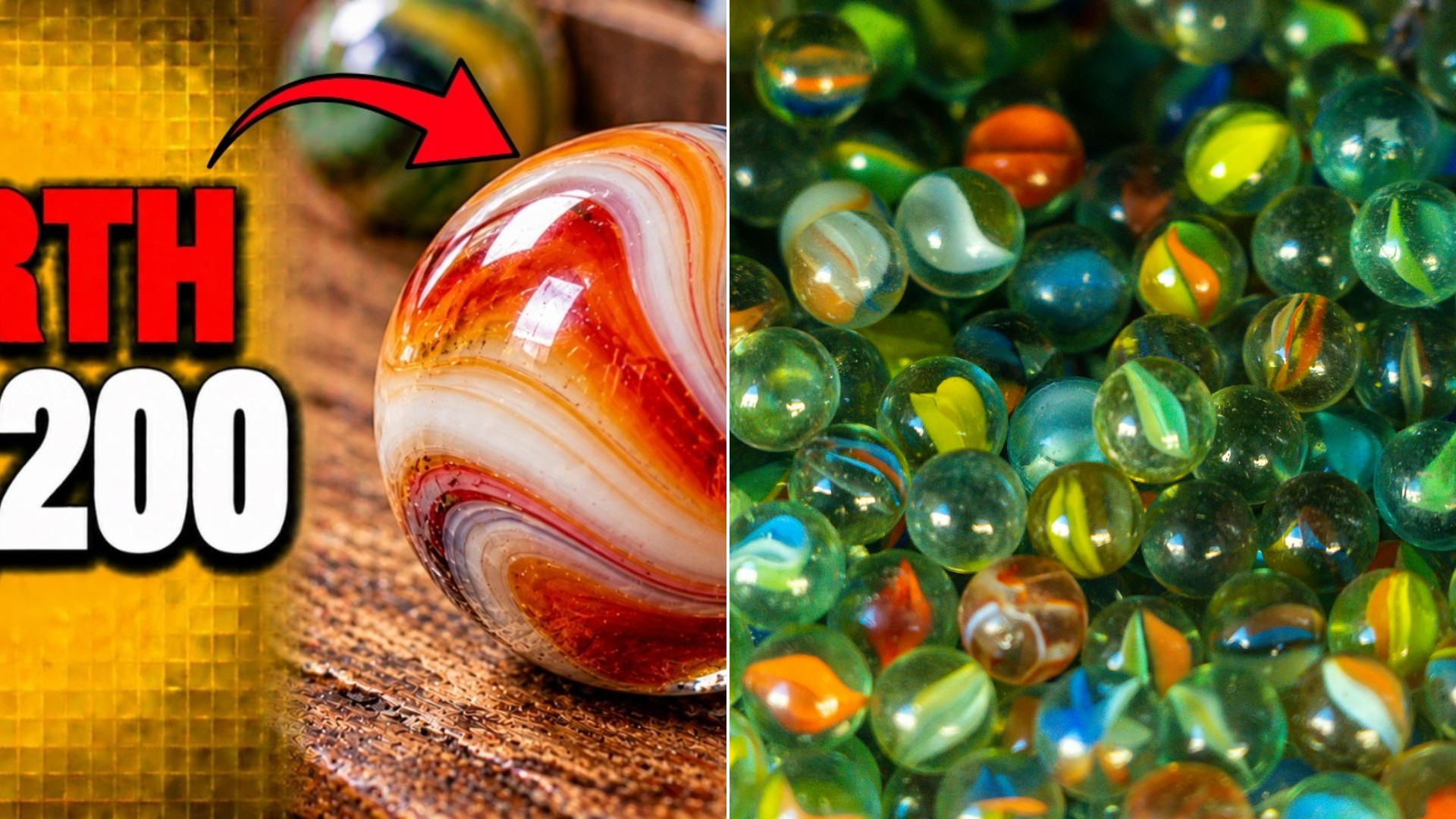
Somewhere in America tonight, a coffee can in a garage may be holding a glass marble worth more than a car. According to antique picker Graham Whitaker, one marble sold at auction for over $36,000. It measured two and a quarter inches across, in white, orange and blue, with a faint sparkle drifting through the middle.
It looks, he says, just like the marbles sitting at the bottom of a coffee can in 10 million American garages. Whitaker is 61 and says he has spent 40 years picking barns, estate auctions and farm sales across the Midwest.
His advice comes in his Graham’s Antique Vault video, and he starts with an honest warning. Old does not mean valuable.
Most Marbles Are Worth Between 10 Cents And $2, He Says
Whitaker says most marbles in most American homes are worth between 10 cents and $2 each. He says he will not pretend otherwise just to keep anyone watching.
The real money, he explains, lives in two narrow places. One is German glass made by hand in the Lauscha region from roughly 1846 until about 1915, when the First World War ended the trade. The other is a handful of American factories in Ohio and West Virginia that burned bright and died young between the wars.
Everything outside those two families, he says, is play glass. Everything inside them can be worth hundreds or thousands.
A $4 Bag At An Estate Sale Hid A Marble That Sold For $110
His first tip is about Martin Christensen and Son, which he says made the first American machine-made marbles after patenting a marble machine in October 1905. The signature is a pattern shaped like the numeral nine at one pole, with a little tail, and a straight cut line directly opposite.
The test is simple. Hold the marble under a lamp and hunt for that nine. Brown and purple are common, yellow is scarce, and true orange is the one collectors chase.
Whitaker says he found a small bag at an estate sale outside Manchester, Iowa, priced at $4 for the whole bag. One marble inside carried the numeral nine, clear under a lamp. That single marble sold for $110.
Never Tip A Sealed Box Into A Jar, Because The Packaging Is The Asset
If you inherited a cardboard tray with marbles seated in little wells, or a mesh sack with a paper header stapled across the top, he says to stop and not open it. He says an ordinary factory box of 25 Akro Agate red slags, worth pennies each when loose, brought over $2,600 still sealed in its tray.
The loss he sees over and over is somebody tipping a box into a jar because the jar looks tidier. That, he says, turns thousands into a handful of loose glass in four seconds.
He says he found a small mesh sack outside Postville, Iowa, with the original paper header still stapled on top. It was priced at $2 because the family had no idea the header mattered. It sold for $480.
Peltier Marbles With Nicknames Like Superman Can Hide The Real Money
Peltier marbles, made in Ottawa, Illinois, have an opaque base with thin colored ribbons and two seams that meet like the stitching on a baseball. The plain ones are worth a few dollars. The rare color combinations have nicknames, and he says that is where the money hides.
A blue base with red and yellow ribbons is a Superman. White with red and green is a Christmas tree. There are also zebras, golden rebels and cherry rinds. Rarer still are the picture marbles with a comic character fired onto the glass in black, with Betty Boop, Moon Mullins and K.O. among the hardest to find.
The test is to check whether the ribbons sit up on the surface or sink into the glass. On top means early, and sunk in means late and common. He says he found a blue, red and yellow one outside Elkader, Iowa, priced at $5 as a plain swirl, and it sold for $340.
Cat’s Eyes Are Not Your Retirement Plan
Whitaker says the mistake he sees most often involves cat’s eyes, the clear marbles with a colored vein inside. People find a jar of them, see that they are obviously old, and start imagining a retirement.
He says they were mass-produced from the 1950s onward by the hundreds of millions in America and Japan, and to a collector they are essentially worthless. The same goes for common Marble King Rainbows and plain clearies, at 10 cents to $2 each. Often the whole jar is worth less than lunch.
He suggests one fun check. Take them into a dark room under an ultraviolet light, since some old glass contains uranium and glows neon green. But glowing, he stresses, tells you what the glass is made of and not what it is worth.
An Opaque Red Marble Priced At $6 Sold For $210
Oxblood, from Akro Agate in Clarksburg, West Virginia, is a dense, opaque red, the color of dried blood or brick, usually with tiny black threads running through it. Genuine Akro oxblood runs from around $50 into the hundreds.
His check is to hold it against a bare bulb. If any light gets through the red, it is ordinary red glass. He says he found one outside West Union, Iowa, fully opaque with fine black threads, priced at $6 as a plain red marble. It sold for $210.
A Rough Scar At The Pole Can Mean Handmade German Glass
German handmade swirls have a twisted core of colored glass suspended inside clear glass. Some carry a thin speckled skin called onion skins, and Whitaker says the $36,000 marble was an onion skin.
His test is to run a fingertip across the poles. If your nail catches on a rough scar, a ground patch or a little pit, he says the marble was cut off a glass rod by hand, almost certainly before 1915. A machine marble has a smooth pole and a seam.
Size multiplies the value, he adds. Standard play size is five-eighths of an inch, and anything over an inch is rare. He says he found a handful at a farmhouse sale outside Dyersville, Iowa, one with rough ground scars at each pole and over an inch across, priced at $3. It sold for $610.
Sulfides, Fakes And The Warning That Perfection Is The Tell
A sulfide is a clear glass marble with a small silvery white figure inside, such as an animal, a bird or a child. Animals are common, human figures are scarcer, and numbers, busts and marbles with more than one figure are the rare ones. He says one with two fish inside sold for $5,900.
This is also where the forgers live. A genuine antique has a rough pontil scar, faint bubbles and a slightly cloudy figure. Fakes are flawless, with no scar and a figure that is too crisp. He says one he found outside Cedar Falls, Iowa, priced at $5, sold for $490.
Four Years Of Production Created The Priciest Machine-Made Marbles
Christensen Agate of Cambridge, Ohio, is a separate company from the earlier Christensen, he says, and made marbles only from roughly 1927 to 1931. Whitaker says these are the highest-value machine-made marbles in the world. He says a single Guinea, barely two-thirds of an inch, took $1,715, and that this past June a factory box of Guineas sold at Morphy Auctions for $49,200.
He says one he found outside El Cajon, Iowa, priced at $8, was confirmed genuine by a specialist and sold for $910.
Kindness Can Destroy More Value Than A Forger
Chips, bruises and subsurface fractures called moons can cut a machine-made marble’s value by more than half. But polishing, he says, is the real killer. Dropping a dull old marble in a rock tumbler grinds away the original factory surface or erases the pontil scar that proved it was antique.
A polished marble feels slippery and looks too glossy. In his words, more value is destroyed by kindness than by fraud.
The Corkscrew In Your Grandmother’s Tin May Be A Popeye
The most common American marble, he says, is the Akro Agate corkscrew, and the version collectors call a Popeye has a clear base with fine white threads. Yellow and blue is common, red and blue is scarce, and purple carries a premium of several hundred percent. A large red and blue Popeye in untouched condition can reach around $600, while the same marble with a couple of tiny chips falls to about $100.
He says he found one outside Postville, Iowa, priced at 50 cents in a bag of ordinary corkscrews, and it sold for $410.
Before You Sell A Jar, Spend 20 Minutes With A Lamp
His final advice is to pick the marble up, find the poles, read the seam, and look into the glass instead of at it. Before selling a jar, or letting anyone price a coffee can by weight, take one lamp and go through them one at a time.
You will be wrong about most of them, he says, but you only have to be right once. If one stops you, do not clean it and do not take the first offer. He suggests sending a photograph to the Marble Collectors Society of America, which he says has been the hobby’s reporting authority since 1975.
More Stories You May Like
- Attics Basements And Sunny Windows Quietly Destroy Collectibles Over Time And Most Owners Never Notice Until The Value Is Gone
- One Estate Sale Dealer Says Family Silver Now Leaves Most American Homes Weighed On A Little Kitchen Scale Because It Has Two Prices That Barely Match
- 55% Of Americans Say They Would Rather Unwrap A Vintage Or Hard To Find Secondhand Gift In Excellent Condition Than A Brand New Mass Produced One This Holiday Season

Leave a Reply