

It is the 8th of December, 1973, nine in the morning, and the parking lot is the size of four city blocks. There is frost on the windshields in the back rows and a line of cars already waiting near the garden center.
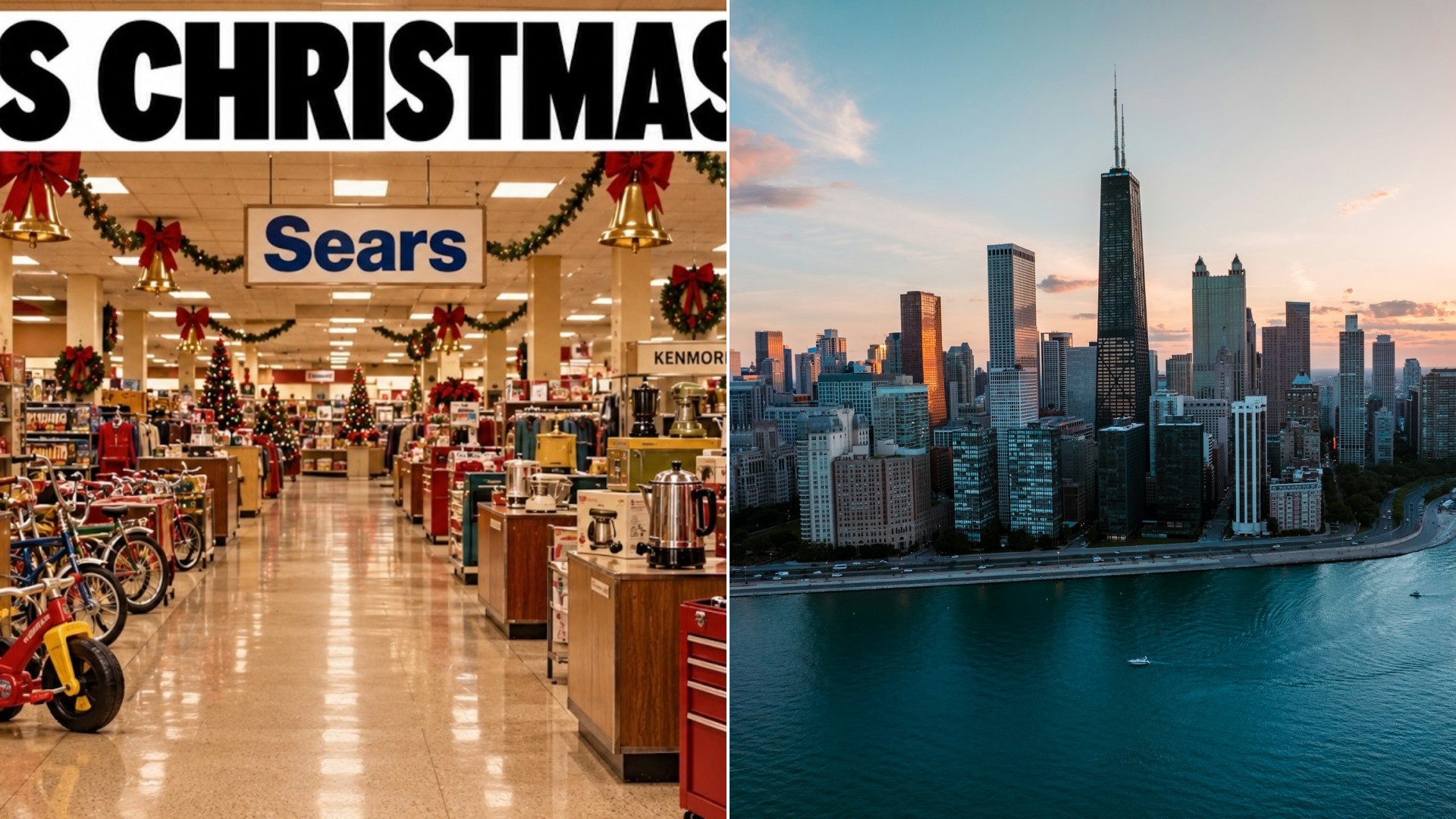
Above the main doors of the Sears store hangs a Christmas display of metal frames, a row of bells, two wreaths the size of truck tires and strings of lamps. The crew put it up in November, the way they do every year, and it has not been switched on once.
That scene opens a walk-through of a 1973 Sears Christmas from The American Rooms, and it works as a tour of the busiest building in the county for about five weeks of the year.
The Company Had Just Built The Tallest Building In The World
Seven months earlier, in May of 1973, Sears topped out its tower in Chicago. It stood 1,451 feet to the roof, taller than anything in New York or anywhere else.
Sears built it because it was the largest retailer on Earth. It had around 350,000 people on its payroll and wanted them in one building with 3 million square feet.
The narrator calls that the high-water mark. No American retailer, he says, has stood further above everybody else than Sears did that spring.
Then The President Asked The Country To Stop Lighting Christmas
In October the oil embargo began. On the 25th of November, two weeks before that Saturday, the president went on television and asked Americans to stop ornamental lighting on houses and non-essential commercial lighting.
He also asked for a halt to Saturday-night gasoline sales and a 50 mph speed limit. Towns switched off their own lamp posts, and one chamber of commerce still held its Christmas lighting contest, judging the unlit displays in daytime.
So the biggest company in American retail, in the year it built the tallest building in the world, held its Christmas in the dark.
“You Found The Page. You Wrote The Number.”
Inside the doors came a sound most of us can still produce from memory, forty cash registers with a bell and a mechanical drawer. To the left sat the catalog desk, with the big Christmas book chained to the counter on a ball chain.
You found the page, wrote the number, and a woman checked a card file. If the item was in the back you waited twenty minutes. If not, it came on the truck and you came back.
By that second Saturday, he notes, a good share of the toys in the book were already gone.
The Toy Aisle Had Holes In The Shelves
Every child knew which way to go. In October the store cleared out lawn furniture and gave the back corner to toys, with steel shelving eight feet high.
The hot toy was the Evel Knievel stunt cycle, a hand-cranked plastic motorcycle that crossed a kitchen floor “at a speed that was genuinely alarming.” Baby Alive and Shrinky Dinks were new that year, and the standing stock included Easy-Bake ovens, Lite-Brite, Barbie and yellow steel Tonka trucks.
By the 8th, he says, the shelves had holes in them, “exactly where the good things had been,” and every parent was reading those holes and recalculating.
One surprise sat by the bicycle wall. In 1972, 1973 and 1974 Americans bought more bicycles than cars, and the boom had peaked before the embargo began.
An Hour In Line For Forty Seconds With Santa
The Santa line ran back past the board games and around the corner into sporting goods. The wait was over an hour, and one teenager with a Polaroid took the only photograph of that Christmas that did not come from the family.
The conversation lasted about forty seconds, then a candy cane on the way down. “Most of us would do the hour again,” he says.
Layaway Paid For Christmas With No Interest
At the back was the layaway counter. Families came in September or October, picked a bicycle or stereo, paid roughly a fifth as a deposit and then a few dollars each payday.
The store charged no interest at any point. That meant a family on a weekly wage could put a $70 bicycle under the tree without borrowing a cent if they started early.
He adds a tender detail. Plenty of children noticed their mother vanishing to the back for ten minutes every other Friday and said nothing for three months, “which is its own small act of love.”
Robes, Tool Sets And Avocado Appliances
Most of the money went upstairs on practical gifts: quilted robes and slippers, boxed shirts, ties and gift sets of cologne. Children wore Toughskins, the store’s own trousers, which were so stiff and indestructible that every kid at school was in them.
Hardware sold Craftsman tools in red metal boxes, and the lifetime warranty meant a broken ratchet could be swapped over the counter with no receipt. Kenmore washers stood in avocado, harvest gold and copper tone, colors that shaped American kitchens for about fifteen years.
The watch counter sold Timex, Bulova and Seiko, and the clerk there was permanent staff because the counter held real money. The auto center sold Die Hard batteries, launched in 1967.
A Third Of The Floor Staff Was Seasonal
Roughly a third of the people working that floor in December had not worked there in November. They were teachers on a second job, mothers with kids in school, college students home from the 18th and retired men placed in hardware.
They got a discount, which for a family on a thin year was a big reason to take the job. “A woman working the gift wrap counter in December was frequently wrapping at a discount the things that were going under her own tree,” he says.
The Lights Over The Door Stayed Off
Back outside, the display was still dark. Stores and towns all over the country did the same thing, leaving decorations in place and the power off.
The lights came back the following year. The speed limit settled at 55, and by 1976 almost nobody talked about it.
Yet he argues the spring of 1973 was the top of the American Century in retail. Sears never stood that high again, and the name came off the Chicago tower in 2009.
What To Do With A Memory Like This
If you stood in that Santa line, the narrator asks what you asked for, not what you got, because “the gap between them is the whole of childhood.”
It is also a good moment to look around your own home. A Craftsman socket set with the red paint worn off the latch, a Kenmore that outlived the marriage, a watch in a drawer, or a Polaroid from a line like that one are the pieces of that December still sitting in houses today.
- Check old tool sets for the Craftsman name, since collectors look for it.
- Keep Polaroids and catalogs together, because they often tell a family story better than anything else.
- Write down who gave you what, while someone can still tell you why.
More Stories You May Like
- Vintage Space Heaters Electric Blankets And Fans Are Best Left Unplugged Because Many Old Models Lack Modern Safety Cutoffs
- He Left A 1909 Thrift Store Print Hanging On His Wall For Two Years Then Pulled Its Nails With Pliers And Found A Hidden Painting Behind The Cardboard He Suspected All Along
- Your Homeowners Policy May Cap Collectibles At A Low Limit So Ask Your Agent About Scheduling Valuable Items Before Something Goes Wrong

Leave a Reply