

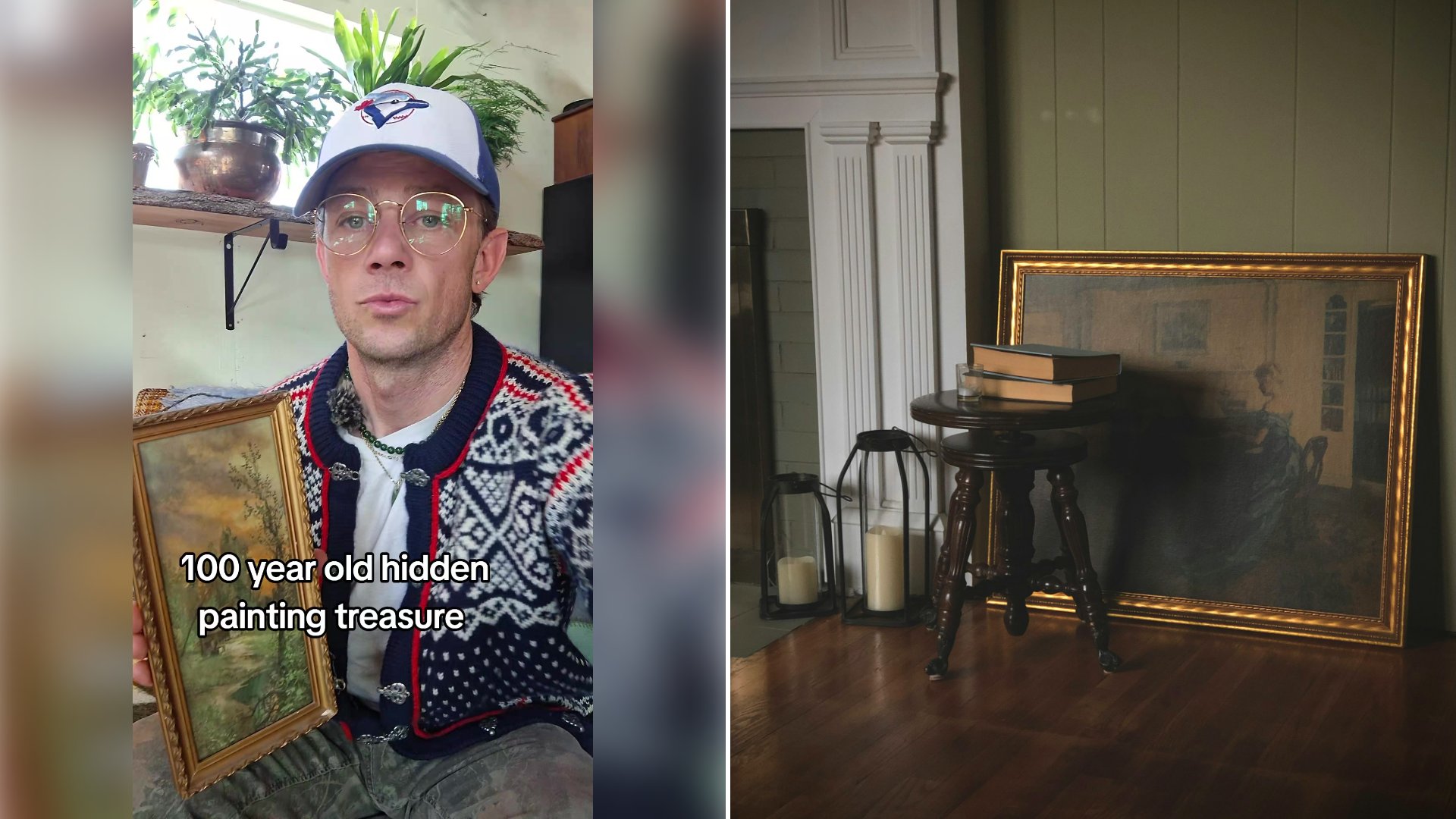
Some people walk past old framed pictures in thrift stores without a second glance. The thrifter behind @my.offgrid.adventure does the opposite. Whenever he goes to a thrift store, he says, he always looks for old pictures, because you never know what might be tucked behind them. His latest example is a print dated 1909 that spent two years on his wall before he finally decided to take it apart.
@my.offgrid.adventure
Two Years on the Wall
The story begins in a very ordinary way. The print had been hanging in his home for the past two years, and one day he noticed it looked kind of dirty. He decided he should take it out and clean it. As he looked it over, he noted that the front glass is handmade, a detail that often signals an older piece. He also said that the print is from 1909, which he describes as about a hundred years old.
His caption jokes that it is funny the picture had been sitting on his wall all along. That is a feeling plenty of collectors know well. Sometimes the best surprises are not in the next store or the next sale but in the thing you already brought home and hung up without thinking.
A Hunch Based on Experience
He did not go into this blind. He explains that he has already found a love letter behind a print, so he has seen how these old frames can hide things. Based on that earlier experience, he told his audience he was pretty sure there was something behind this one as well.
His hunch is rooted in a real habit. As he puts it, sometimes there is money, and sometimes you just never know what valuable goods are behind these old pictures. That is why he keeps checking the framed art whenever he is thrifting.
Pulling the Nails
Next came the careful part. He picked up a pair of pliers and began pulling out the nails that held the frame together. Take your time with this step, because old nails can be brittle and the wood around them can split.
Once the frame was open, the first layer he found was cardboard. Under it was the print itself, and behind the print was another piece of cardboard. For a moment it might have looked like the end of the road, but when he lifted that second layer he made his discovery. There was a hand painting hiding behind the print.
His reaction was pure joy. He said he could not believe there was a hidden painting behind the picture, and that he knew there was something behind it. He called it an old painting and said, simply, that it is so cool.
Why Old Frames Hide Surprises
It may sound strange that a painting could end up behind a print, but there are a few reasons old frames can hold unexpected things.
In earlier times, frames and artwork were not always treated as precious. A family might reuse a good frame for a new picture, slipping the newer print in front without removing what was already inside. People also used spare cardboard, newspaper or scraps of paper as backing to make a picture fit snugly, and sometimes those scraps were old letters, photos or drawings. In other cases, a small painting was simply stored out of sight behind another picture for safekeeping.
For researchers and appraisers, these hidden layers can be valuable clues. Backing boards and papers can reveal approximate dates, the name of a framer, a shop address or a note from the person who owned the piece. Old newspaper used as backing can sometimes be dated by its headlines, while handwriting on the back of a board might name the artist or a recipient.
How to Look Behind a Picture Safely
If you want to try this yourself, a few cautions are worth knowing before you grab the pliers.
First, look at the back before you touch anything. Examine the dust cover, the hanging wire and any labels, stamps or handwritten notes. Take a photo of everything exactly as you found it, so you have a record of what the original assembly looked like. Second, work on a clean, flat surface with a soft cloth or towel under the frame, which protects both the glass and the table.
Third, remove fasteners slowly. Old frames may be held by nails, brads or small metal tabs, and they can be rusty. Use pliers or a flat tool gently, and avoid prying hard against the wood. Fourth, handle the glass with care. Old glass can be thin and uneven, and a crack can slice a finger quickly. Wear gloves if you have them.
Fifth, resist the urge to clean the artwork itself. Paper, paint and old adhesive can all be damaged by household cleaners. If you find a hand painting, keep it out of direct sunlight, avoid touching the painted surface, and consider asking a conservator or an appraiser for advice before you try to restore anything.
Reading Clues in Old Glass and Prints
His observation about the handmade front glass is a nice detail to remember. Antique glass can have tiny bubbles, faint waves or slight distortion, because older manufacturing methods were less uniform than modern ones. If you see those traits, it may be a sign that the glass is original.
A date on a print can also be tricky. A date printed on the piece might refer to when a design was copyrighted, when an image was published or when the frame was assembled.
The Thrill of Looking Closer
What makes this story so appealing is how simple the lesson is. A dusty picture on a thrift store shelf, a few nails, a pair of pliers and a bit of curiosity were all it took. The thrifter did not need an expert, a fancy tool or a lot of luck. He needed the habit of looking carefully at things other people ignore.
The moment captured the joy that keeps thrifters coming back. Next time you pass a row of old pictures, take a second look, flip one over, and ask what might be waiting behind the cardboard.

Leave a Reply