

Some family traditions are passed down at the dinner table. This one was passed down in the backyard. Fifty years ago, a grandfather had a time capsule buried on the family property, and he had one request for the relatives who came after him: wait, and open it just as planned. Now the whole family has finally gathered on a sunny lawn to do exactly that.
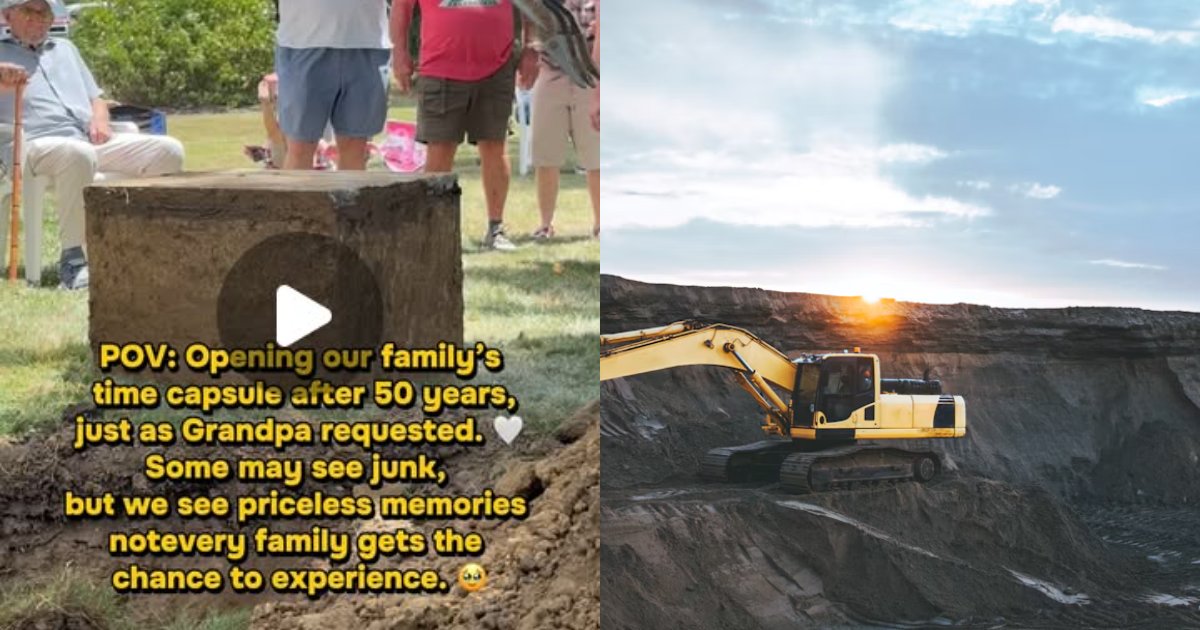
The moment was shared by @mommakay93 on Instagram, who described it as the chance to see “priceless memories not every family gets the chance to experience.” Some people might look at a vault full of weathered old things and see junk. This family clearly saw something else.
Heavy machinery for a heavy lid
A time capsule that has been underground for half a century is not something you pop open with a screwdriver. The family gathered on the grass beside a house while an excavator hoisted a large concrete lid off a buried rectangular vault. Relatives stood around watching, some with phones raised to catch the moment the seal came away from the ground.
Once the lid was off, a man used a tool to pry along the edge of the container. Inside, there was insulation packed around the contents and a lot of items that had clearly taken on water over the decades. Nothing about it looked pristine, and that is part of the charm. Fifty years in the ground leaves its mark.
Gloves on and everything out on the tables
Next, family members pulled on protective gloves and started unpacking. Folding tables were set up right on the lawn, and dozens of weathered items were laid out for everyone to see. The collection included vintage newspapers and magazines, old soda bottles, Pabst Blue Ribbon cans, license plates, matchbooks and pins.
The showstopper might have been an unopened bottle of Four Roses bourbon, which one person held up proudly for the crowd. The rest of the haul reads like a snapshot of everyday life in the 1970s: what people read, what they drank, what they carried in their pockets and stuck on their jackets.
Why ordinary objects make the best time capsule contents
Nothing in this capsule was a famous collectible, and that is what makes it so appealing. A newspaper from the day shows what was making headlines and what things cost. A beer can shows the branding and design of its era. A license plate shows what a state looked like on the road. A matchbook might name a restaurant or a bar that closed decades ago. Together these small, everyday things tell you more about a time and place than one fancy keepsake ever could.
The story also carries something harder to see on a table: a grandfather who thought ahead. He chose a place, buried the capsule, and trusted that his family would wait. Fifty years later they did, and they did it together.
Ideas if you want to start your own family time capsule
This family’s capsule is a good reminder of what to do, and what to plan for, if you want to leave something behind for the next generation.
- Choose everyday items such as a current newspaper, a magazine, a drink can or a pin. The ordinary things are the ones people find fascinating later.
- Plan for moisture. Water got into this vault over time, so sealing paper items in airtight, waterproof containers gives them a better chance.
- Pad the contents with insulation or other protective material so items do not knock into each other.
- Write down where the capsule is buried and when it should be opened, and tell more than one person.
- Invite the whole family to the opening. Having everyone there is half the fun.
How time capsules are usually built to last
The best capsules treat water as the enemy. Containers are typically made of materials that resist corrosion, such as stainless steel, thick plastic pipe with sealed end caps, or poured concrete, and the seams are sealed so moisture has a hard time creeping in. Even then, buried containers face shifting soil and groundwater, which is why a vault that has sat underground for decades can still end up damp inside. Small packets of silica gel and paper wrapped in acid free tissue give the contents a better chance.
What to do when you open one
- Photograph everything exactly where it sits before moving it. The arrangement is part of the record.
- Wear gloves, and consider a dust mask if anything looks moldy, because damp paper can grow mold.
- Do not pull apart stuck pages. Lift wet paper gently on a flat tray and let it dry slowly, away from direct sun and heat.
- Rinse dirt off metal and glass gently rather than scrubbing, since hard cleaning can remove the printed graphics collectors care about.
- Keep a simple inventory of what each item is and what shape it is in.
As for what it all might be worth, that depends on condition, rarity and demand. Water damaged paper and rusty cans are usually valued for the history they carry rather than a price tag, and a sealed bottle is often kept as a display piece.
The takeaway
A time capsule works because it freezes ordinary life in place. Planning for moisture, writing down the plan and getting the family together turns a hole in the ground into a story that can be told for generations.
Credit for the original post goes to @mommakay93 on Instagram.

Leave a Reply