

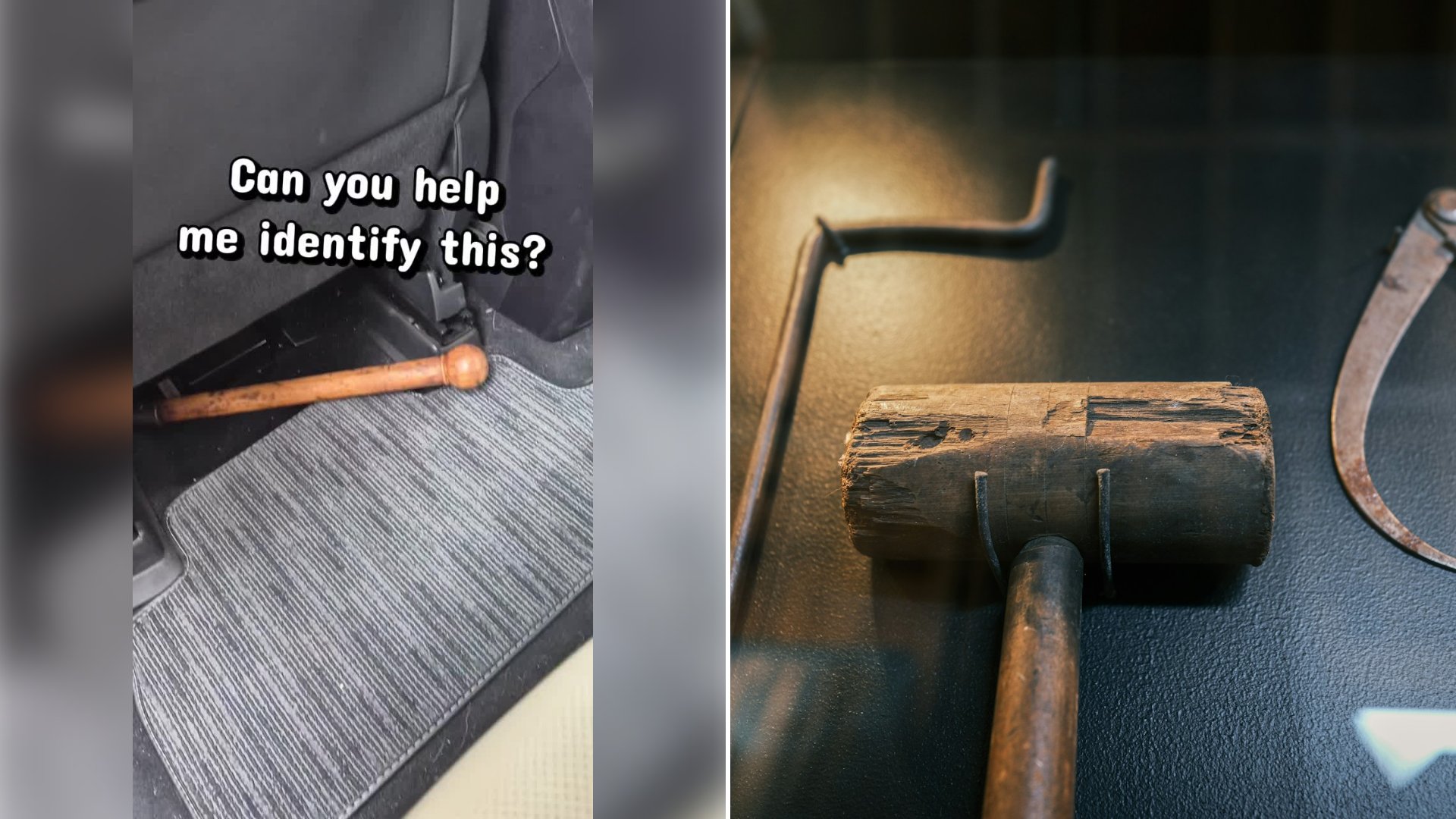
Every family seems to have one object nobody can explain, tucked in a junk drawer or, in this case, wedged under a car seat for who knows how long. TikTok creator @jnmwoodworking finally decided to crowdsource an answer after pulling out a mysterious antique wooden club shaped tool that has apparently been a longstanding, unsolved family mystery. The video simply shows the object from every angle and asks viewers what on earth it actually is.
The tool has a rounded, club like head, a worn wooden handle, and the kind of smoothed, darkened surface that only comes from decades of handling. It is clearly old, clearly handmade or at least hand finished, and clearly designed to do something specific, which is what makes the mystery so compelling. There is no label, no stamp, no obvious clue beyond its shape and the wear patterns left behind by whoever used it.
@jnmwoodworking
Club shaped wooden tools like this one show up often enough in antique circles that there is a fairly short list of likely candidates, and shape plus wear pattern usually narrows it down quickly. A smooth, rounded head with a worn handle and no sharp edges is a classic profile for a laundry bat, sometimes called a washing beetle or wash paddle, which was used before electric washing machines to beat dirt and water out of wet clothing against a washboard or flat stone. The repetitive swinging motion explains the kind of even, polished wear found on handles of genuine antique examples.
Other strong contenders in this category include a butter paddle or butter worker, used to shape and press butter after churning, and a meat mallet or tenderizing bat, used in home kitchens before standardized metal versions became common. Each of these tools shares the same basic club silhouette because the job they did required a solid, blunt striking or pressing surface attached to a handle built for repeated hand use. Without maker marks, the most reliable way to narrow the identification further is usually the exact weight, the presence or absence of ridges or texturing on the striking face, and any regional context about where the family lived and what work they did.
What makes objects like this genuinely rewarding to research is that they represent the kind of everyday labor that rarely gets documented formally. Nobody wrote a manual for grandma’s laundry bat, it was just a tool that got used, handed down, and eventually forgotten in a junk drawer or, apparently, under a car seat. Crowdsourcing an identification taps directly into people who recognize these tools from their own family history, which is often more reliable than any catalog, since catalogs rarely bothered to record the humble, handmade tools that got the actual chores done.
Whatever the final verdict turns out to be, the mystery itself is the real draw. A single unlabeled object, passed down through enough years that even the family has lost the thread, is a small reminder of how much everyday history simply slips away unrecorded, waiting for the right comment section to bring it back.
More from Vinyl and Velvet
- An Antique Warehouse Tour Reveals a Working Miniature Salesman’s Sample Barber Chair and a Mystery Object Several Commenters Swear Looks Like a Bazooka
- A Restorer Strips Decades of Paint Off an Antique Door Latch Using the ‘Crockpot Method,’ and Commenters Joke That It Looks Like Someone Is Slow-Cooking a Victorian Lock for Dinner
- Thrifter Lifts a Wooden Chair Off the Shelf, Flips the Seat Back Forward, and Realizes Mid-Reaction That the Whole Piece Unfolds Into a Four Step Library Ladder

Leave a Reply