

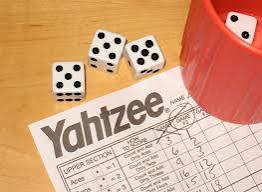
Yahtzee’s official corporate history starts with a detail most board games can’t claim: the game was invented by a couple who never wanted credit, sold it for a price measured in game sets rather than dollars, and never came forward publicly even after their creation sold tens of millions of copies.
A Dice Game Invented for a Circle of Friends
According to Hasbro’s own account of the game’s origins, Yahtzee began sometime in the early 1950s as a homemade dice game played by a wealthy Canadian couple aboard their private yacht. They called it simply The Yacht Game, and it caught on quickly with the friends they invited aboard to play it. The rules — five dice, thirteen scoring categories, three rolls per turn — were entirely their own invention, refined through repeated play rather than any formal design process. Toy history archives corroborate the account: the couple’s identity has never been publicly confirmed, and by most tellings they never sought recognition for creating what would become one of the best-selling dice games in history.
A Deal Paid in Game Sets, Not Cash
The game might have stayed a private amusement for one social circle if the couple hadn’t wanted more copies to give away. They approached Edwin S. Lowe, a New York toy manufacturer who had already built a career popularizing Bingo in the United States, and asked him to produce a run of gift sets so they could hand the game out to friends. Lowe recognized commercial potential the couple apparently didn’t see in their own creation, and according to Hasbro’s history, he acquired full rights to the game in exchange for 1,000 finished gift sets — no royalty, no ongoing payment, just product. It’s a strikingly modest transaction for a game that would go on to sell tens of millions of units worldwide.
Renamed, Trademarked, and Nearly a Flop
Lowe rebranded The Yacht Game as Yahtzee and filed the trademark with the U.S. Patent Office, with the mark’s first commercial use dated to early April 1956. But the rename didn’t translate into instant sales. Lowe classified and marketed it as a poker dice game, and early advertising struggled because the scoring system was hard to explain in a print ad or a thirty-second pitch — you basically had to play it to understand why it was fun. Sales in the earliest going were, by most accounts, underwhelming for a company betting real production money on a new title.
Parties Sold the Game When Ads Couldn’t
Lowe’s fix was to abandon conventional advertising almost entirely. Instead, the company organized and promoted Yahtzee parties — informal gatherings where people could sit down, roll the dice, and understand the appeal in ten minutes flat. The strategy worked because it solved the exact problem traditional ads couldn’t: Yahtzee needed to be experienced, not described. Word-of-mouth from those living-room gatherings drove momentum through the late 1950s and into the 1960s, and by the time E.S. Lowe Company sold to Milton Bradley in 1973, more than 40 million units had already been sold. Milton Bradley itself became a Hasbro subsidiary in 1984, and Hasbro has reported annual sales in the range of 50 million units in the years since.
The Quietest Origin Story in Board Game History
Most vintage toy and game origin stories involve an inventor chasing recognition, patents, and royalties for decades. Yahtzee’s founding couple did the opposite: they built something purely for their own enjoyment, gave it away casually to a manufacturer for a stack of finished sets, and then disappeared from the story entirely. Nearly seventy years and tens of millions of sold copies later, nobody officially knows their names — just that they liked rolling dice on their yacht, and that the deal they struck for a thousand gift sets ended up being one of the most consequential handshake agreements in board game history.

Leave a Reply