

On January 5, 1978, a private citizen named Mark Berson filed a petition with the U.S. Consumer Product Safety Commission asking the agency to ban particleboard containing formaldehyde outright, or at minimum require cautionary labels on it, according to the commission’s own records. It’s a minor entry in a federal agency’s case file, and it targeted particleboard broadly rather than paneling specifically. But it marks close to the exact moment formaldehyde stopped being an obscure chemistry term and started being a reason to avoid a wall covering that was, at that point, sitting in a huge share of American living rooms.
How Paneling Got Everywhere
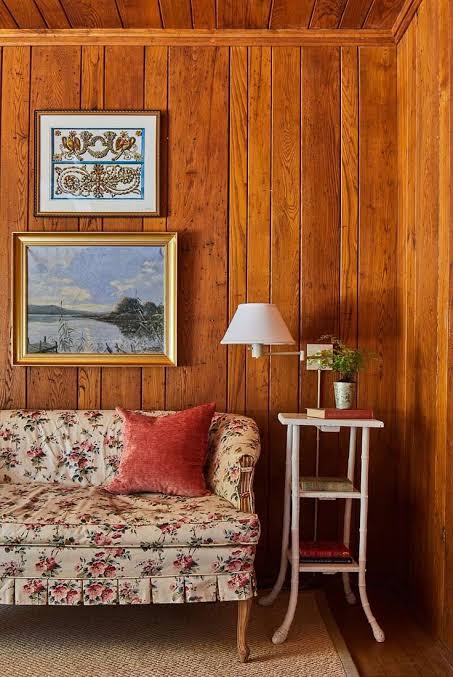
Cheap wood-grain paneling was never sold as a design statement. It was sold as a shortcut. Hardboard and thin plywood-veneer panels, bonded together with urea-formaldehyde resin adhesives, let a homeowner or a builder cover an entire wall in an afternoon without the mess or skill drywall and plaster required, and the material became “one of the most common” ways prefab and postwar homes finished interior walls through the 1960s and 1970s, according to wall-panel manufacturer George Panel’s own account of the category’s history. It looked good against the mid-century interest in bringing natural materials indoors, it hid imperfect framing, and it was cheap enough that it became a default finish rather than a deliberate choice in millions of new-construction and renovated rooms. Basement rec rooms, dens, and starter-home living rooms across the country got the same treatment for the same reason: a four-by-eight sheet cost less, went up faster, and needed no paint, sanding, or drying time compared with a plastered or drywalled wall.
\
The Chemical Behind the Panel
The resin that made paneling cheap and easy to bond is the same resin that eventually made regulators nervous. Urea-formaldehyde adhesives off-gas formaldehyde over time, and by the late 1970s the CPSC was fielding enough complaints about a closely related product, urea-formaldehyde foam insulation, to document 195 separate incidents of “odor and health problems” reported since 1972, including cases where residents left their homes entirely, according to the commission’s own 1978 release on the issue. The gas, the agency noted, “can be highly irritating, causing respiratory difficulties, headaches, nausea, dizziness and eye and skin irritation” at elevated concentrations — the same active ingredient bonding the fibers in a hardboard wall panel.
The regulatory fight came to a head on April 2, 1982, when the CPSC issued a final rule banning urea-formaldehyde foam insulation in homes and schools outright, citing both cancer and acute-irritant risks. That ban didn’t survive contact with the courts. The U.S. Court of Appeals for the Fifth Circuit vacated it on June 23, 1983, ruling the commission’s evidence was too thin to justify a full prohibition — roughly 71% of the formaldehyde measurements the agency relied on came from homes where residents had already complained of symptoms, and the cancer-risk finding rested on a single rat study involving 240 animals, according to the court’s own opinion in Gulf South Insulation v. CPSC. Notably, the opinion itself flagged that particleboard and paneling relied on the same formaldehyde-based bonding resins the insulation ban targeted, without those products facing the same court-imposed evidentiary bar.
A Reputation That Outlasted the Regulation
The legal defeat didn’t undo the damage to formaldehyde’s reputation. Manufacturers spent the following years reformulating pressed-wood products, and by the commission’s own more recent accounting, emissions from pressed-wood goods have dropped 80 to 90 percent from 1980s-era levels, driven by mandatory formaldehyde standards adopted in California and voluntary national standards that followed, according to the CPSC’s own formaldehyde update. That’s the real mechanism behind paneling’s disappearance from American living rooms: not a single dramatic ban on the product itself, but a slow-building consumer and regulatory wariness toward the resin holding it together, arriving at almost the exact moment 1980s design was already moving toward pastels and lighter, painted interiors anyway.
By the time drywall and fresh paint fully retook the American living room, wood paneling wasn’t just outdated. It was the wall covering people specifically remembered as the one that might be making the air worse, whether or not any individual sheet actually was — and reputations built out of genuine 1970s and ’80s regulatory battles tend to outlive the science that gets litigated years later.

Leave a Reply