

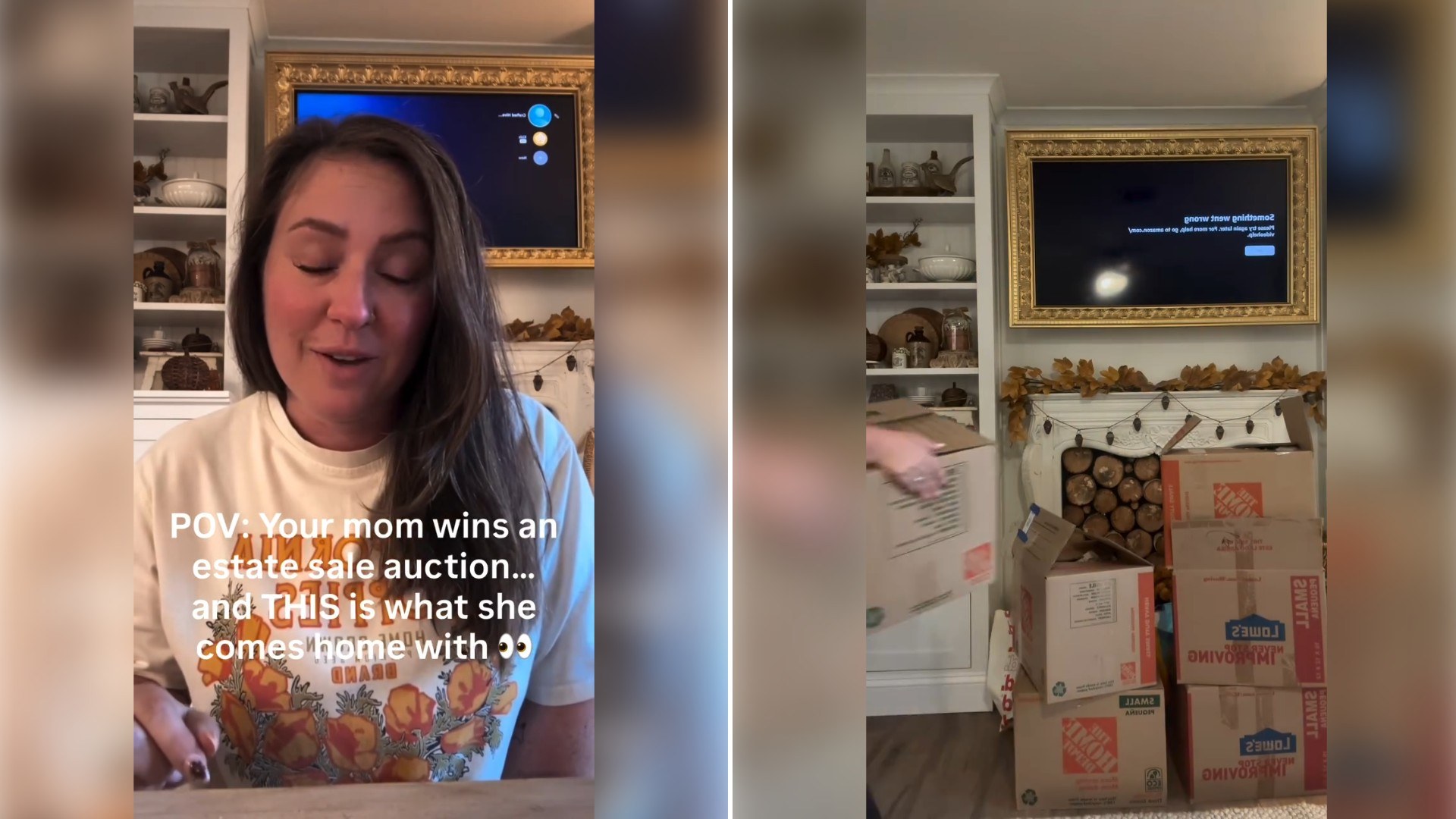
Estate sales have always carried a whisper of mystery, but few people take that mystery as far as the mother at the center of a viral moment shared by @craftedhiveculture. According to the creator, her mom did not simply browse tables of secondhand goods looking for a bargain; she bid on an entire estate auction lot completely sight unseen, with no idea what was packed inside the boxes she was buying. It is the kind of gamble that estate sale veterans talk about in hushed, half-admiring tones, the auction equivalent of buying a storage unit without ever lifting the door.
The payoff, or at least the beginning of it, arrived when the mother came home with her car packed full of unopened boxes, the contents of an entire household distilled into cardboard and packing paper. Speaking directly to the camera, the creator walks viewers through just how blind the purchase really was, explaining that literally nobody in the family had any idea what was waiting inside. That kind of uncertainty is rare in an era when most secondhand shopping happens with the buyer holding every item in their hands before committing to a price.
View this post on Instagram
The video then cuts to b-roll of the actual unpacking beginning, boxes being pulled from the car and opened one after another, with the creator promising a full, item by item reveal in a follow up video. That promise alone is enough to hook an audience that has grown obsessed with the slow reveal format, the modern equivalent of watching someone open a time capsule, except this time capsule was assembled by a stranger’s entire life and sold off in a single blind lot to the highest bidder.
Blind estate auction lots exist for a simple, practical reason: when a family is closing out an entire household, whether after a death, a downsizing, or a move into assisted living, sorting every single item individually for sale can take weeks that nobody involved has the time or emotional bandwidth for. Auction houses and estate liquidators will sometimes bundle the leftover, unsorted contents of a home into lots specifically because it is faster to sell everything at once to a buyer willing to take the risk than to catalog every last drawer and closet.
For the buyers who take that risk, the appeal is part financial calculation and part genuine thrill. A single blind lot can contain anything from worthless clutter to genuinely valuable antiques, vintage jewelry, or collectibles that the estate itself never had properly appraised, meaning a confident or lucky bidder can occasionally walk away with items worth many multiples of what they paid. It is a strategy that requires real nerve, since the same lot can just as easily turn out to be mostly packing material and broken lamps.
This kind of content has become a full subgenre of secondhand and thrifting media precisely because it recreates suspense that scripted shows spend enormous budgets trying to manufacture. There is no need for a twist ending when the entire premise already guarantees one; every box could hold something worthless or something extraordinary, and neither the creator nor the audience knows which until the tape is cut and the flaps come open. That built-in uncertainty is a big part of why these reveal videos routinely rack up views that more polished, predictable content struggles to match.
For anyone tempted to try a blind lot themselves, estate sale regulars generally recommend starting small and doing a little homework first, since not every auction house handles unsorted lots the same way. Attending in person when possible, asking whether any items were already appraised or excluded from the lot, and setting a firm spending limit before the bidding starts can all soften the risk without eliminating the thrill entirely. It will not guarantee a jackpot, but it does mean that whatever ends up coming out of those boxes, win or bust, the story is one worth telling.
There is also a broader lesson here about how quickly a family’s accumulated belongings can end up scattered into blind lots once nobody is left to sort through them personally. Estate liquidation has become its own small industry precisely because so many households reach a point where a lifetime of possessions needs to move quickly, and stories like this one are a reminder that behind every mystery box sits a home that once had its own daily rhythms and routines, now reduced to cardboard waiting for a stranger to decide what happens to it next.
Whatever ends up inside those boxes, the anticipation itself has already done its job, turning a private family gamble into a story an entire audience now feels personally invested in. That kind of built-in stake, wanting to know the outcome of someone else’s risk, is exactly what keeps a promised follow-up video from feeling optional, since viewers who watched the setup will want to see how the bet actually paid off.
For readers who have ever wondered whether they would have the nerve to bid on something completely unknown themselves, stories like this one offer a useful gut check, since the appeal clearly lies less in guaranteed value and more in the simple thrill of not knowing, a trade-off that only makes sense for buyers genuinely comfortable walking away with nothing worthwhile at all.
Professional estate liquidators who handle these blind lots for a living often note that the biggest financial risk usually is not fraud or misrepresentation but simple logistics: hauling away heavy furniture, storing dozens of unopened boxes until there is time to sort through them, and disposing responsibly of whatever genuinely turns out to be worthless. That unglamorous back end of the hobby rarely makes it into a highlight reel, but it is very often the real determining factor in whether a blind lot purchase ends up feeling like a win or simply an expensive storage problem.

Leave a Reply