

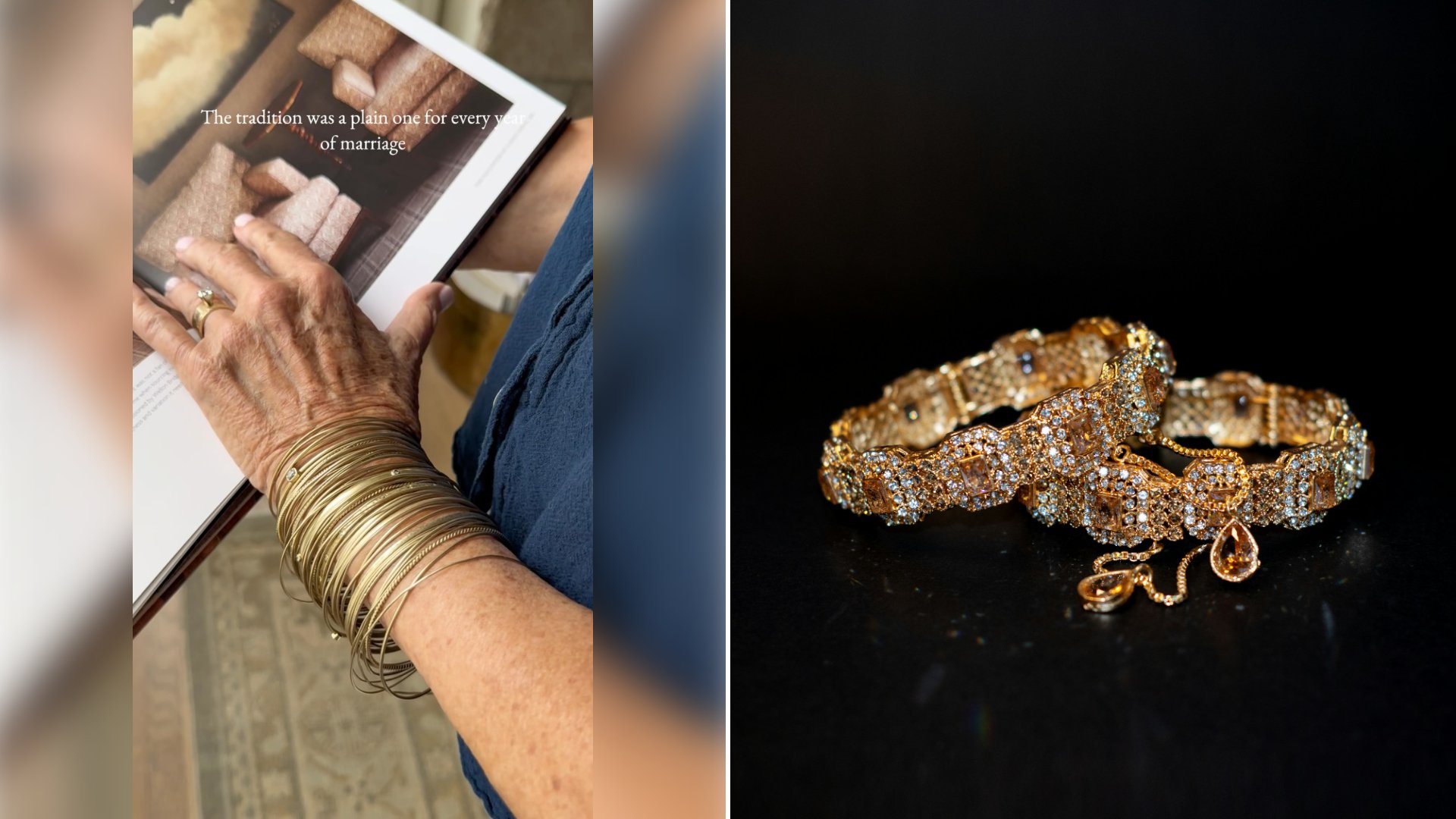
“Hi, my name is Jannie. This is my stack,” she says, sitting in an armchair in a sunlit living room, her forearm wrapped almost wrist to elbow in thin gold bangles. “49 for 48 years of marriage, plus one from my wedding day.” The video, posted by @yearlycompany, moves between Jannie talking and close-up shots of the bangles themselves, some of them visibly bent and worn thinner than the rest.
The oldest piece in the stack is also her favorite. “My favorite one, probably my first one,” she says. “That one had belonged to my husband’s mother.” The earliest bangles in her collection bend more easily than the newer ones, a difference she attributes to a change in who has been making them over the years: “Since Ann’s been making them, they don’t bend as much. They don’t bend at all.”
She lays out the rule the stack was built on while turning the pages of a photo album, her bangles sliding and catching the light. “The tradition was a plain one for every year of marriage, and on the year a child was born, it had notches,” she says, a small, specific detail that turns the stack into something closer to a timeline than a jewelry collection, each bangle corresponding to an actual year, and the notched ones marking the years her children arrived. “I’ve gotten some fancier ones, but I love the twist,” she adds, naming a few favorites by design: an antique diamond pattern, and what she calls her fanciest, an étoile style. “And I love them all together,” she says. “I like the sound they make, and I like the way they feel.”
A one-bangle-per-year anniversary tradition like Jannie’s is a version of a custom that shows up across several cultures, most prominently in South Asian bridal jewelry, where a new bride traditionally receives a set of gold or glass bangles at her wedding, sometimes added to again at major anniversaries or after the birth of a child. What makes Jannie’s version distinctive is the documentation built into the jewelry itself: a stack that grows by exactly one piece a year, with notches marking births, functions as a wearable family record that a photo album or a written journal would normally hold instead.
For anyone hoping to start or continue a tradition like this with inherited or custom pieces, jewelers who specialize in bangle stacking generally recommend keeping each piece slightly different in width or finish, the way Jannie’s early thin bangles contrast with her newer, sturdier ones, both so individual pieces are easier to tell apart over time and so the stack can be added to gradually without needing to match an exact original design. Keeping a simple written log of when and why each piece was added, something Jannie’s story suggests she may be doing mentally if not on paper, also protects that history for whoever inherits the collection next.
More from Vinyl and Velvet
- Jeweler Reads the Engraving Inside an 18 Karat Wedding Band a Snorkeler Says She Found in the Adriatic Off a Puglia Beach Club and Vows to Return It to Whoever Knows the Full 2017 Date
- Volunteer Gravestone Cleaner Asked Viewers Who Joseph Lampkin Was, Then Cleaned His 1871 Headstone and Revealed the Railroad Dump Car Accident That Killed Him at 17
- Safe Technician Empties a Hidden Safe He Says a Family Found Two Months After Losing Their Sister and Pulls Out Coin Collection Books, a Pouch of Rolled Coins and a Revolver Booklet

Leave a Reply