

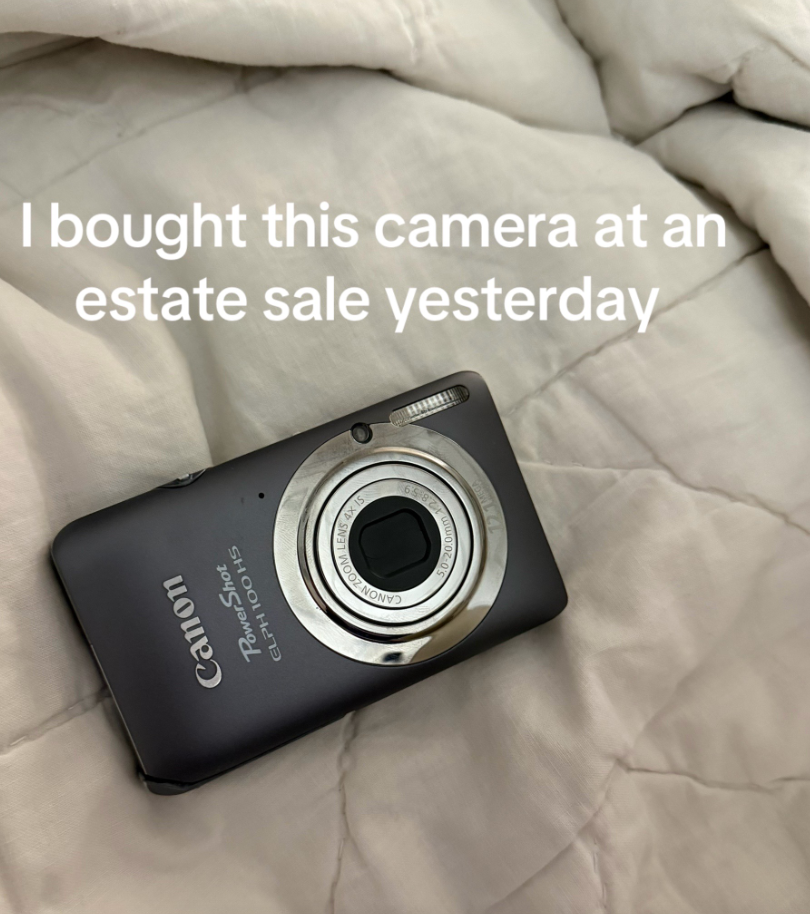
Haylee Davis picked up a used camera at an estate sale for $10, the kind of impulse buy thrifters make on instinct alone. What she didn’t expect was to later discover a photo of herself at age nine already stored inside it. Davis shared the discovery on TikTok under her handle, @hayleeadavis.
In her post, Davis lays out the basic shape of the find: she bought a secondhand camera at an estate sale for $10, and at some point afterward discovered that it already contained an image of her at nine years old. That detail alone is what makes the story stand out even among the crowded genre of thrift and estate-sale finds — it isn’t simply a coincidence of taste or timing, but a direct, personal link between the buyer and an object she had no prior reason to think had anything to do with her.
What Davis’s own post does not establish is exactly how that photo ended up on that specific camera, or the full chain of ownership the device passed through before landing at the estate sale where she bought it. Estate sales typically involve items accumulated from a single household or family over years, sometimes decades, and cameras in particular can pass between relatives, get repurposed, or sit unused in storage long enough that their contents predate their most recent owner by a wide margin. Without a documented account of who owned the camera between the time the photo was taken and the day it appeared at the sale, the discovery is best understood as a striking, verified coincidence rather than a fully “solved” mystery — what’s confirmed is what Davis found and where, not the complete history of how it got there.

That distinction doesn’t make the story any less remarkable. Finding any trace of your own childhood inside an object you bought as a stranger, for a few dollars, at a sale run by people you’d never met, is the kind of thing that would stop most thrifters in their tracks. It’s the sort of find that collectors and secondhand shoppers talk about for years afterward, precisely because it defies the odds in a way that’s hard to explain away — even without a fully reconstructed timeline of the camera’s past owners.
The TikTok photo post linked above is where Davis shared the image and the story behind it, walking her followers through exactly what she found and when.
Estate sales occupy a different niche than typical thrift-store browsing, which is part of why this particular find carries an extra layer of intrigue. Unlike donated goods that pass through a store’s general intake process — often sorted, cleaned, and stripped of any obvious personal context before they reach a shelf — estate sale items are usually sold more or less as they were left, straight out of a home, a garage, or a storage unit, with whatever contents or personal traces they still carry. That’s precisely why cameras can be such an unpredictable category at estate sales: a device that looks empty on the outside can still hold an SD card, undeveloped film, or internal memory from whoever used it last, sometimes years earlier.
That unpredictability is exactly what makes Davis’s story land the way it does, and also why it’s worth being precise about what has and hasn’t been established. What’s confirmed, through Davis’s own post, is the purchase price, the discovery itself, and her account of finding an image of herself at nine years old. What isn’t confirmed is the specific sequence of hands the camera passed through between whenever that photo was taken and the day it appeared at the estate sale Davis attended. That gap matters: a family member could have owned the camera the whole time before it was sold as part of an estate, it could have changed hands multiple times, or there could be a mundane explanation involving a shared device. Absent documentation of that chain, the responsible framing is a verified, striking coincidence with an unconfirmed backstory, not a fully solved mystery.
Even with that caveat, it’s easy to see why the discovery struck a nerve online. Estate sales are inherently a little uncanny — strangers walking through the remnants of someone else’s life, pricing and picking through what’s left — and finding a literal trace of your own childhood in that setting collapses the usual distance between buyer and seller in a way few other thrift-store stories manage.
The Takeaway
Secondhand cameras, especially older film and point-and-shoot models, are worth a second look before you clear their memory or send them for repair — undeveloped film, SD cards, or internal storage sometimes still holds images from a previous owner, and those photos can occasionally lead somewhere meaningful, whether that’s identifying a past owner or, in rare cases, connecting back to your own history. If you buy a used camera at an estate sale or thrift store, check for film or storage media before assuming it’s empty, and consider it good etiquette to try to return any personal photos you find to their rightful owner if you can identify them. Estate sales in particular tend to move quickly and don’t always come with a documented history of an item’s prior owners, so a little curiosity about an object’s past — asking the seller what they know, or simply examining what’s inside — can turn an ordinary find into a story worth telling.

Leave a Reply