

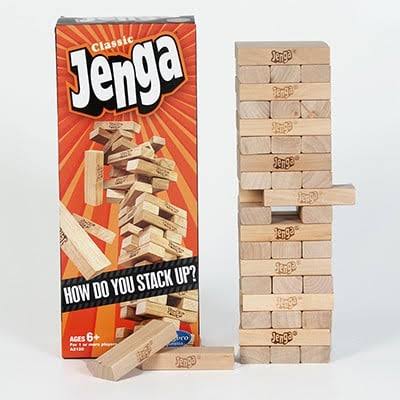
Jenga’s name comes from the Swahili word kujenga, meaning “to build,” and that’s not a marketing flourish tacked on after the fact. Leslie Scott, the game’s inventor, grew up speaking Swahili as a second language and spent her formative years in West Africa, where the wooden blocks that became Jenga started life as a homemade family pastime, not a product.
Blocks From a Ghanaian Sawmill
Scott was born in Tanganyika, in what is now Tanzania, and later relocated with her family to Ghana. According to the documented history of the game, her family had a set of wooden building blocks custom-cut from a sawmill in Takoradi, Ghana, and the block-stacking game that became Jenga evolved out of ordinary family play in the early 1970s. There was no design brief and no toy company involved — just a family with easy access to timber and an appetite for a simple physical challenge: build a tower, then take turns removing pieces from it without letting it fall.

From Oxford Dinner Parties to a Trademark
Scott eventually moved to Oxford, England, in her twenties, bringing sets of the blocks with her. The Strong National Museum of Play’s account of her career describes how British friends who encountered the game became genuinely enthusiastic about it, which convinced Scott there was a real commercial opportunity. She commissioned an initial production run of 100 sets through Camphill, a Yorkshire community organization that supports people with learning disabilities, and went into real personal debt getting the product ready for market. She trademarked the name Jenga and launched it commercially at the London Toy Fair in January 1983 through her own company, Leslie Scott Associates. She chose the name specifically because it referred to nothing else in English — she wanted the word to become synonymous with the game itself rather than compete with an existing meaning.
A Department Store Demo That Sealed the Deal
Getting retail buy-in required Scott to personally sell the concept. Harrods agreed to stock the game only on the condition that Scott demonstrate it in person during the Christmas shopping season, which she did, standing at a table stacking and toppling towers for shoppers who had never seen anything like it. That grassroots, hands-on demonstration strategy — remarkably similar to how other now-classic games of the era won over skeptical retailers — helped Jenga find its first real commercial footing in the UK.
Crossing the Atlantic Through a Chain of Licenses
Jenga’s path to global distribution ran through a chain of licensing deals rather than a single big sale. In 1985, entrepreneur Robert Grebler acquired the U.S. and Canadian rights and assigned worldwide licensing to a company called Pokonobe Associates. Corporate history records show the license passed from there through Irwin Toy to Schaper, and when Hasbro later acquired Schaper, Jenga was relaunched under the Milton Bradley banner in 1987. That licensing structure has proven durable but financially lopsided for Scott herself: reporting on the arrangement indicates Pokonobe Associates has retained roughly 80 percent of royalties over the decades, with Scott’s share closer to 20 percent or less — a split she has said in interviews she came to regret once Jenga’s scale became clear.
From a Family Pastime to the Toy Hall of Fame
By 2019, worldwide sales of Jenga had passed 80 million game sets — the equivalent of more than 4.3 billion individual wooden blocks manufactured and shipped since Scott’s first Camphill production run. The game earned formal induction into the National Toy Hall of Fame on November 5, 2020, cementing its place alongside a small handful of games considered genuinely foundational to modern play. What makes Jenga’s origin stand out from most toy-aisle staples isn’t the eventual sales figures, though — it’s that the mechanic itself, pulling a single piece from a load-bearing structure without collapsing the whole thing, came directly out of a real childhood in Ghana rather than a boardroom brainstorm.

Leave a Reply