

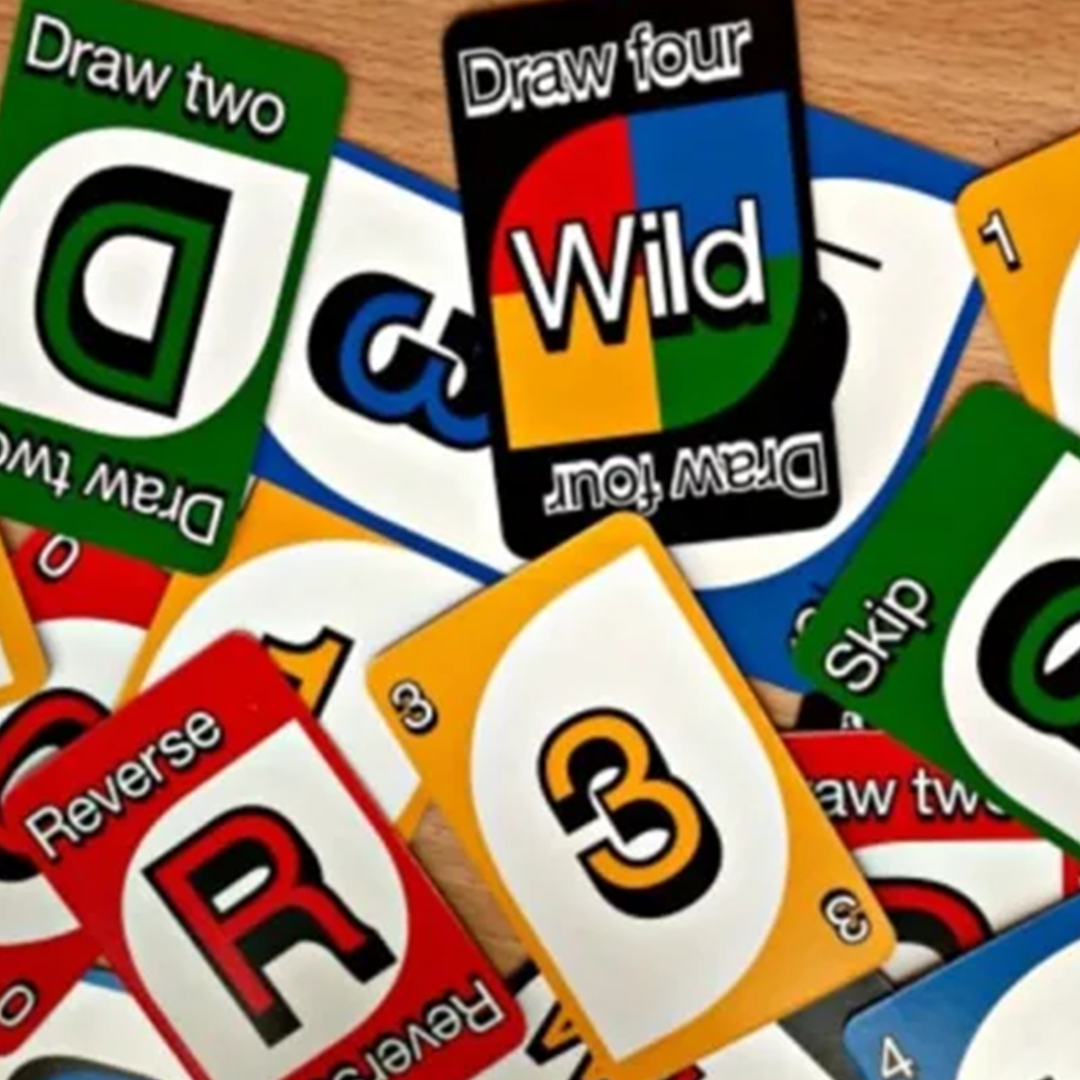
Merle Robbins mortgaged pieces of his household budget to print 5,000 copies of a card game he’d scribbled onto index cards, and sold them out of the barbershop he ran in Reading, Ohio. That barbershop game became Uno, and by the time Mattel bought the company that owned it, the brand was moving more copies than almost any card game in the industry.
A Family Argument Over Crazy Eights
Uno began as a fix for a squabble. In 1971, Robbins and his family were playing Crazy Eights, a public-domain shedding game with roots in the German tradition of mau-mau, and couldn’t agree on the house rules. Rather than keep arguing, Robbins wrote down a fixed rule set, added a few new mechanics — the reverse, the skip, the wild card — and gave the whole thing a new name: Uno, Spanish and Italian for “one,” a nod to the rule requiring a player to announce the word when down to a single card. According to the documented account of the game’s origins, Robbins was working as a barber in Reading, a small suburb just north of Cincinnati, at the time.
Printed on Faith, Sold at the Barber’s Chair
Turning a house rule set into an actual product took real money the Robbins family didn’t have lying around. They pooled roughly $8,000 — a serious sum in 1971 dollars — to print 5,000 copies of the game. Robbins sold the first batches directly out of his barbershop, and the company’s own historical account describes local shops around the Cincinnati area gradually picking up the game as word spread through the Midwest and into the South. There was no distributor, no licensing deal, no toy-fair debut — just a barber convincing customers mid-haircut that this new card game was worth a few dollars.
The $50,000 Sale That Changed Everything
Word-of-mouth sales were real, but scaling a card game nationally required capital and infrastructure Robbins never set out to build. In 1981 he sold the rights to Robert Tezak, who ran a funeral home in Joliet, Illinois, and moonlighted as an entrepreneur. The terms of that sale were $50,000 up front plus a royalty of ten cents per game sold — a modest deal that nonetheless let Robbins walk away from the barber’s chair for good. Tezak formed International Games Inc., ran the operation out of a back office behind his funeral parlor, and had a local printer in Maywood, Illinois manufacture the cards. Under Tezak’s ownership Uno expanded into international markets, eventually printing instructions in more than a dozen languages.
Mattel Buys the Cornerstone
By the start of 1992, International Games Inc. had grown into a company with roughly $30 million in annual sales, more than 30 games on the market, and distribution in 25 countries — still a mid-sized operation compared to the major toy makers. That changed on January 23, 1992, when Mattel announced it was acquiring International Games Inc. in a stock swap of undisclosed value, folding Uno and its sister title Skip-Bo into Mattel’s newly formed games division. At the time, Mattel was the second-largest toy company in the country behind Hasbro, and the deal marked its first acquisition since buying Aviva Sport the previous year. Under Mattel’s marketing muscle, Uno went from a strong regional seller into one of the best-selling card games on the planet, eventually surpassing 150 million copies sold worldwide.
What a Barbershop Deal Was Really Worth
It’s tempting to read the $50,000 sale as the twist ending — the classic story of an inventor who cashed out too early. But that framing undersells what Robbins actually accomplished before he ever met Tezak. He took a house rule for a public-domain card game, self-financed a print run with no guarantee of return, and built enough regional demand that a stranger in Illinois was willing to pay real money and ongoing royalties for the rights. The barbershop wasn’t a footnote on the way to Mattel’s billion-dollar franchise — it was the only reason Mattel had anything worth buying two decades later.

Leave a Reply