

Most people would walk into a hotel room, see a pile of empty cardboard toy boxes and wonder whether someone forgot to take out the trash. A toy show host walked into one and saw a puzzle he was uniquely equipped to finish. By the end of the conversation, he had paid $1,000 for the lot.
The scene played out on a Saturday night at Retro HorrorCon, after the crowds had gone home. The host behind the Toy Federation show explained that during the day he is running around keeping the event on track, so he rarely gets a chance to shop the floor. His real shopping happens after hours, in what collectors call room trading, where dealers and fans sell straight out of their hotel rooms.
He was called into one room because the seller knew he likes boxes. The seller, he recalled, wanted something like $3,000 for everything he had, loose toys included. The host did not want everything. He wanted the empty G.I. Joe boxes, and he already owned plenty of loose figures and vehicles to put inside them.
Why Empty Boxes Are Worth Real Money
If that sounds odd, it is worth explaining to anyone who did not grow up tearing open Saturday morning toys. For many collectors of 1980s action figures and vehicles, the box is half the prize. A vehicle sitting loose on a shelf is one thing. The same vehicle with its original box, its artwork and its sticker sheet is something else entirely.
Among the boxes were ones for the Dreadnok cycle, Swampfire, the Skystorm X-Wing, the Armadillo and the Devilfish, along with the Destro Dominator. He pointed out details collectors look for: whether the flag points on the box had been cut out, how bright the white of the cardboard remained, and whether the stickers were applied cleanly. Another box was for the Hammer, which he called one of the most difficult G.I. Joe vehicles to find intact, partly because of its very long antenna that nearly every kid snapped off.
The deal came together after some back and forth. By his account, the seller first wanted around $1,200, and the buyer said he was fine at $1,000 for all of the empty boxes. Some boxes came with instructions too, which is another small detail that fills in a complete set.
The plan is to put the loose vehicles he already owns back into the matching boxes, then display the finished sets at his booth at an upcoming Retro Toy Con. He also admitted there is a catch. Some vehicles cannot be put back without damage. A Moray, he said, cannot be taken apart and boxed without breaking something, and he had broken a couple of them to complete one.
The Rest Of The Haul
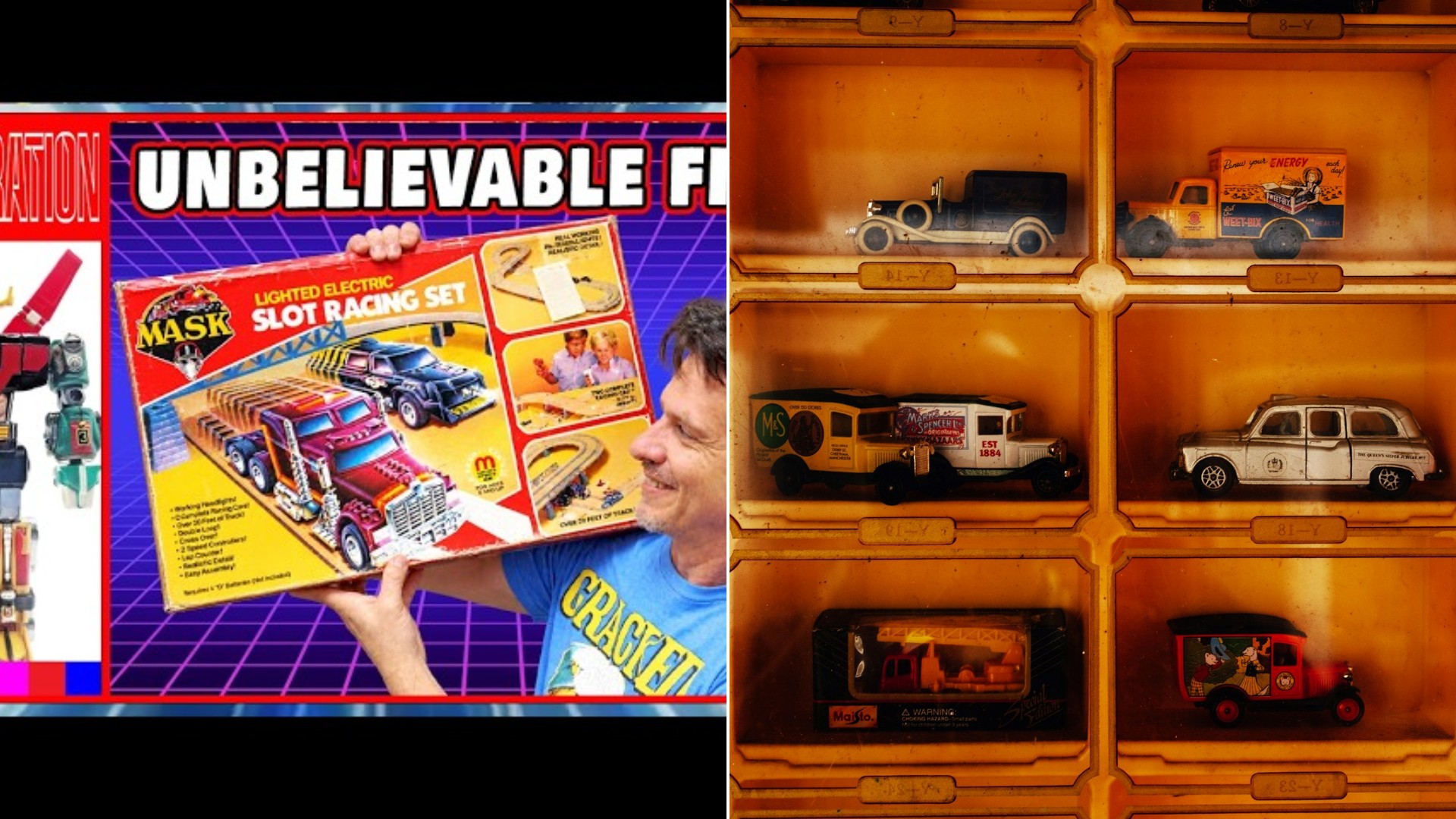
The boxes were only part of the weekend pickups. He showed a set of figures he put at about $100, Secret Wars figures, A-Team figures still sealed, and a lighted slot racing set that is headed for the basement beside other themed sets. He also found original storyboards from cartoons, including Conan and My Little Pony, which he noted he did not collect but could not pass up. He guessed they went for about $100 apiece. A G.I. Joe storyboard, he said, would have stayed in his own collection.
One more story stood out: a special Kenner pack-in, a backdrop for a Slave I toy that was offered by mail with Star Wars boxes. The seller asked $1,000, the buyer argued it was closer to $400 or $500, and they settled the matter by trading a boxed Kenner 12-inch Boba Fett. He said it was a piece he had never owned.
All of this, he said, happened between about ten at night and midnight, which is the big lesson of the whole episode: the best stuff does not always turn up on the show floor. If you attend a convention, stay after dark and see who has set up in a hotel room.
How To Hunt Boxes Without Overpaying
You do not need a $1,000 budget to benefit from what this story shows. If you collect vintage toys, the same thinking applies at flea markets, estate sales and thrift stores.
- Know what you already own. The host could say yes to a pile of empty boxes because he had the contents. Collectors who buy boxes with no plan end up with a closet of cardboard.
- Check condition closely. Look at corners, flaps, sun fading and whether any cut-out panels have been removed. A clean box is worth more than a tired one.
- Do not be afraid to counter. Both deals above started with a seller’s high number and ended somewhere in the middle, which is normal in this hobby.
- Be wary of breaking things. Putting a loose toy back into a box can snap brittle tabs and plastic, especially on older vehicles. If a piece is stiff, stop.
- Consider grading. For the most pristine pieces, a third-party grading service can help establish condition, though it costs money and is not for everything.
- Store boxes flat and dry. Basements are tempting but damp. A closet in a climate-controlled room is safer.
It is easy to chuckle at a man paying four figures for empty packaging. But talk to anyone who has tried to complete a childhood collection and they will tell you the same thing. The toy is the memory, and the box is the proof that it was ever new. Somewhere in a convention hotel on a Saturday night, a stack of cardboard turned into the start of several finished sets. Not a bad night’s work.
More Stories You May Like
- Antique Shopper Left a Vintage Rug Behind at the Store and Has Thought About It Every Single Day Since Wondering If She Should Go Back
- Woman Finds an 1800s Hand Painted German Marriage Cabinet on Facebook Marketplace Ten Minutes From Her House and Says It Might Be Her Favorite Marketplace Find to Date
- Daughter Thought Her Dads One Hundred Twenty Five Dollar Print Was Worth Two Thousand Dollars and Was Way Off

Leave a Reply