

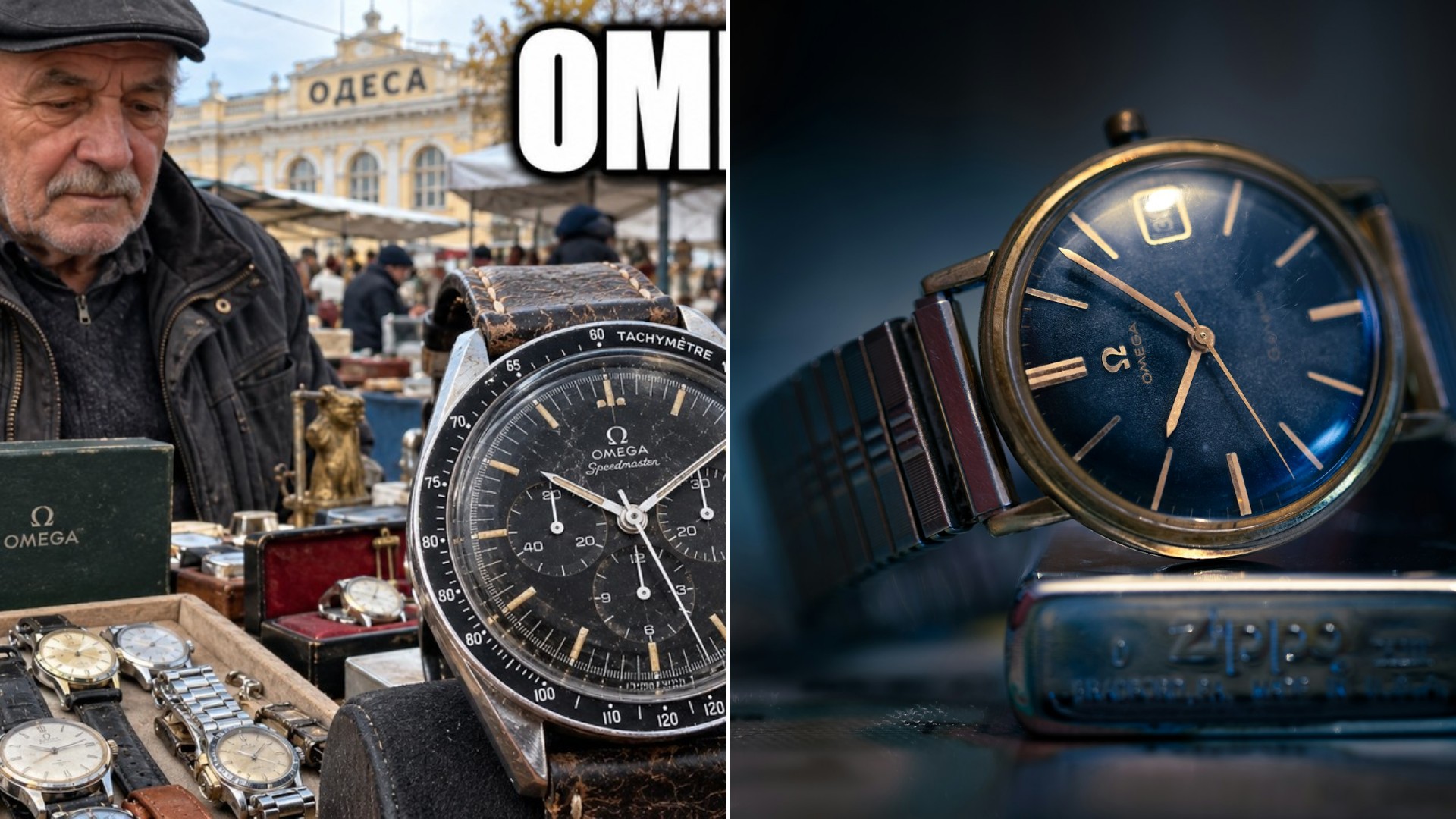
He promised himself a $200 budget and one simple rule: buy watches he could resell, not just ones he liked. Then, on a trip to the flea market in Odessa, a collector saw an Omega Speedmaster. The price was $270, the seller would not let him open the case, and he walked to the ATM.
The collector runs the YouTube channel Time Gamble, where he hunts for vintage watches at flea markets, restores them, and tries to turn small budgets into bigger ones. The question for this trip was whether you can really make money at a flea market if you buy with your head instead of your heart.
He admits the rule was likely to last right up until he saw the first beautiful dial. By the end of the day, he had nine resale projects, and one very expensive wild card.
Smart Passes at the Start
The first hour was about discipline. He spotted a handsome Soviet Raketa, but the seller wanted $25, and he says he can sometimes find a similar one for $7 or $8. A Sekonda was $18 and not in great shape. A Swiss Delbana with a gold-plated case was $50, and spending a quarter of his entire budget on a watch with uncertain resale potential was a no.
His reasoning is worth remembering. If you are buying to resell, you must leave room for both profit and repairs. At each table, he did that math out loud, and he walked away from anything that did not leave a margin.
The Cheap Finds That Fit the Plan
His first purchase was a Raketa that he did not love as a whole. He disliked the dial, but the case was in almost perfect condition, and a good original case is valuable when you have movements waiting to be restored at home. It cost $12.
The standout of the day, he said, was a Soviet Chaika that was practically brand new, never worn. It has a gold-plated case, a beautiful dial and a design with genuine stone inserts. He has seen used examples listed for around $200, though he is quick to say that an asking price is not a sale price. He paid $20.
The rest of the shopping list looked like this:
- An Orient with an unusual design, missing its bracelet, for $15.
- A Citizen Eco-Drive with what he believes is a sapphire crystal, for $20. The hand was twitching, so it could be a simple recharge or a bigger repair.
- A working men’s Seiko with an alarm and chronograph, probably from the 1980s or 1990s, for $20.
- A sports watch from the First Moscow Watch Factory with a hacking seconds mechanism, for $15. The dial had been replaced and the case was worn, but the movement worked, and he already had a case and a dial at home.
- A Soviet Vostok in well-preserved condition, for $5.
- An Orient with an unusual shimmering dial, for $17.
- A 1960s Mayak, with a beautiful case and a dial in good shape, for $10. The crystal has a spiderweb of cracks, but crystals can be replaced.
Fakes and Warning Signs
Not everything on the blankets was real. He found pocket watches that turned out to be Chinese, bags of watches that were replicas, and a “Tissot” that he realized was a cheap copy. His reminder is that you cannot trust a fancy name printed on a dial.
He also passed on a green-dial Orient for $35, a Slava for $25 that did not seem to be working, a women’s Citizen for $25, and a stack of Soviet Zvezda ladies’ watches at $5 apiece, since he already has a box of them at home. A Kanderski at $20 looked rough, and he said he can find them cheaper.
He also likes a certain part of the market, where people sell things from their homes. There are fewer professional dealers, which means a watch may not have passed through several resellers’ hands, and that is where he found the Citizen.
The Omega That Broke the Budget
Then came the surprise. Near the area where professional resellers trade, a man was trying to sell a watch to them. One reseller said he did not have enough money, so the collector asked to take a look. The man opened the box, and inside was an Omega Speedmaster.
The collector says he has wanted a Speedmaster for a long time. He already has a Seamaster, but a Speedmaster never made it into his collection. The big question was whether it was real or fake. From the outside, it looked very convincing. To be sure, he would need to open the case and examine the movement, and the seller would not allow it.
He also did not want to attract attention. With resellers standing around, he was worried that a close inspection and talk about value would start an auction on the spot. So he asked the price. It was $270, more than his whole starting budget.
“My common sense tells me to walk away,” he said, “but the collector inside me is already imagining this watch on my wrist.” Common sense lost. He turned to an old friend who never argues or asks questions: the ATM. He withdrew extra cash and bought the watch.
He was clear that the Omega is a separate, personal purchase and not part of the $200 challenge. He took it straight to his local watchmaker to check the movement and verify authenticity. He called it a big risk, and said that if it is fake, it will be a very painful lesson. If it is real and the condition allows, he plans to wear it himself.
The Final Math
Back to the original budget. He spent $134 on nine watches, which leaves $66 of the $200. That is not profit yet. He still has to check the movements, clean the watches, restore them, photograph them and sell them, and only then will he find out what the money has become.
He also shared the result of his last giveaway. A custom-dial Mayak he listed on eBay with a starting bid of just $1 ended at $58 after 14 bids. He called that a modest result, and said sometimes the buyer is happier than the seller when you start so low. For the next giveaway, he listed a Soviet Zim from the 1950s with a hand-painted pin-up dial.
What Flea Market Watch Hunters Can Learn
His day offers clear rules for anyone who buys vintage watches at a market:
- Set a budget and keep it. Every extra dollar counts when you plan to resell.
- Judge the case, the dial and the movement separately. A good case or a working movement can justify a low price on its own.
- Know the going price. He could pass on the $25 Raketa because he knew he can find them for $7 or $8.
- Be wary of famous names. Fake Tissots and replicas show up on many blankets.
- Walk the market twice. The first pass finds the obvious items, the second finds what you missed.
And if a dream watch shows up at an awkward price, he says, ask yourself the question he put to his viewers: would you risk $270 on an Omega Speedmaster that you cannot open?
More Stories You May Like
- Seller At A French Flea Market Called A Box Napoleon III Era For €60 But The Maker Marks Point To 1932 Through 1962
- Conagra Reportedly Pulls Celeste Frozen Pizza After 64 Years Ending A Story That Began In A 1937 Chicago Tavern
- Minute Maid Frozen Juice Ends After 80 Years And Blue Bell Butter Crunch Is Listed As Gone While Cheese Pizza Cheetos Puffs Are Reportedly Being Phased Out

Leave a Reply