

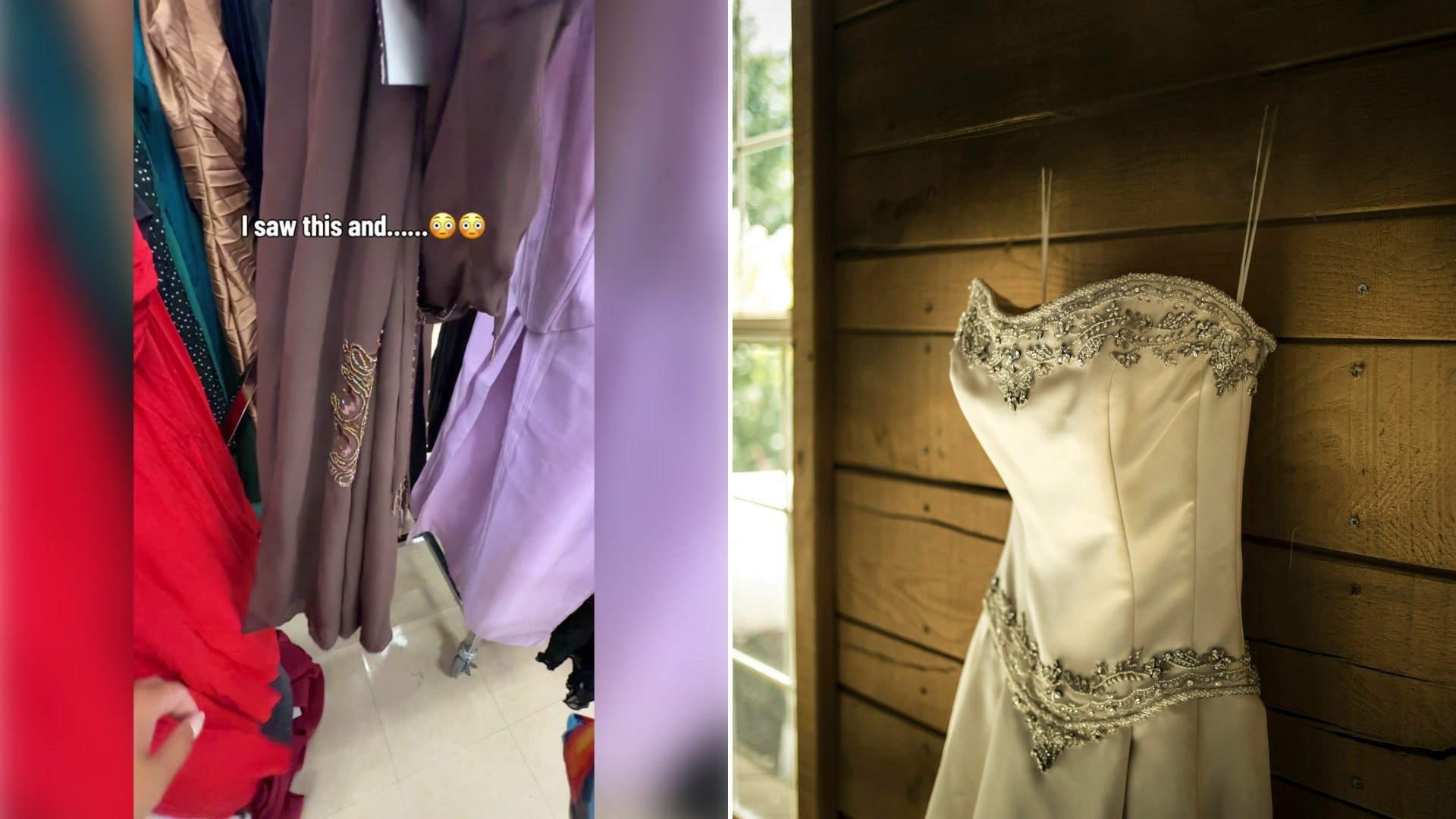
Some thrift finds need no elaborate backstory to work, and a clip from @char_evans.tiktok is a good example of exactly that, simply pulling a heavily beaded, clearly vintage brown dress off a store rack and showing it off to the camera. The detailed craftsmanship speaks for itself, row after row of dense beadwork that would be prohibitively expensive to reproduce at scale today, and her reaction moves quickly from surprise to genuine disbelief.
That disbelief is aimed at two things at once: the dress’s remarkably intact condition after what was clearly a long life somewhere before ending up on a thrift rack, and its ten dollar price tag, an amount wildly out of proportion to the labor that clearly went into making it in the first place.
Heavily beaded vintage garments occupy a particular sweet spot within thrift and vintage fashion collecting, since hand-applied beadwork of this density was, and still is, an enormously labor-intensive process, making garments like this one functionally impossible to replicate at a comparable price point using modern retail manufacturing. Finding one in genuinely wearable condition at a thrift store, rather than in a specialty vintage shop charging accordingly, is exactly the kind of gap between assumed and actual value that makes thrifting content so satisfying to watch.
That value gap is also precisely why experienced thrifters train themselves to check construction details closely, since a garment’s true worth is often visible in exactly this kind of handwork rather than in a label or a general style impression.
Beadwork of this density typically represents dozens, sometimes hundreds, of hours of hand labor, since each individual bead has to be sewn on securely enough to survive regular wear without shedding, a process that resists any real mechanization even with modern manufacturing technology. That labor intensity is exactly why heavily beaded garments have historically carried a significant price premium when new, and it is exactly why finding one decades later, still structurally intact, in a thrift store bin represents such an enormous, almost accidental value gap between what the garment actually cost to produce and what it is currently being sold for.
The dress’s survival itself deserves real appreciation, since heavily beaded garments are notoriously fragile over time, prone to thread deterioration, bead loss, and fabric strain from the sheer accumulated weight of dense beadwork pulling against the base fabric for years or decades. A beaded piece surviving in genuinely wearable, intact condition long enough to end up on a thrift rack, rather than falling apart in someone’s closet or getting discarded once beads started shedding, suggests either careful original storage or simple good fortune, and likely some combination of both.
Vintage clothing with this kind of intricate handwork also occupies an interesting position within broader conversations about fashion sustainability and slow fashion more generally. A garment built to this level of craftsmanship was clearly never intended as disposable fast fashion, and finding it decades later still functional stands as a quiet, tangible argument for how differently clothing used to be made, built to last through genuine durability and quality materials rather than planned obsolescence.
There is also something worth noting about how thrift store pricing structures generally have very little built-in mechanism for recognizing this kind of specialized craftsmanship value. Most thrift stores price clothing based on broad category and general condition rather than detailed construction analysis, which means a heavily beaded vintage dress and a mass-produced modern garment in similar physical condition can easily end up priced nearly identically, entirely missing the enormous difference in labor and materials that actually went into each one.
That pricing blind spot is precisely what experienced thrifters learn to exploit, training their eye specifically to spot handwork, quality fabric, and construction details that a general pricing system overlooks entirely. A find like this one functions as a small, satisfying validation of that skill, rewarding the kind of careful, detail-oriented browsing that distinguishes a serious vintage hunter from a casual browser skimming past racks without a second glance.
The color and cut of the dress also matter to how a find like this one gets received within vintage collecting circles, since a rich, deep brown paired with dense beadwork suggests a formal or evening garment from an era when that combination was genuinely fashionable rather than a purely decorative modern reinterpretation. Dating a piece like this one accurately usually requires cross-referencing fabric type, bead style, and construction techniques against known historical patterns, a kind of informal expertise that serious vintage collectors build up slowly through years of handling real garments rather than something easily picked up from a quick internet search.
It is also worth noting how videos built around a single dramatic price-versus-quality reveal like this one have become a kind of shorthand genre within thrift content broadly, distinct from longer, narrated haul videos that walk through an entire shopping trip. The format works because it needs almost no setup or context; the visual contrast between the garment’s obvious quality and its low price tag does all the persuasive work in a matter of seconds, which is part of why this kind of clip tends to circulate so widely even among viewers with no particular interest in thrifting as a regular hobby.
For fellow thrifters, a find like this one is a good reminder to always check the detail work on anything that looks even slightly special, since craftsmanship this obvious, once you know to look for it, is rarely priced anywhere close to what it is actually worth.

Leave a Reply