

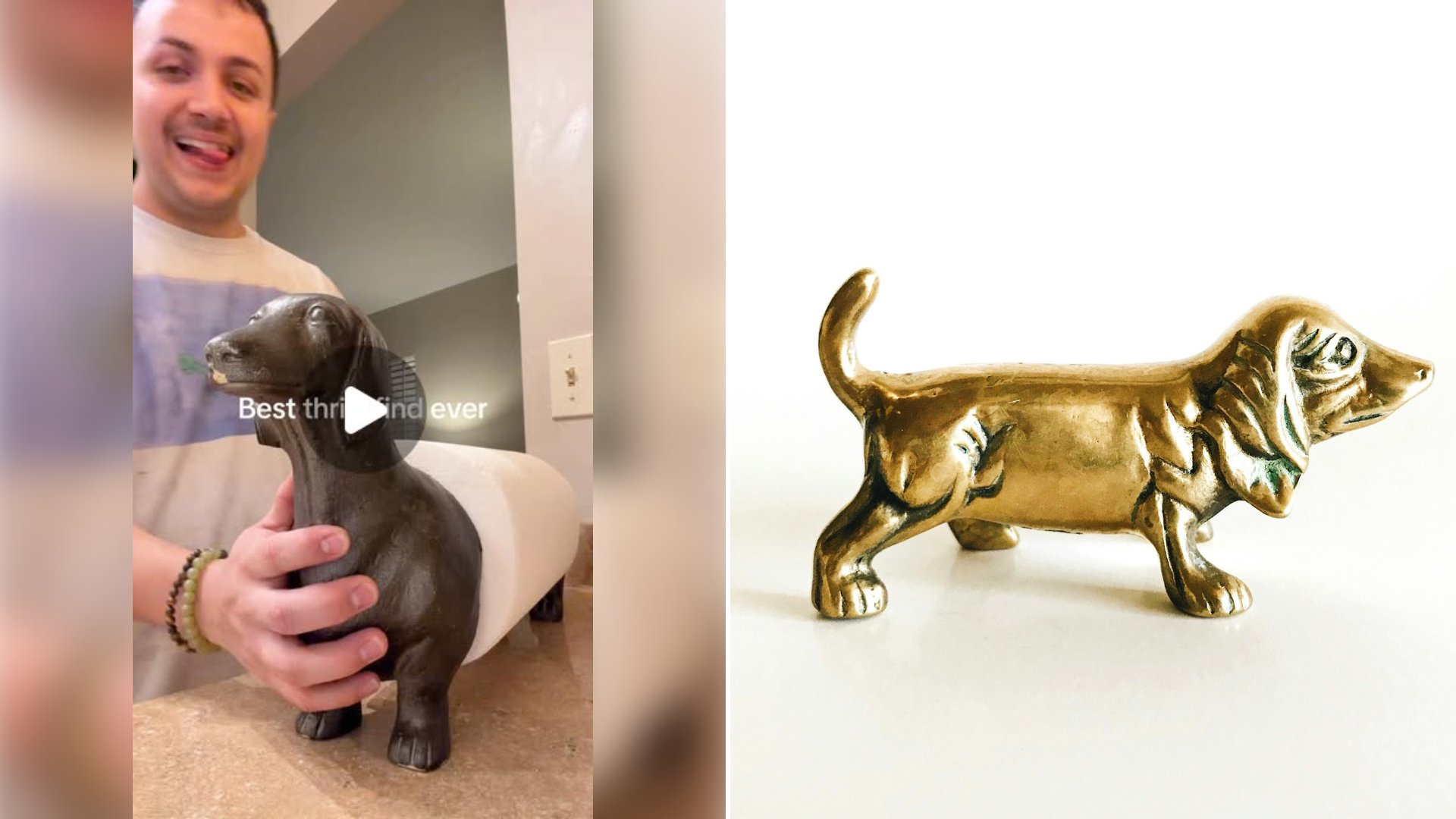
Thrift stores turn up plenty of odd kitchen gadgets, but every so often one lands with an extra layer of coincidence attached. In a recent reel, thrifter @leonfinds holds up a ceramic paper towel holder shaped like a dachshund, its long body curving around to cradle the roll while a pair of painted eyes stare out from a stretched-out snout. The joke lands immediately: she says the little ceramic dog looks exactly like her own real dachshund at home, right down to the floppy ears and the slightly worried expression.
The find is the kind of thing thrift shoppers live for: cheap, funny, and weirdly specific. A paper towel holder shaped like a specific dog breed is not a mass-market item today, which is exactly why it reads as a jackpot the moment it shows up on a shelf for a few dollars.
Novelty animal-shaped kitchenware like this dachshund holder has deep roots in mid-century American design. Starting in the 1950s, companies such as Holt Howard, Josef Originals, and Napco began flooding kitchens with anthropomorphic ceramics: rooster-shaped canister sets, cat-faced cookie jars, owl salt and pepper shakers, and plenty of dog-themed pieces. Many of these lines were manufactured in Japan for the U.S. export market during the postwar boom, when American manufacturers partnered with Japanese ceramic studios to produce cheerful, mass-produced novelty items at a price point regular households could afford.
Dachshunds in particular became a recurring design motif in that era. Their long, low silhouette was practically made for stretching across a functional object, which is why collectors can still find dachshund-shaped boot scrapers, bookends, string holders, and yes, paper towel and toilet paper holders from the 1950s and 1960s. Design historians often point to the breed’s popularity in American households after World War II, paired with its naturally elongated shape, as the reason it became such a go-to template for novelty home goods manufacturers looking for a form that doubled as a practical object.
That combination of function and whimsy is a big part of why this category of kitchenware has held onto collector interest decades later. Unlike purely decorative figurines, these animal-shaped gadgets actually did something: they held your paper towels, dispensed your string, or scraped mud off your boots, all while looking like a cartoon version of a household pet. That dual identity as both useful tool and conversation piece is exactly what makes them fun secondhand finds today, and why a certain segment of thrifters specifically hunt for mid-century novelty kitchenware sections whenever they walk into a store.
Pricing on these pieces varies a lot depending on condition, maker, and breed specificity. A generic unmarked ceramic animal holder might sell for next to nothing, while a piece that can be traced to a known mid-century maker, especially one in excellent condition with its original glaze intact, can command real money from collectors who specialize in kitsch kitchenware. Chips, cracks, and crazing in the glaze (the fine spiderweb cracking that develops in old ceramic finishes over time) all affect resale value, which is part of why experienced thrifters inspect these pieces closely before buying rather than assuming age alone makes something valuable.
What makes this particular find land so well with viewers, though, isn’t really the resale math. It’s the personal coincidence: a thrifter who owns a real dachshund stumbling across a decades-old ceramic version of her own dog, priced like pocket change, sitting on a random shelf. That kind of alignment between a found object and someone’s actual life is a big part of what keeps people scrolling through thrift-haul content in the first place. It transforms a routine store visit into something that feels almost fated, even when the explanation is simple: dachshund-themed novelty items were made by the thousands, and sooner or later, one was going to end up in the hands of someone who already loved the breed.
For anyone inspired to go looking for their own mid-century animal novelty piece, the advice from longtime pickers is consistent: check the bottom for a maker’s mark or stamp, look closely for hairline cracks before buying, and don’t expect every animal-shaped kitchen gadget to be worth a fortune. Most aren’t. But every now and then, one turns up that’s worth far more than the price tag suggests, either in dollars or, like this one, in sheer personal irony.
More from Vinyl and Velvet
- Thrifter Wonders If a Silver Toned Grape Cluster Stand on a Store Shelf Is the Perfect Match for Her Red Glass Strawberry Salt and Pepper Shakers, Then Tests It at Home
- Thrifter Pulls a Black Bowling Ball Off a Goodwill Shelf, Turns It to Reveal the Grim Reaper From Billy and Mandy Painted on It and Calls It a God Tier Pull
- Thrifter Spots a Spider Man Night Light on a Thrift Store Rack, Finds a Loose Wire Inside, Scrubs Off the Grime and Pops In Fresh Batteries to Make Him Glow Red

Leave a Reply