

Every thrifter dreams of the moment when a cheap, ordinary looking item turns out to be the real thing. This time the item was a plain, thin gold colored bangle hanging on a rack of costume jewelry with a price tag of just $2.99. A closer look at the inside of the band told a very different story from the price.
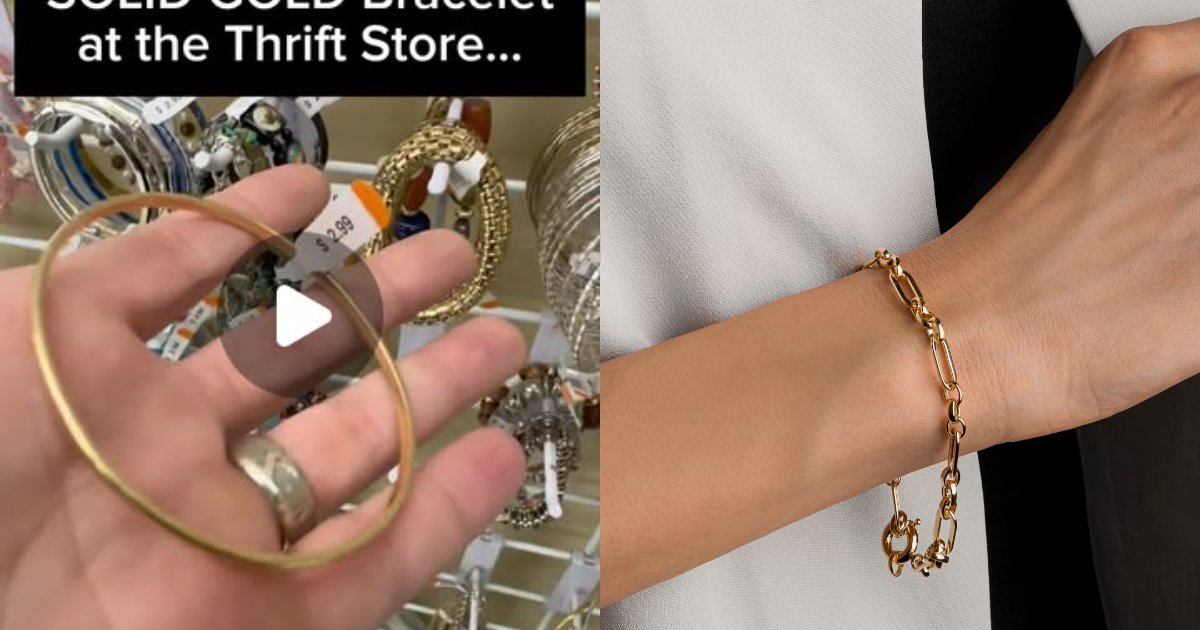
The find was shared by @retrotoyenvy on Instagram, who framed it as a $1400 solid gold bracelet sitting on a thrift store shelf and then walked through exactly how to check one yourself.
The bangle on the rack
The scene starts at a white wire rack crowded with thrift store bracelets. A hand reaches in and picks out a thin, plain, gold colored bangle with a $2.99 sticker. Nothing about the presentation suggests anything special. It hangs among everything else, in standard store lighting, the sort of piece most shoppers would walk right past.
Checking the hallmark
The key question comes next: how can you tell? The answer is on the inside of the band. A tiny stamp sits next to the price tag, and an extreme close up shows the engraved mark reading 14k. As the caption explains, that stamp means the piece is 58.5% gold. Hallmarks like this one are usually the first thing experienced jewelry hunters look for, and they are easy to miss if you never turn a piece over.
Putting it on the scale
To find out what it is worth, the bangle goes on a small yellow digital scale. The display reads 14.04 grams. A scrap gold calculator then works out the value from that weight, and the total comes to $796.14. That is the melt value of the gold alone, for a bracelet that was priced at $2.99.
The headline figure was $1400, so there is a gap between that number and the scrap calculation shown. The creator does not explain the difference, so it is best to treat $796.14 as the confirmed scrap value and the larger figure as the creator’s framing of what the piece could be worth.
What this teaches thrifters
Even without the exact final number, the lesson is clear. A price tag at a thrift store is based on a category, not on the individual piece. A shelf of costume jewelry is usually priced as costume jewelry, which means an occasional real gold piece can slip through at a bargain price. The only way to catch it is to check.
- Turn every bracelet, ring and necklace over and look for stamps such as 10k, 14k, 18k or 925 on the inside or near the clasp.
- Remember that 14k means 58.5% gold, so the weight matters. A heavier piece holds more gold.
- Carry a small digital scale that reads in grams to estimate weight on the spot or at home.
- Use a scrap gold calculator with the current gold price to estimate melt value, and remember melt value and resale value are not always the same.
- Take a good look at the hallmark under bright light or with a small magnifier, because stamps can be tiny and worn.
Karat marks, decoded
Karats describe how much of a piece is pure gold out of 24 parts. Pure gold is 24k, which is too soft for most everyday jewelry, so it is usually blended with other metals. That is why 14k works out to 14 parts gold in 24, or 58.5%. In the same way, 10k is about 41.7% gold and 18k is 75%. A stamp such as 585 is the same 14k claim written as a fineness number, and 925 usually points to sterling silver rather than gold.
Marks that mean it is not solid gold
Not every gold colored piece with a stamp is the real thing. Letters such as GF (gold filled), GP (gold plated), HGE (heavy gold electroplate) or RGP (rolled gold plate) describe a thin layer of gold over another metal. These pieces can be lovely and collectible as costume jewelry, but they do not carry meaningful scrap value. Always read the full stamp before getting excited.
Quick checks before you buy
- Gold is not magnetic, so a piece that snaps to a magnet is not solid gold. A piece that does not stick is not proven to be gold, though, so treat this as a way to rule things out.
- Look for wear where the finish rubs thin, such as clasps and edges. A different colored metal showing through suggests plating.
- A stamp can be faked, so for anything significant, a jeweler or gold buyer can test the metal with acid or an electronic tester.
Melt value versus what a buyer pays
Scrap gold is priced by weight, and the market price moves daily, so a calculation is only a snapshot. Gold is commonly weighed in grams or troy ounces, and one troy ounce is about 31.1 grams. Buyers who melt jewelry down usually pay somewhat below the full melt figure because they have costs of their own. Pieces with strong design, a maker’s mark or collector appeal can be worth more as jewelry than as scrap, so it is worth a second opinion before anything gets melted.
Credit for the original post goes to @retrotoyenvy on Instagram.

Leave a Reply