

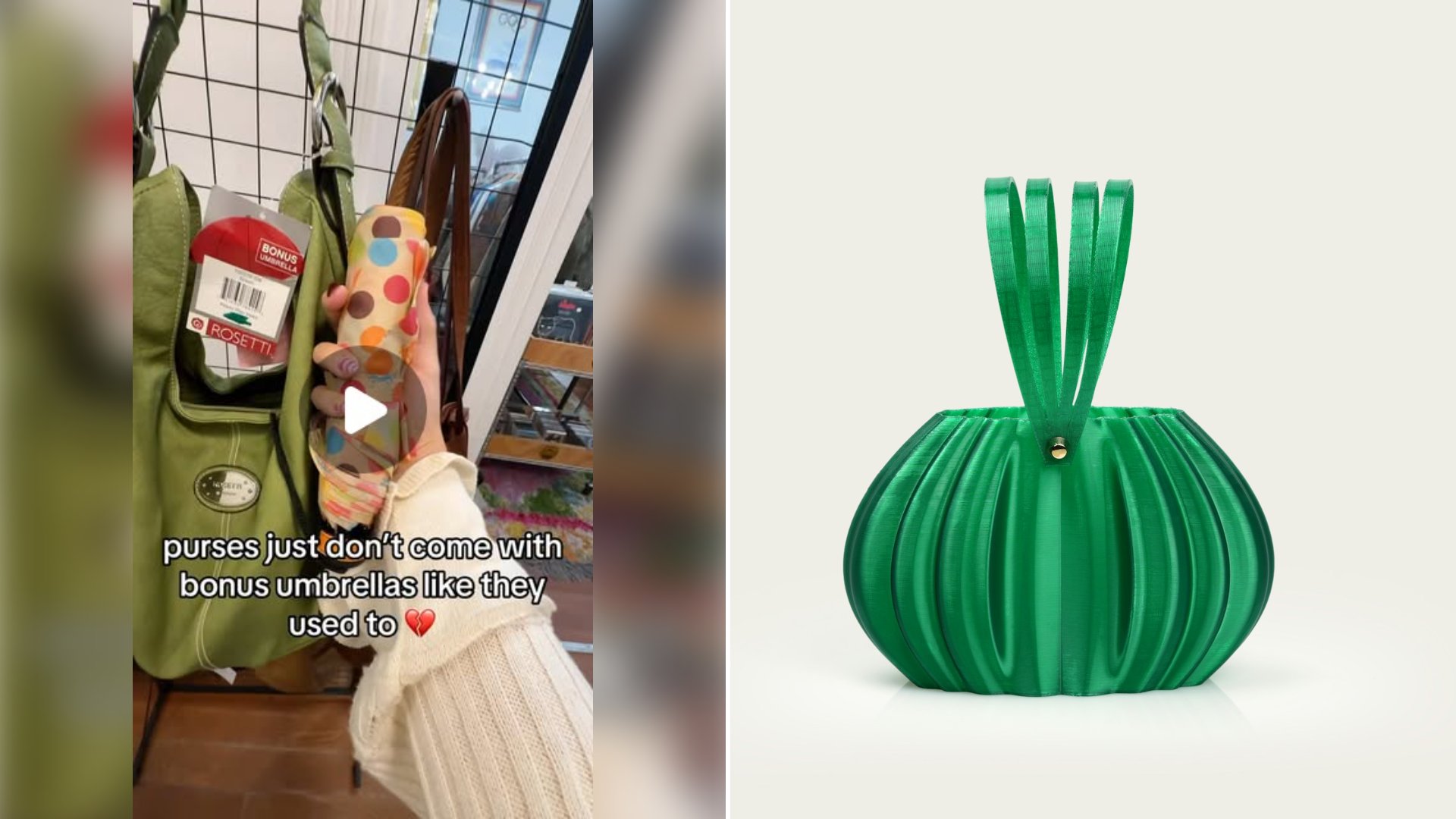
Some thrift finds are good because of the item itself. Others are good because of what comes tucked inside. In a reel from @dingbaats, a shopper holds up a vintage lime green purse, bright and clearly decades old by its shape and hardware, then reveals the real surprise: a tiny matching umbrella built right into the design, sized and colored to coordinate perfectly with the bag itself. The reaction is immediate disbelief that purses used to come with a cute little bonus accessory like that as a standard feature.
It’s a small detail, but it says a lot about how handbags used to be designed and marketed. A matching umbrella wasn’t just a gimmick tucked in for fun; it was a selling point, meant to make a single purse feel like a complete, coordinated accessory system rather than just a bag to carry things in.
Handbag manufacturers in the mid-20th century regularly built in small matching accessories as part of a purse’s identity. Compact mirrors, coin purses, and yes, miniature umbrellas sized to slide into a dedicated interior pocket, were marketed as proof that a bag had been thoughtfully designed rather than mass-produced without any extra care. This approach fit into a broader postwar retail philosophy that treated accessories as a coordinated wardrobe system: matching gloves, hats, shoes, and handbags were commonly sold and worn together, and a purse that came with its own built-in umbrella slotted neatly into that same logic of total coordination.
That era of design began fading for a few overlapping reasons. As fashion moved away from rigid, fully coordinated outfit formulas starting in the late 1960s and into the 1970s, the demand for matchy-matchy accessory sets declined along with it. At the same time, manufacturing shifted toward cost efficiency: a built-in umbrella pocket and a custom miniature umbrella add real production cost to a bag, and as handbag manufacturing scaled up and moved increasingly toward mass production, manufacturers trimmed features that didn’t directly affect a purse’s basic function. The novelty extras that once differentiated one maker’s bag from another’s slowly disappeared as the accessory market consolidated around simpler, cheaper production.
There’s also a practical shift worth noting: collapsible umbrellas themselves got smaller and more universally compact over the decades, which somewhat reduced the need for a purse to have a custom-built slot for one. Early collapsible umbrella designs were bulkier, so a purse manufacturer building in a dedicated pocket for a specifically sized miniature umbrella made more sense when off-the-shelf compact umbrellas weren’t as reliably small or standardized as they are today.
For collectors and vintage sellers, a purse with its original matching umbrella still intact is considered a more complete and more desirable find than the bag alone. Accessories like this are exactly the kind of small included piece that tends to get separated or lost over decades of use and resale, so when a bag turns up with its full matching set still together, it signals the item was likely well cared for by a single owner rather than passed through multiple hands. That completeness factor can meaningfully affect what a vintage handbag is worth to someone specifically collecting this category of fashion history.
The color itself is worth a mention too. Lime green, along with other saturated citrus tones, was a defining palette choice in several decades of handbag design, often paired with bold geometric hardware and structured shapes that read as distinctly of their era at a glance. That boldness is part of why vintage bags in colors like this photograph so well and catch attention instantly in a thrift haul video, long before anyone even gets to the surprise tucked inside.
Finds like this are a reminder that vintage accessories were often engineered with a level of detail that doesn’t always carry over into modern fast-fashion equivalents. A thrift shopper flipping through a rack today isn’t just looking for a cool color or an interesting shape; sometimes the best part of the find is hidden in a zipped pocket, waiting to make the whole purse feel like a tiny, perfectly coordinated time capsule.
More from Vinyl and Velvet
- A Flea Market Reseller’s Booth Is Stacked Floor to Ceiling With Vintage Coach Handbags Decorated in Flower Claw Clips, and Shoppers Are Begging to Know When It Opens Next
- Thrifter Shows Off Her Entire Growing Rack of Vintage Ralph Lauren Sweaters, Every Single One Picked Up Secondhand for Under $12 Apiece
- Shopper Pulls a Monogrammed Crewneck Off a Thrift Store Rack and the Entire Comment Section Insists the Embroidered Letters Look Exactly Like a Blurred Out Face

Leave a Reply