

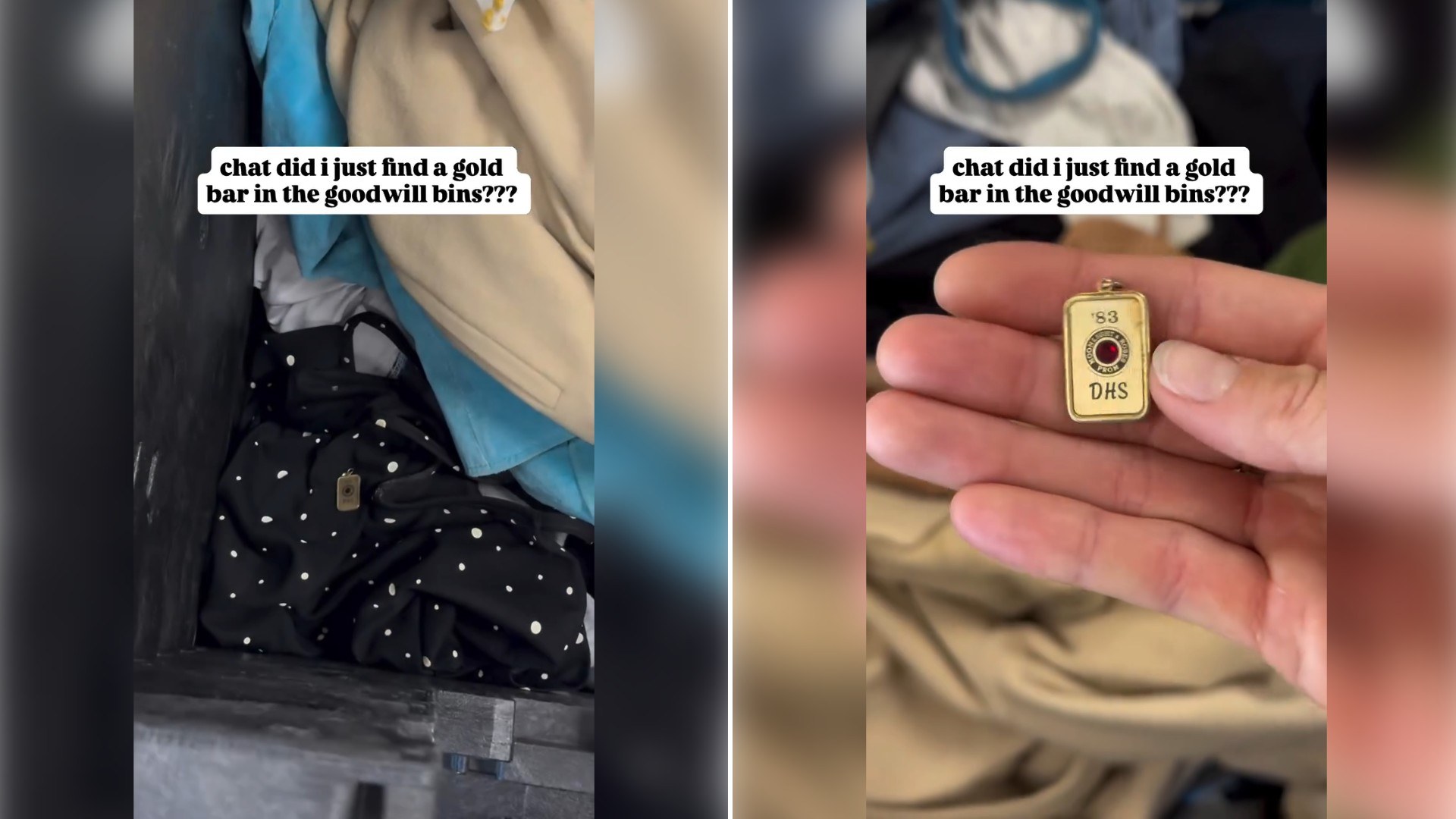
The best bin-diving videos often end without a clean resolution, and that unresolved tension is exactly what makes a recent find from @pickedbypickles so watchable. Digging through a Goodwill outlet’s unsorted pile, she pulls out a gold-colored pendant shaped like a small bar, and rather than waiting to get it tested later, she asks her followers right there in the store whether they think it could actually be real gold, possibly even set with a genuine ruby.
That in-the-moment uncertainty is the entire engine of the video. There’s no reveal, no confirmed appraisal, just an honest, open question posed directly to an audience that clearly has opinions, turning a quiet discovery into a small, ongoing debate playing out in real time in the comments.
Outlet bin diving has become known for exactly this kind of gamble, since unsorted piles occasionally include jewelry that ends up there by accident, donated without anyone checking whether it might be more valuable than the rest of the pile around it. Identifying real gold or gemstones by eye alone is genuinely difficult even for experienced shoppers, which is part of why crowdsourcing a second opinion has become such a common move among bin divers who find something promising but uncertain.
That crowd-sourced verdict process has also become its own small ritual within thrifting content, since an audience of experienced secondhand shoppers and jewelry enthusiasts often collectively knows more about spotting the telltale signs of real gold, hallmark stamps, specific weight, a certain kind of shine, than any single shopper standing in a store trying to make a quick decision.
Bin diving specifically has grown into a genuine subculture over the past several years, distinct enough from ordinary thrifting that its most devoted participants have developed their own vocabulary, etiquette, and shared understanding of how outlet stores actually operate behind the scenes, restocking patterns, pricing quirks, which locations tend to yield better finds than others. A video like this one, built around a single uncertain pendant, is really just one small data point within that much larger, ongoing community conversation.
There is something genuinely useful about this crowdsourcing model beyond the entertainment value alone. A comment section full of people offering competing theories, some citing hallmark placement, others pointing to the specific shade of the metal or the way light catches a genuine stone versus a cheap imitation, functions almost like a distributed appraisal service, pooling scattered expertise that no single viewer, including the shopper herself, could access alone. That collective intelligence is one of the more genuinely valuable byproducts of building a following around this kind of content.
It is also worth pointing out how differently this scenario plays out compared to the more polished, resolved reveal videos that dominate a lot of thrifting content. A creator who waits to get an item tested before posting anything controls the narrative entirely, presenting only the confirmed, satisfying outcome. Posting the uncertainty itself, before any answer exists, is a riskier but often more engaging choice, since it invites the audience to participate in figuring out the answer rather than simply consuming someone else’s already-resolved discovery.
That willingness to post before knowing the outcome also says something about how trust gets built within a following over time. A creator confident enough to show genuine uncertainty, rather than only the wins, tends to build a more engaged and more forgiving audience, one used to following along through real ambiguity rather than only being shown curated, guaranteed payoffs.
Gold-testing itself, whether through at-home acid tests, a jeweler’s magnet check, or a proper professional appraisal, remains a genuinely useful skill for anyone who spends time in outlet bins or similar unsorted secondhand environments, since the volume of jewelry passing through these spaces virtually guarantees that some real gold slips through pricing meant for costume pieces.
For bin divers hoping to spot a similar find, the advice that tends to circulate after videos like this one is consistent: when in doubt, buy the cheap gamble and get it properly tested later, since the cost of being wrong at outlet bin prices is almost always lower than the cost of walking away from something real.
It is also worth reflecting on why jewelry specifically ends up as the category most prone to this kind of accidental undervaluing in bin environments. Clothing can be assessed reasonably well by fabric, cut, and visible labeling even by untrained eyes, but jewelry often requires specialized knowledge, or at minimum specialized tools, to distinguish genuine material from a convincing imitation. That knowledge gap is exactly what creates the opportunity bin divers are chasing every time they sort through a pile of loose, unlabeled pieces mixed in with everything else.
There is also a small lesson here about the value of documenting a find publicly before knowing its outcome, rather than waiting for a tidy conclusion. Plenty of viewers will never see a follow-up video confirming what the pendant actually turned out to be, and that is, in a strange way, part of the appeal rather than a flaw. Thrifting and bin diving are fundamentally activities built around uncertainty, and a video that captures that uncertainty honestly, rather than editing it away, ends up feeling truer to the actual experience of the hobby than a version that only shows confirmed, satisfying outcomes.
Whatever the pendant eventually turns out to be, real gold and ruby or simple costume jewelry, the video has already done its job, turning an ordinary bin dive into a small, collective mystery worth following to its eventual answer.

Leave a Reply