

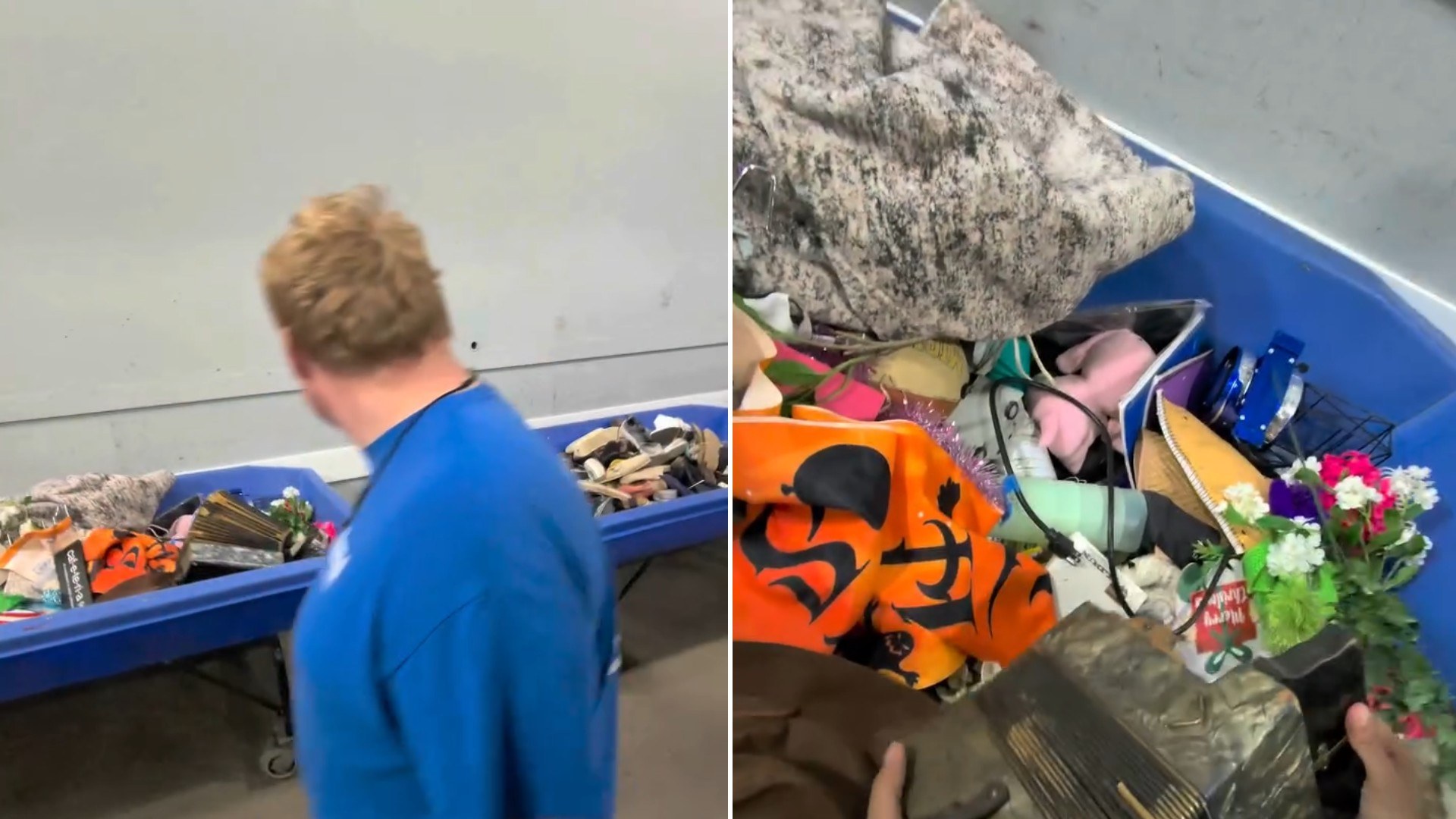
Bin diving, the practice of sorting through unsorted, sold-by-the-pound merchandise at thrift store outlets, rewards fast hands and low expectations, which makes it the perfect setting for a genuinely surprising find. That is exactly what happens to @healwaysgetsthegoodstuff, who pulls a full-sized accordion out of the pile, only to discover another shopper had already spotted it and had plans of her own.
The resulting exchange is quick and good-natured, a bit of playful tug of war over who actually gets to claim the instrument, and the moment captures something true about bins culture specifically: with no fixed placement and constant restocking, whoever spots an item first and moves quickest generally wins, and a little friendly rivalry over a good find is practically part of the experience.
Outlet-style thrift bins have become their own dedicated subculture within secondhand shopping, distinct from browsing neatly organized racks at a standard thrift store. Items arrive unsorted, often priced by weight rather than individually, and the appeal is precisely the unpredictability, since a bin might turn up anything from ordinary clothing to, on a good day, a full musical instrument that somebody donated without a second thought.
A full-sized accordion in particular is the kind of find that stands out even by bin-diving standards, a bulky, specific, faintly unusual object that most shoppers would never expect to see mixed in with everyday castoffs. Its presence in the pile at all says something about how much genuinely interesting material ends up donated rather than sold or kept, simply because the original owner no longer had a use for it.
Part of what makes outlet bins such fertile ground for this kind of discovery is the sheer scale and turnover involved. Unlike a standard thrift store, where staff sort and price items before they ever reach the floor, outlet locations exist specifically to move enormous volumes of unsorted donations quickly, often refreshing entire bins multiple times a day. That constant churn means regular bin divers develop a kind of sixth sense for timing, learning which hours tend to bring fresh stock and showing up accordingly, ready to move fast the moment new bins hit the floor.
Musical instruments specifically occupy an interesting place in the donation ecosystem. Unlike clothing or housewares, an instrument often represents a specific, sometimes expensive, sometimes sentimental purchase made by someone at some point in their life, whether for a child’s lessons, a hobby that never quite took off, or a phase of interest that eventually passed. When an instrument ends up donated rather than sold directly, it is frequently because clearing out space mattered more to the previous owner than maximizing what they could get for it, which is exactly the kind of gap that creates opportunity for whoever finds it next.
The etiquette question raised by this video, what happens when two shoppers spot the same item at the same time, is one of the more interesting unwritten rules within bin culture. There is no official arbiter, no staff member stepping in to settle disputes, which means the community has developed its own informal norms over time: generally, whoever physically has hands on an item first gets the benefit of the doubt, but a good-natured negotiation, like the one captured here, is almost always preferred over an actual standoff.
That kind of low-stakes camaraderie is arguably one of the more underrated appeals of bin diving as a hobby. Unlike a formal auction or an online marketplace bidding war, a shared physical space like an outlet bin puts strangers in direct, immediate contact with each other, and the community largely polices itself through humor and goodwill rather than conflict, a dynamic this video captures perfectly in miniature.
There is also a broader trend worth noting here, since musical instruments specifically have become an increasingly visible category within thrift and secondhand content over the past few years. Whether it is a guitar spotted leaning against a wall of donated goods, a set of drums found disassembled in a box, or, as in this case, a full accordion pulled from an unsorted pile, instrument finds tend to generate outsized attention online, precisely because they are rare enough to feel like genuine luck rather than a predictable outcome of a normal shopping trip.
That rarity also raises the stakes of a find like this one in a way that ordinary clothing or housewares simply cannot match. A shirt or a coffee mug found in the bins is, at most, a minor win. A full-sized instrument, whether or not the person who finds it can even play it, carries an entirely different weight, part financial opportunity, part genuine curiosity about how it ended up there in the first place, and part simple delight at stumbling across something so specific in a pile built for the completely generic.
For anyone new to bin diving, videos like this one double as a quick primer on etiquette as much as strategy: move fast, expect the unexpected, and when someone else calls dibs on something you both spotted at once, a little good humor usually settles it faster than anything else.
It is worth remembering, too, that bins culture has become its own thriving corner of secondhand video content precisely because the format rewards genuine, unscripted reaction over polished presentation. There is no way to stage a moment like this one convincingly, two shoppers genuinely surprised by the same unexpected object, which is exactly why clips like this tend to resonate far beyond the community of dedicated bin divers who already know the drill.
Whoever ultimately walked away with the accordion, both shoppers left with a story worth telling, which, in bins culture, often counts as its own kind of win regardless of who technically got the item.

Leave a Reply