

Somewhere right now, a brand new record player is sanding someone’s favorite album down to noise. It looks adorable, sitting on a shelf in a cute little suitcase in teal or pink for about $60. But the needle inside is pressing down on the grooves at roughly 7 grams, when a proper turntable tracks closer to 1.5 grams. One audio channel, Honest HiFi, has a blunt name for it: a cheese grater with a speaker bolted on.
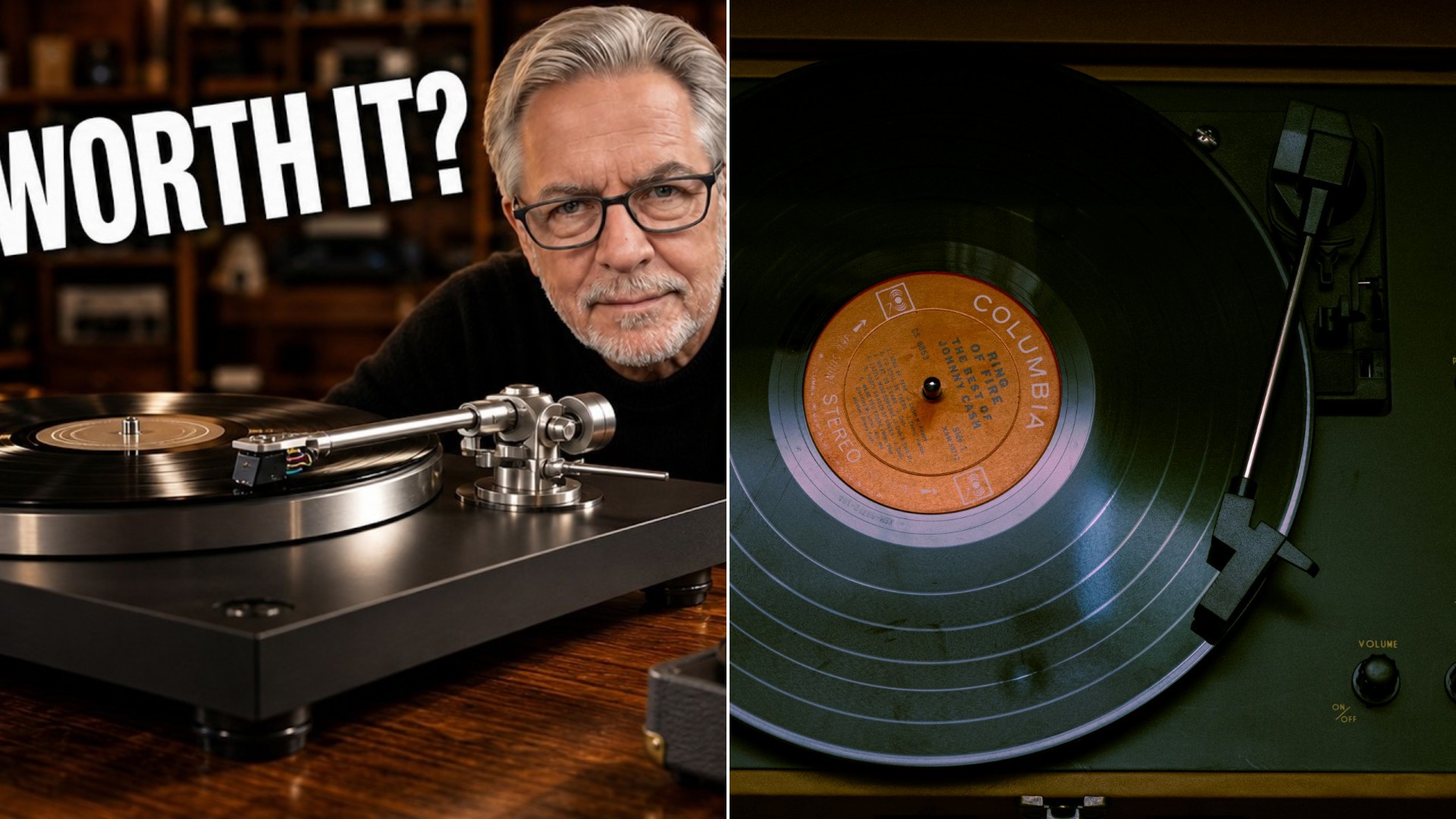
The host, who calls his a watchdog channel, says a handful of companies never stopped building turntables the right way, and he named six of them. His guide matches a model to the budget you actually have.
First, the problem. A turntable drags a tiny diamond through a groove thinner than a human hair. The suitcase players are built down to a price, and the part that protects your records is the first corner cut.
Why the Suitcase Player Is the Problem
Those players use a ceramic cartridge, the cheapest way to turn a wiggle into sound, and it needs lots of weight pressing down to stay in the groove. That is where the 7 grams comes from. There is no counterweight to balance the arm, and on all-in-one models the speaker sits in the same box as the needle, so the whole thing vibrates while it is trying to read.
To be fair, he says, this gets exaggerated online. One spin on a cheap player will not vaporize your record. Wear depends on tracking weight, needle alignment, the condition of the stylus and how many times you play it. But a crude cartridge pressing near 7 grams with no way to adjust it stacks the odds against your collection. A proper magnetic cartridge at 1.5 grams barely rests on the groove. Play a favorite a few hundred times on the cheap one, he says, and you slowly trade away the high frequencies you bought vinyl for. A worn groove does not grow back.
His test has three parts. Does the turntable use a real, adjustable cartridge at a sane tracking force? Can that model be upgraded and repaired instead of thrown out? And is it built to last for years? Every model he names passes. Suitcase players fail all three.
The Six Brands and Their Prices
Fluance, a Canadian company founded in 1999 in Niagara Falls, is his pick for starting out. The RT81 runs around $220 and gives you an adjustable counterweight, an Audio-Technica magnetic cartridge and a dense engineered wood plinth. He says the RT81 already protects your records completely, and spending more only buys better sound. The RT85, around $500, adds an acrylic platter and an Ortofon 2M Blue cartridge.
Audio-Technica, founded in Tokyo in 1962, began by making phono cartridges. Its AT-LP60X, around $150, is fully automatic and easy for a gift, but the cartridge is fixed in place. The AT-LP120X, at about $350 to $450, is a direct drive deck with a removable head shell and a VM95 cartridge, so you can drop in a sharper stylus later. It also has a built-in phono preamp, the little amplifier that a turntable’s tiny signal needs. If you are on the fence, he says, get the LP120X.
Technics, the hi-fi arm of Panasonic, released the original SL-1200 in October 1972. The Mark 2 followed in 1979 with quartz lock and became the standard in clubs and radio stations. Panasonic stopped making it in 2010, used prices rose, and in 2016 it came back. Today he points to the SL-1500C at around $1,100 for home listening, the SL-1200 Mark 7 in a similar range for toughness, and the SL-1200G at around $4,000.
Project, an Austrian company founded in 1991, made nothing but turntables when the world thought vinyl was dead. Its Debut series launched in 1999 and has sold close to a million units. The Debut Carbon Evo runs about $500 to $600 with a carbon fiber tone arm and a factory-aligned cartridge.
Rega, founded in 1973 in Essex, England, builds its own tone arms by hand. The Planar 1, at around $600, arrives with the cartridge fitted and the tracking force preset, which he calls the easiest real turntable to set up. The Planar 3, at roughly $1,100 and up, has been a benchmark for decades.
VPI, an American company founded in 1978 by Harry and Sheila Weisfeld in Cliffwood, New Jersey, started with a record cleaning machine. Its handbuilt Scout runs a few thousand dollars, and flagship tables climb into the tens of thousands. He says it is not where you start, but where people arrive after years in the hobby.
The Budget Map and Three Rules
His quick map is simple. Around $200 to $250, buy the Fluance RT81. Around $350 to $450, the Audio-Technica LP120X. Around $500 to $600, pick the Fluance RT85, the Project Debut Carbon Evo or the Rega Planar 1. Around $1,000 to $1,200, step up to the Planar 3 or the Technics SL-1500C. Beyond that, you are buying for the love of it.
He also gives three rules to avoid getting burned. If a turntable has speakers built into the body, walk away. Make sure the arm has an adjustable counterweight, since no counterweight means no control over tracking force. And buying used is fine, even smart, as long as the cartridge and stylus are in good shape, because a worn stylus quietly does the damage.
One more tip: some Project and Rega models leave out the phono preamp, so check whether your amplifier or powered speakers already have one. If not, budget a small box to sit between them.
The expensive mistake, he says, was never buying a cheap turntable. It is buying one built to be thrown away and letting it wear down a record collection worth far more than itself. Records outlast machines when you let them. A great pressing from the 1970s can still sound stunning today, as long as whatever you set it on was built to respect it.
More Stories You May Like
- Old Toasters And Mixers With Frayed Cords Can Be Fire Risks So Inspect Before You Plug In Or Just Display Them
- Two Mystery Boxes From Johnny D’s Record Collection Get Opened In Phoenix And One Record Is Still Sealed With A $50 Price Tag
- Adults Drove 35% Of Toy Industry Growth And Adult Only Households Now Account For 55% Of Toy Sales So Those Old Toys Matter

Leave a Reply