

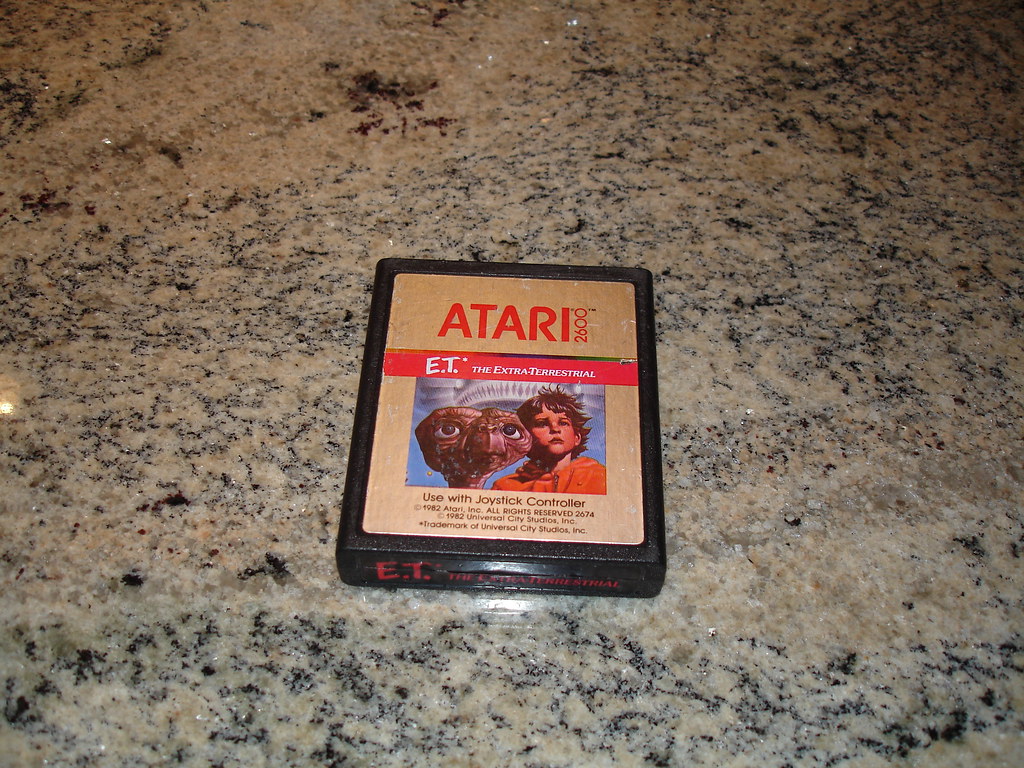
One cartridge in the Smithsonian’s National Museum of American History still carries the dirt it was buried in. It’s a copy of Atari’s E.T. the Extra-Terrestrial, cataloged in the museum’s permanent collection as object NMAH.1519322, and unlike almost everything else on display a few floors up, this artifact’s value comes entirely from having been thrown away. For three decades it sat in a landfill in Alamogordo, New Mexico. Then, in 2014, somebody went and dug it back up.
A Game Built in Five Weeks
Atari rushed E.T. into production in 1982 to cash in on the summer’s biggest movie, reportedly giving designer Howard Scott Warshaw around five weeks to build the entire game from scratch. The result shipped buggy, confusing, and widely mocked, and it became shorthand for everything that went wrong during the video game industry’s collapse that followed. Atari had manufactured far more cartridges than the market wanted, for E.T. and for a stack of other 1982 and 1983 titles, and it needed somewhere to put the surplus.
The Burial
In September 1983, truckloads of unsold cartridges and hardware from an Atari plant in El Paso, Texas were hauled to a municipal landfill in Alamogordo, crushed, and buried under concrete. The exact quantity became one of gaming’s most inflated legends — some retellings claimed as many as five million E.T. cartridges alone, a figure Snopes has traced and debunked as wildly overstated. The real haul, spread across the whole dump and every Atari title in it, was far smaller, but the burial itself was real, and for thirty years it existed mostly as an urban legend collectors argued about online.
The Crash That Followed
The Alamogordo burial happened right as the broader North American video game industry entered what’s now called the crash of 1983, a collapse driven by an oversaturated console market, a flood of rushed and low-quality games, and retailers who stopped trusting the category altogether. Revenue fell by roughly 97 percent between 1983 and 1985 by some industry estimates, and Atari itself, once the dominant name in home gaming, never fully recovered its footing. E.T. didn’t cause the crash on its own, but it became the single most convenient symbol of it: a rushed cash-in game, built to ride a movie’s momentum, that ended up literally buried under the wreckage of the business decisions around it.
The Dig
That changed on April 26, 2014, when a documentary crew backed by Xbox Entertainment Studios secured the city of Alamogordo’s permission to excavate the site for a film called Atari: Game Over. Fans, journalists, and former Atari employees watched as bulldozers pulled crushed, dirt-caked cartridges out of the ground on camera, finally settling the argument. According to NBC News’ coverage of the dig, several hundred cartridges came out intact enough to be cleaned up, and the city of Alamogordo later auctioned many of them off on eBay, splitting proceeds to help fund municipal projects.

From Trash to the National Collection
Most of the recovered cartridges went to collectors and museums that specifically celebrate gaming history. One went somewhere more unexpected: the Smithsonian’s National Museum of American History added a landfill-excavated E.T. cartridge to its permanent collection, a move CBS News reported at the time as recognition that the game and its burial had become a genuine piece of American cultural history, not just a punchline. The museum’s own collection record and accompanying object story page frame the cartridge as evidence of the industry’s first great boom-and-bust cycle, preserved exactly as it was pulled from the ground rather than restored to look new.

Why a Bad Game Ended Up in a Museum
The cartridge isn’t in the Smithsonian’s collection because E.T. is good. It’s there because the object tells a bigger story than the game itself ever could: an industry that overbuilt, oversupplied, and then tried to literally bury the evidence, only to have it dug up on camera three decades later in front of an audience that had grown up hearing about it as a myth. What was once treated as garbage, quite literally, is now treated as a primary source — proof that the line between a landfill and a museum case can be thinner than anyone in 1983 could have guessed.

Leave a Reply