

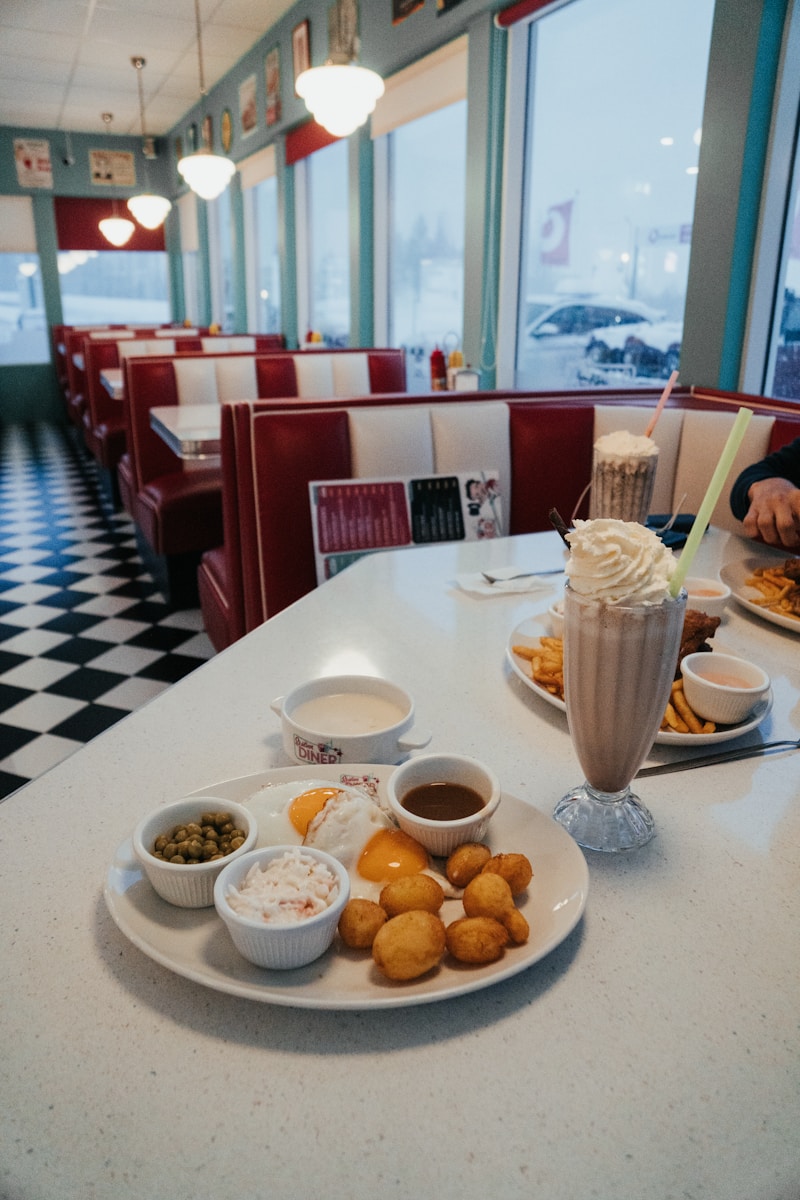
Every classic American diner seems to share the same countertop: a swirl of boomerang-shaped squiggles floating across a speckled background, usually in some combination of turquoise, black, and gold. That’s not a coincidence or a generic “retro” cliché — it’s one specific laminate pattern, designed for a specific purpose, that escaped its original industry and became the visual shorthand for an entire era.
Designed for Trains, Not Diners
The pattern most people know as “boomerang” laminate started life in 1951 under a different name: Skylark. According to Formica’s own 110th-anniversary brand history page, designer John Hughes of Brooks Stevens Design Associates created the pattern specifically to customize the interiors of passenger trains — a booming design category in the early 1950s, as railroads competed with the newly ascendant automobile and airplane for travelers. Formica as a company was founded even earlier, in 1912, originally as an industrial substitute for mineral mica used in electrical insulation, according to Formica’s history of the brand. It wasn’t until the 1930s that the company pivoted toward decorative surfaces, and by the 1950s its laminates were showing up everywhere from the Library of Congress annex and Radio City Music Hall to the interiors of luxury ocean liners.

Raymond Loewy’s Fingerprints on the Pattern
Skylark got its most consequential makeover in 1954, when Raymond Loewy Associates — the industrial design firm behind everything from the Coca-Cola bottle’s later refinements to the Studebaker Avanti — took over color styling for what became Formica’s Sunrise Collection, per Formica’s history page. It’s that Loewy-era palette that eventually filtered into the suburban kitchens and dinettes of the postwar housing boom, as Formica sales climbed toward $24 million and the material became the default finish for countertops nationwide, according to Formica’s own account. The pattern’s association with the diner counter specifically comes from this same period, when laminate suppliers pitched the material directly to the restaurant and hospitality trade as an affordable, easy-to-clean, and visually modern alternative to older countertop materials.
Two Reinventions and a Rebrand
The pattern didn’t stay static. In 1988, to mark Formica Corporation’s 75th anniversary, in-house design director Alex DeGregori renamed it Boomerang and reapplied it in four postmodern colorways using a rotary silkscreen technique, according to Formica’s own history. Then in 2005, designer Renee Hytry Derrington restyled the pattern once more, this time returning it to its authentic 1950s colors as part of an internationally launched Classics Collection. Across both reissues and its original run, Formica describes the design as having remained “a staple of residential and commercial spaces for more than 70 years” — an unusually long shelf life for what began as a one-off pattern meant to decorate train cars.
Why It Became Diner Shorthand
The reason a train-car pattern from 1951 ended up defining diner aesthetics comes down to timing and material logic as much as design. Postwar diners needed countertops that could survive constant wiping, spills, and cigarette burns while still looking modern and inviting, and laminate solved that problem cheaply at exactly the scale the diner boom required. Skylark’s specific geometry — free-form, slightly futuristic, easy to reproduce at low cost across huge sheets — made it a natural fit for an industry that wanted “space age” without the expense of anything actually space age. Once enough diners, bowling alleys, and soda fountains installed it, the pattern stopped reading as a specific product and started reading as an entire decade.

Formica wasn’t working alone on the pattern’s legacy, either — Loewy’s involvement placed Skylark alongside a roster of other industrial designers the company brought in over subsequent decades, part of a deliberate strategy of pairing name-brand design talent with an otherwise unglamorous industrial material. That strategy is arguably why Skylark, unlike hundreds of other laminate patterns Formica has produced since 1913, is still recognizable enough to warrant two separate reissues rather than quietly disappearing into a discontinued-pattern archive. Most countertop patterns from the 1950s never got a 1988 rebrand or a 2005 “authentic colors” relaunch; Skylark got both, which says as much about its design pedigree as it does about diners’ staying power in the American imagination.
That’s the real trick of Skylark’s longevity: it was never meant to symbolize the 1950s at all, just to sell train tickets and countertops — and it ended up outlasting both the trains and most of the diners it was installed in.

Leave a Reply